FDA Issues New Guidance on Bioanalytical Method Validation for Biomarkers
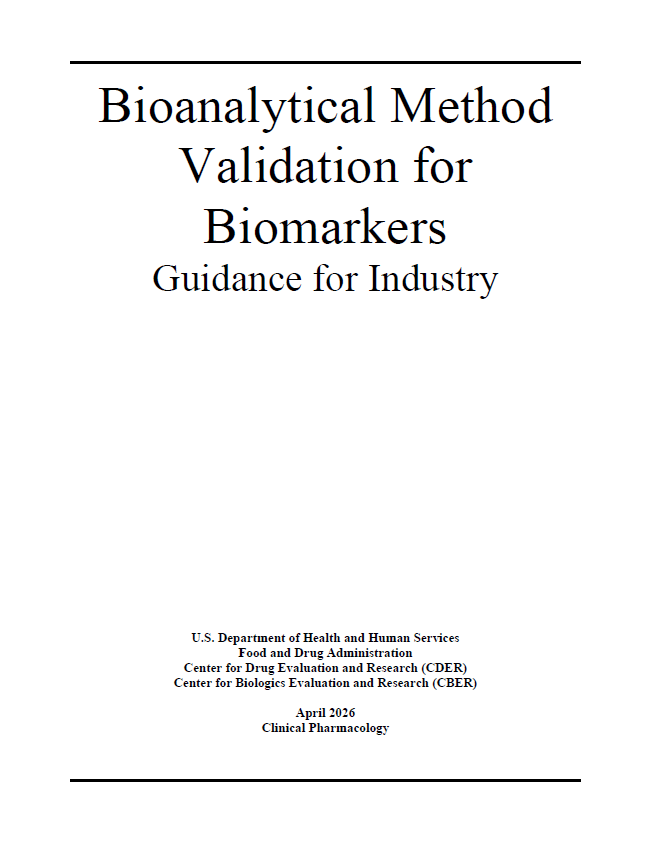
In April 2026, the U.S. Food and Drug Administration (FDA) published a new guidance titled “Bioanalytical Method Validation for Biomarkers”, providing recommendations for the validation of assays used to measure biomarker concentrations in biological samples.
This document reflects the FDA’s current thinking and complements existing frameworks, particularly ICH M10 on bioanalytical method validation.
Key Background
The guidance addresses a regulatory gap left by ICH M10 (2022), which does not cover biomarkers. As a result, the FDA introduces this dedicated document to clarify expectations for biomarker assay validation while maintaining alignment with M10 principles.
Importantly, the publication of this guidance will lead to the withdrawal of the 2018 FDA Bioanalytical Method Validation guidance, which previously covered biomarkers alongside drugs and biologics.
Scope and Application
The guidance applies to:
Sponsors and applicants (INDs, NDAs, BLAs, ANDAs)
Bioanalytical assays measuring in vivo biomarker concentrations in biological matrices such as blood or urine
It explicitly excludes:
Veterinary biomarkers
Veterinary drug concentration measurements
Core Regulatory Expectations
A central concept introduced is the “fit-for-purpose” approach to validation.
Full validation is expected when biomarker data support regulatory decision-making, such as safety, efficacy, or labelling claims
Reduced or tailored validation may be acceptable for internal decision-making (e.g. early development, candidate selection)
The FDA emphasises that validation should ensure data integrity and reliability, addressing key performance characteristics such as:
Accuracy and precision
Sensitivity (LLOQ/ULOQ)
Selectivity and specificity
Stability and reproducibility
Impact of sample handling and storage
Alignment with ICH M10
The guidance clearly positions ICH M10 as the foundational framework, recommending that:
M10 principles should be the starting point for biomarker assay validation
Adjustments may be necessary depending on the biomarker type or analytical platform
Sponsors are encouraged to justify any deviations and to engage early with FDA review divisions.
What This Means for Manufacturers
Although this is an FDA guidance, it has practical implications for EU and UK manufacturers, particularly those:
Developing companion diagnostics or biomarker-driven therapies
Using biomarkers in clinical performance or clinical evaluation
Preparing global submissions (FDA + EU MDR / UKCA)
Key considerations include:
1. Increased scrutiny on biomarker data
Biomarkers used to support claims (e.g. performance, safety, clinical benefit) will require robust validation aligned with regulatory expectations.
2. Need for clear validation strategy
Manufacturers should define early whether a biomarker is:
Exploratory (fit-for-purpose validation), or
Regulatory-critical (full validation required)
3. Documentation alignment
Validation data may need to be reflected across:
Clinical Evaluation Reports (CER) under MDR
Performance Evaluation Reports (IVDR, where applicable)
Technical documentation and GSPR compliance
4. Global harmonisation pressure
Even though MDR/IVDR do not explicitly mirror FDA guidance, alignment with ICH M10 principles is increasingly expected, making this guidance relevant beyond the U.S.
Read the full document below.