FDA Updates Authorized Companion Diagnostic Devices List to 226 Entries
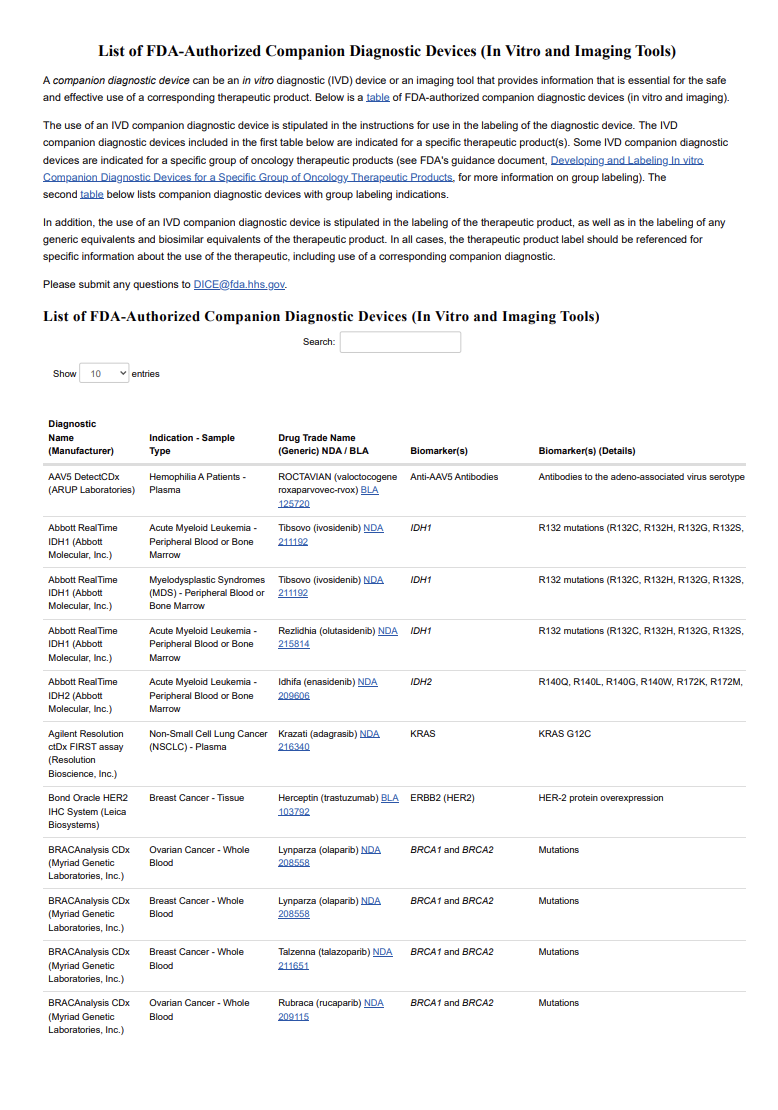
The U.S. Food and Drug Administration (FDA) has published an updated iteration of its official list of FDA-Authorized Companion Diagnostic Devices (In Vitro and Imaging Tools).
The updated database now encompasses 226 authorized companion diagnostic (CDx) entries, incorporating recent device approvals, expanded biomarker indications, and formalized group labeling pathways designed to streamline precision medicine deployment across oncology and non-oncology therapeutic areas.
Purpose and Regulatory Function of Companion Diagnostics
A companion diagnostic is an in vitro diagnostic (IVD) device or imaging tool that provides information essential for the safe and effective use of a corresponding therapeutic product.
Under FDA regulatory frameworks, the clinical utility and legal indication of a companion diagnostic are explicitly linked across both product labeling streams:
Therapeutic Product Labeling: Specifies the requirement for an FDA-authorized companion diagnostic test to identify patients who are most likely to benefit from the therapy or who are at increased risk of serious adverse reactions.
Diagnostic Device Labeling: Outlines the specific therapeutic product(s), biomarker alterations, specimen requirements, and analytical parameters validated for clinical decision-making.
Generic and Biosimilar Applicability: In accordance with FDA guidance, companion diagnostic requirements outlined in reference product labeling apply equally to approved generic and biosimilar equivalents.
Expanded Device Listing and Biomarker Coverage
The updated primary table lists 226 authorized companion diagnostic entries, detailing the specific diagnostic device, manufacturer, clinical indication, tissue/sample type, associated drug therapy, and target biomarker.
Key biomarkers represented in the expanded listing include:
Oncogene Mutations & Alterations: EGFR, BRAF, KRAS, NRAS, ALK, ROS1, RET, MET, FGFR1/2/3, and IDH1/IDH2;
DNA Damage Repair & Tumor Profiling: BRCA1/BRCA2, homologous recombination deficiency (HRD), microsatellite instability (MSI), and tumor mutational burden (TMB);
Cell Surface Receptor Expression: HER2 (ERBB2), PD-L1, and EGFR;
Non-Oncology & Gene Therapy Biomarkers: Anti-AAV5 antibodies for adeno-associated virus (AAV) vector-based gene therapies.
Group Labeling Indications and Targeted Therapies
A major feature of the FDA's updated repository is the dedicated section for companion diagnostics approved under group-labeled indications.
Group labeling enables a single companion diagnostic assay to be used across an entire class or group of oncology therapeutic products that share the same biomarker mechanism of action. This framework reduces regulatory burden and avoids the need for sequential single-drug label expansions.
Representative FDA-authorized CDx assays featured in the updated database include:
Next-Generation Sequencing (NGS) Panels: FoundationOne CDx, FoundationOne Liquid CDx, and MI Cancer Seek;
PCR and Real-Time Assays: cobas EGFR Mutation Test v2, therascreen KRAS RGQ PCR Kit, and Abbott RealTime IDH1/IDH2;
Genetic Risk & Germline Testing: BRACAnalysis CDx;
Immunohistochemistry (IHC) & In Situ Hybridization (ISH): VENTANA anti-PD-L1 (SP142/SP263) assays and PATHWAY HER2/neu tests.
These diagnostics support treatment selection across a broad spectrum of diseases, including non-small cell lung cancer (NSCLC), cutaneous melanoma, breast cancer, ovarian cancer, acute myeloid leukemia (AML), myelodysplastic syndromes (MDS), and colorectal cancer.
Diversity of Specimen Types and Diagnostic Technologies
The FDA listing reflects the rapid evolution of diagnostic modalities, transitioning from traditional tissue biopsies toward minimally invasive liquid biopsy platforms:
Solid Tissue Biopsies: Formalin-fixed paraffin-embedded (FFPE) tumor tissue remains the gold standard for many IHC, ISH, and targeted NGS panels.
Liquid Biopsies & Plasma: Circulating tumor DNA (ctDNA) isolated from plasma samples supports non-invasive biomarker profiling when tissue is insufficient or unobtainable.
Whole Blood & Bone Marrow: Peripheral blood, bone marrow aspirates, and whole blood specimens support hematologic malignancy testing and gene therapy antibody screening.
Impact on IVD Manufacturers and Pharma Sponsors
For IVD manufacturers, biotechnology companies, and pharmaceutical sponsors operating in precision therapeutics, the updated FDA companion diagnostics listing provides vital benchmarks for product development and co-development strategies.
Sponsors and regulatory teams should focus on:
Aligning CDx development timelines with drug clinical trial phases to ensure concurrent FDA approval;
Evaluating group labeling eligibility for multi-marker NGS platforms to maximize clinical utility post-approval;
Verifying that CDx specimen requirements account for real-world clinical feasibility (e.g., tissue vs. liquid biopsy);
Monitoring therapeutic label updates for both reference products and biosimilars to maintain accurate IVD intended use statements.
By monitoring the FDA's expanding CDx database, developers can ensure regulatory compliance, optimize diagnostic-therapeutic co-development, and accelerate patient access to targeted precision medicines.