FDA Publishes Updated Guidance on Pyrogen and Endotoxins Testing
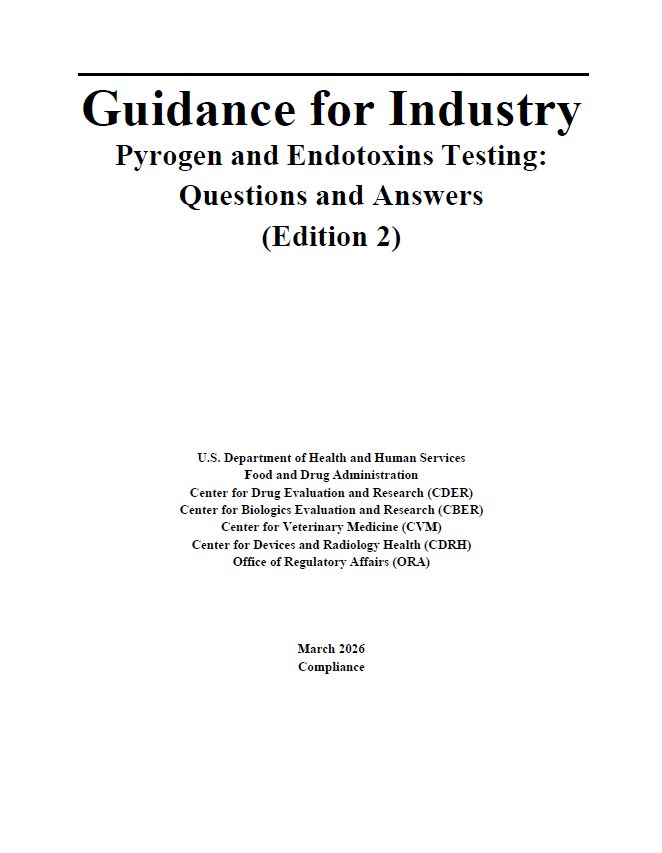
The U.S. Food and Drug Administration (FDA) has published an updated guidance titled “Pyrogen and Endotoxins Testing: Questions and Answers (Edition 2)” (March 2026).
The document provides nonbinding recommendations reflecting the FDA’s current thinking on endotoxin and pyrogen testing for drugs, biological products, and medical devices.
Scope of the Guidance
The guidance is intended to address specific topics not fully covered in existing standards and compendial chapters, including:
USP <85> Bacterial Endotoxins Test
USP <161> Medical Devices – Bacterial Endotoxin and Pyrogen Tests
AAMI ST72: Bacterial Endotoxins—Test Methodologies
It does not replace these standards but provides additional clarification on regulatory expectations.
Key Clarifications
Sampling for In-Process and Finished Product Testing
The FDA states that sampling must be:
Scientifically sound and appropriate
Based on manufacturing process understanding
Consider factors such as:
Raw materials
In-process materials
Manufacturing design
Endotoxin removal steps
Sampling approaches should be adjusted over time as process knowledge increases and should be reflected in regulatory submissions where applicable.
Retesting and Out-of-Specification Results
The guidance refers to USP <85> for retesting principles:
Retesting is acceptable under defined conditions (e.g., dilution below MVD)
If an OOS result occurs at MVD and is not attributable to error, the batch should be rejected
All procedures must be predefined in approved SOPs.
Sample Storage and Handling
The FDA confirms that:
Endotoxin detection may be affected by storage and handling conditions
Manufacturers should establish procedures supported by stability data
This includes consideration of endotoxin source and behaviour in testing.
Use of Composite (Pooled) Samples
Pooling of samples is permitted under certain conditions:
For drug products:
Typically applicable to small-volume parenterals
Requires adjustment of the Maximum Valid Dilution (MVD)
FDA recommends pooling no more than three units
For medical devices:
Pooling should follow extraction approaches aligned with:
ISO 10993-11
ISO 10993-12
Certain product types (e.g., suspensions) may not be suitable for pooling.
Use of Alternative Test Methods
Alternative methods may be used if they:
Provide advantages (e.g., sensitivity, precision)
Are validated according to USP <1225>
Demonstrate equivalent or better performance
In case of dispute, the USP compendial method remains the reference.
Transition Between Test Methods
When changing endotoxin test methods:
Comparability between methods must be demonstrated
Validation should include:
Detection limits
Inhibition/enhancement testing
Performance on product samples
Regulatory submissions may be required depending on product type (e.g., supplements, 30-day notices).
Endotoxin Limits
The FDA states that:
The 1987 guidance endotoxin limit table is no longer applicable
Limits should be established using:
USP <85>
AAMI standards
Limits must reflect current dosage and product characteristics.
Quality by Design (QbD) Considerations
The guidance indicates that endotoxin control strategies may be based on:
Product and process understanding
Risk management approaches
Use of in-process testing and monitoring
Endotoxin limits should be justified case-by-case.
Medical Device-Specific Expectations
For medical devices, endotoxin limits depend on intended use and contact type:
0.5 EU/mL or 20 EU/device
(devices contacting cardiovascular or lymphatic systems)0.06 EU/mL or 2.15 EU/device
(devices contacting cerebrospinal fluid)
Testing should follow USP <161> and applicable ISO 10993 standards.
Relevance for Manufacturers
This updated guidance provides clarification on:
Sampling strategies
Acceptance criteria and retesting
Method validation and transitions
Establishment of endotoxin limits
Manufacturers placing products on the U.S. market should ensure that their testing approaches and documentation are aligned with these expectations, in addition to applicable compendial and regulatory requirements.
Read the full document below.