FDA Issues Final Guidance on Medical Devices with Indications Associated with Weight Loss
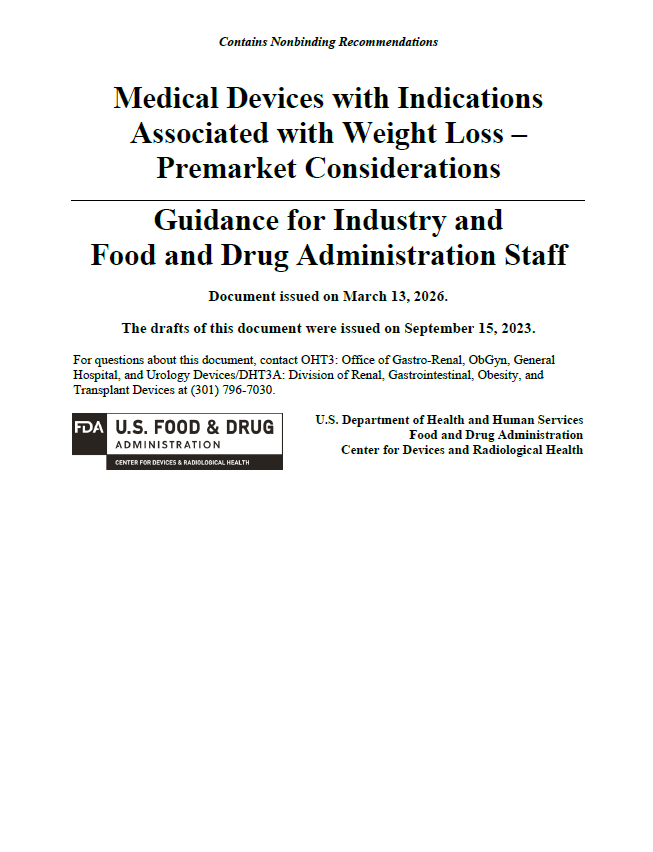
The U.S. Food and Drug Administration (FDA) has issued a final guidance titled “Medical Devices with Indications Associated with Weight Loss – Premarket Considerations.” The document provides the FDA’s current thinking on the development, evaluation, and regulatory considerations for medical devices intended to support weight loss or weight management.
The guidance includes recommendations on non-clinical testing, clinical study design, and benefit–risk assessment to support premarket submissions for these devices. It is intended to promote consistency in regulatory review and facilitate the efficient evaluation of submissions.
The document applies to devices intended for weight loss, weight reduction, weight management, or obesity treatment in patients who are overweight or have obesity.
Key points
Scope
The guidance applies to medical devices with indications related to weight loss or weight management, including technologies such as intragastric balloons, aspiration therapy systems, neuromodulators, ingestible space-occupying devices, and endoscopic gastric modification devices.
Regulatory pathways
The recommendations support submissions through regulatory pathways including Premarket Approval (PMA), De Novo classification, Investigational Device Exemption (IDE), and 510(k), depending on the device classification and risk profile.
Clinical study design
FDA generally recommends randomized, controlled, and preferably double-blinded clinical trials to demonstrate safety and effectiveness for devices with indications associated with weight loss.
Effectiveness endpoints
Weight-loss effectiveness is typically evaluated using percent total body weight loss (%TBWL) together with responder rates and other clinically relevant endpoints.
Study duration
For devices claiming an indication of weight loss, clinical studies generally require at least 12 months of follow-up to demonstrate effectiveness, while shorter durations may support limited or short-term indications.
Non-clinical testing
Submissions should include comprehensive bench performance testing, which may include evaluation of mechanical integrity, corrosion resistance, durability, leak and burst resistance (for inflatable devices), and other device-specific performance assessments.
Benefit–risk assessment
FDA emphasizes a structured benefit–risk evaluation, balancing the magnitude and durability of weight loss against the severity and frequency of device-related adverse events and potential improvements in obesity-related comorbidities.
What this means for manufacturers
This guidance clarifies FDA’s expectations regarding clinical evidence, safety evaluation, and regulatory documentation for devices intended to support weight loss or weight management.
Manufacturers developing these technologies should ensure that their regulatory submissions include robust clinical data, appropriate non-clinical testing, and a well-documented benefit–risk profile.
These recommendations aim to support a consistent regulatory framework and help ensure that weight-loss devices demonstrate an appropriate balance between safety and effectiveness before entering the U.S. market.
Read the full document below.