FDA Announces New eMDR System Enhancements: What Medical Device Manufacturers Should Know
The U.S. Food and Drug Administration (FDA) has announced a series of upcoming enhancements to its electronic Medical Device Reporting (eMDR) system, including updates linked to the consolidation with the Adverse Event Monitoring System (AEMS), changes to accepted country code formats, and new IMDRF adverse event coding updates.
These changes are particularly relevant for manufacturers and other high-volume submitters using AS2 or API-based electronic MDR submissions.
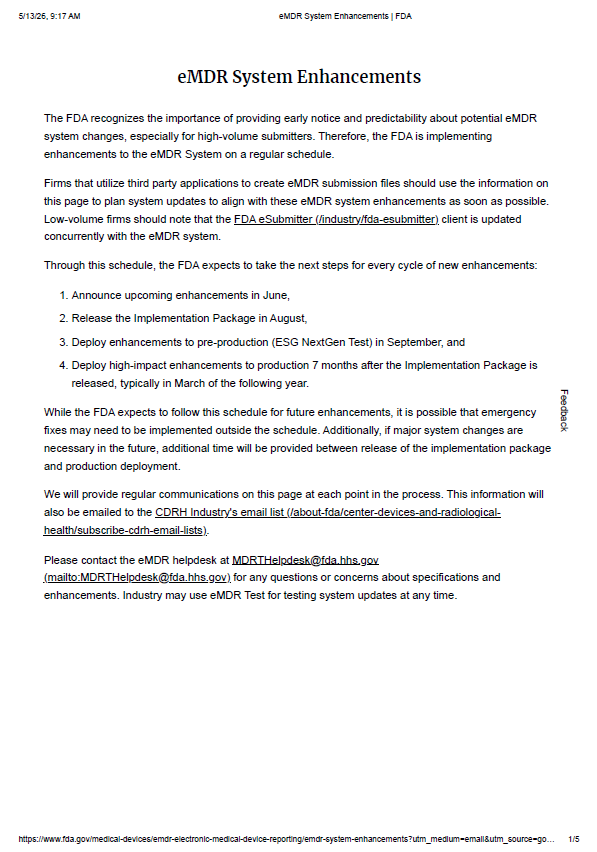
FDA Introduces a More Predictable eMDR Update Schedule
The FDA stated that it intends to follow a recurring implementation cycle for future eMDR enhancements:
Announcement of upcoming changes in June
Release of implementation packages in August
Deployment to pre-production testing environments in September
Production deployment approximately seven months later, typically in March of the following year
According to the agency, this approach is intended to provide greater predictability for manufacturers and software providers managing automated reporting systems.
Consolidation with AEMS Will Not Change Submission Formats
One of the most significant updates is the ongoing consolidation of eMDR with the FDA’s Adverse Event Monitoring System (AEMS).
The FDA clarified that:
The electronic MDR submission format will remain unchanged
Submission destination addresses will not change
Minor changes to Ack3 error messages are expected
Parsing functionality should not be affected
However, the FDA recommends that AS2/API submitters verify compliance with the August 2024 XML specification included in the eMDR Implementation Package.
Key Dates
Test deployment: May 11, 2026
Production deployment: May 31, 2026
FDA Will Reject ISO Alpha-2 Country Codes
As part of the AEMS consolidation, the FDA announced that the eMDR system will no longer accept ISO 3166-1 alpha-2 country codes.
Manufacturers submitting eMDRs through AS2/API systems will instead need to use:
GENC 3-letter country codes
The FDA also noted that:
FIPS 10-4 codes are currently accepted but are outdated and no longer recommended
These requirements have already been documented in the eMDR Implementation Package since 2020
This update may require manufacturers and software vendors to revise validation logic, XML mapping rules, and internal coding libraries used in complaint handling and vigilance systems.
IMDRF Adverse Event Code Updates Continue
The FDA also confirmed continued alignment with International Medical Device Regulators Forum (IMDRF) maintenance updates.
IMDRF 2025 Maintenance Updates
The adverse event codes used in sections F10 and H6 of Form FDA 3500A were updated following IMDRF maintenance changes introduced in Fall 2025.
Timeline:
Test deployment: September 26, 2025
New codes available for use: October 6, 2025
Mandatory implementation for AS2/API users: March 31, 2027
IMDRF 2026 Maintenance Updates
Further code updates are expected in 2026, with new hierarchy files scheduled for release in August 2026.
Timeline:
Test deployment: September 2026
New codes available for use: October 2026
Mandatory implementation for AS2/API users: March 31, 2027
What This Means for Manufacturers
Manufacturers using automated MDR submission systems should assess whether internal systems, third-party reporting tools, and regulatory databases are aligned with the updated FDA specifications.
Particular attention may be needed for:
XML validation rules
Country code configurations
IMDRF adverse event terminology mappings
Ack3 error handling workflows
Testing activities in ESG NextGen environments
Although low-volume users relying on FDA eSubmitter are expected to receive concurrent updates automatically, companies operating custom integrations may need additional implementation and validation activities ahead of the production deadlines.
The FDA also noted that emergency fixes may still occur outside the planned enhancement schedule when necessary.
Read the full document below.