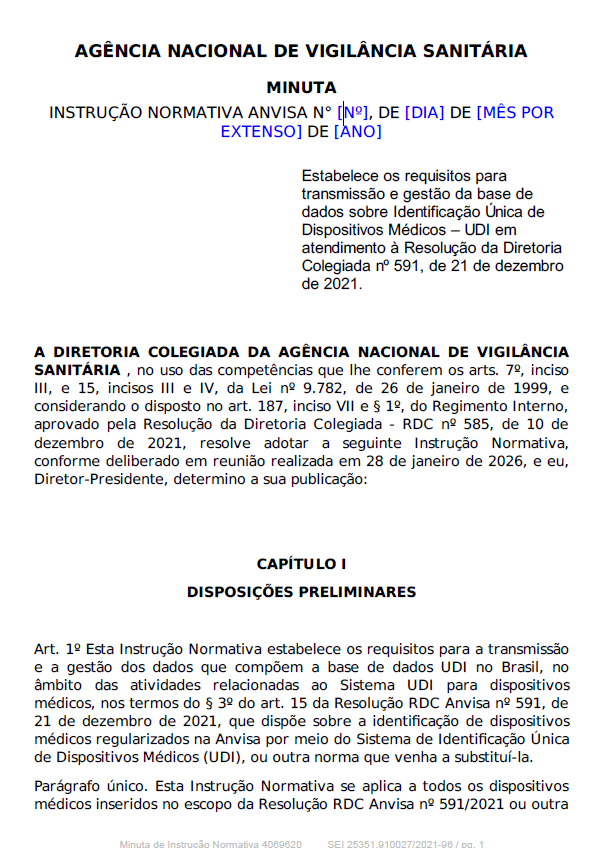
ANVISA has released a Draft Normative Instruction establishing detailed requirements for the transmission and management of UDI data within Brazil’s Unique Device Identification (UDI) system, known as SIUD (Sistema de Identificação Única de Dispositivo) .
The draft complements RDC 591/2021, which introduced the Brazilian UDI framework, and defines operational rules for submitting, correcting, updating, and managing UDI data. The Instruction is set to enter into force on 1 March 2026 .
Below we outline the key provisions and what they mean for manufacturers holding sanitary registration in Brazil.
Scope and Applicability
The Instruction applies to all medical devices within the scope of RDC 591/2021, or any regulation replacing it .
It defines:
SIUD as the Brazilian UDI database system
UDI data as the dataset linked to a specific UDI-DI
Sanitary regularization as the authorization (notification or registration) granted by ANVISA
Market availability as commercialization in Brazil by the registration holder
Importantly, responsibility remains with the company holding the sanitary regularization in Brazil.
Mandatory UDI Data Transmission Before Market Placement
Under Article 3, devices covered by RDC 591/2021 must have their UDI data transmitted to SIUD before being placed on the Brazilian market .
Key requirements:
The transmitted UDI data must be equivalent to the device information approved by ANVISA
Only the UDI-DI component is submitted to SIUD
The UDI-PI component must still be maintained within the company’s Quality Management System, in accordance with RDC 665/2022
What this means for manufacturers
Alignment between regulatory approval data and UDI dataset becomes critical.
Internal QMS traceability obligations remain unchanged.
UDI submission is an additional regulatory step prior to commercialization.
Submission Methods: Individual or Bulk
UDI data transmission may be performed:
Individually, via electronic form in SIUD
In bulk, via structured file upload or machine-to-machine communication
For bulk submission, companies are responsible for implementing their own system according to ANVISA’s implementation guide .
Each UDI dataset must correspond to one single UDI-DI and one device model .
Practical impact
Manufacturers with large portfolios should assess:
IT readiness for structured bulk upload
Data governance processes
Resource allocation for SIUD integration
Publication and 60-Day Correction Window
Once transmitted, UDI data will be published on ANVISA’s portal on the publication date indicated during submission .
Corrections are permitted within a 60-calendar-day grace period after publication .
After this period:
Only changes that do not require issuance of a new UDI-DI may be made
If changes require a new UDI-DI (as defined in RDC 591/2021), a UDI-DI substitution must be performed within 30 days of publication of the regulatory change in the Official Gazette
Manufacturer considerations
Strong pre-submission validation processes will be essential.
Regulatory and labeling teams must coordinate closely to avoid triggering unnecessary UDI-DI changes.
Monitoring Official Gazette publications becomes operationally relevant.
Transfer of Registration and Discontinuation Obligations
In case of transfer of sanitary registration ownership, formal transfer procedures under RDC 903/2024 must be finalized before SIUD updates .
The successor company must transmit new UDI-DI data within 30 days of the relevant cancellation and transfer resolutions entering into force .
For discontinued devices, expired authorizations, or cancelled registrations:
The registration holder must record discontinuation in SIUD within 30 days
Inactivation of UDI-DI does not affect permitted commercialization or donation of used devices under RDC 579/2021
Third-Party Users
Registration holders may authorize third-party users to transmit UDI data via SIUD .
However:
Responsibility remains with the registration holder
The holder must define the scope of products for which third parties are authorized
This is particularly relevant for foreign manufacturers relying on Brazilian Registration Holders (BRHs).
Deadlines and Voluntary Submissions
Mandatory transmission timelines follow Article 15 of RDC 591/2021, based on device risk class .
Until the compulsory deadline applies:
UDI submission may be made voluntarily
Devices already on the market at the time of entry into force may also have UDI data transmitted voluntarily .
ANVISA Suspension Power and Sanctions
ANVISA may suspend UDI data transmission for specific device types to preserve SIUD operational viability .
Non-compliance constitutes a sanitary infraction under Law 6.437/1977, without prejudice to civil, administrative, or criminal liability .
Entry into Force
The Normative Instruction is scheduled to enter into force on 1 March 2026 .
Why This Matters
For manufacturers placing devices on the Brazilian market, this draft clarifies:
Operational mechanics of SIUD submissions
Strict timelines for correction and substitution
Clear accountability of registration holders
Data consistency obligations between regulatory approval and UDI records
Companies should begin assessing:
Internal data readiness
QMS traceability alignment
IT capabilities for bulk upload
Governance processes for lifecycle events (transfer, discontinuation, cancellation)
Early preparation will reduce compliance risks once the Instruction becomes fully applicable.