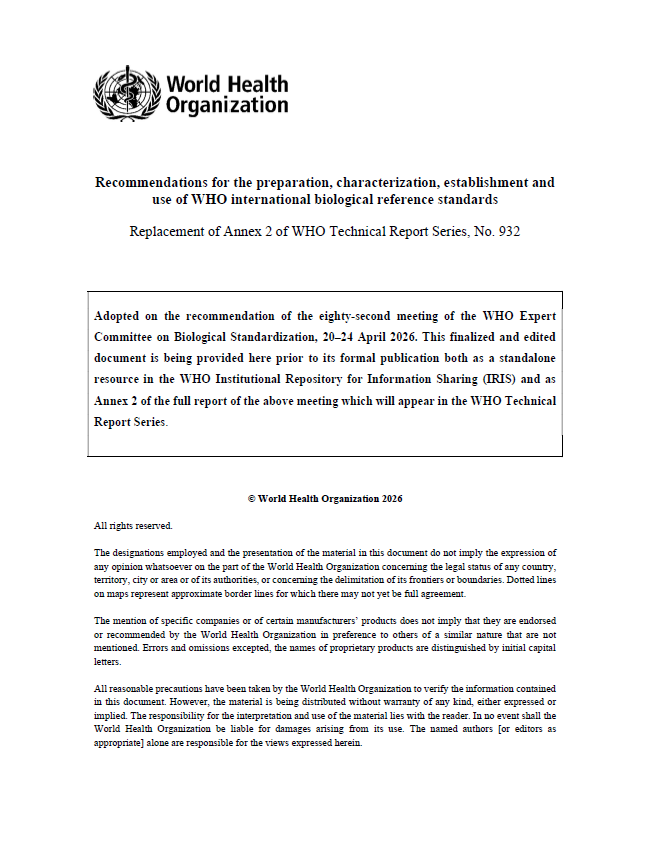
The World Health Organization (WHO) has adopted a comprehensive revision of its recommendations for the preparation, characterization, establishment and use of WHO International Biological Reference Standards (WHO IBRS). The document, adopted by the WHO Expert Committee on Biological Standardization (ECBS) in April 2026, replaces Annex 2 of WHO Technical Report Series No. 932 and reflects the significant scientific, technological and regulatory developments that have taken place over the past two decades.
While the update is primarily aimed at WHO collaborating centres, custodian laboratories and organizations involved in the development and maintenance of international reference materials, it also contains several important elements for manufacturers of in vitro diagnostic (IVD) devices and biological medicinal products that rely on internationally recognized reference standards for assay calibration, validation and quality control.
Why WHO International Biological Reference Standards Matter
WHO International Biological Reference Standards serve as the global reference point for the measurement of many biological substances used in healthcare. They support the regulation and quality control of biological medicinal products, facilitate harmonized measurement of biomarkers and pathogens, and contribute to the evaluation and validation of diagnostic tests.
According to WHO, these standards are essential for ensuring the quality, safety and effectiveness of biological products while also enabling comparability of laboratory results across different methods, platforms and geographical regions.
The updated recommendations reaffirm the central role of WHO reference standards in supporting global public health activities, including disease diagnosis, monitoring of immune responses, blood safety testing, therapeutic monitoring and the development of new biological products.
A New Harmonized Framework
One of the most visible changes introduced by the revised guidance is the adoption of the term “WHO International Biological Reference Standard” (WHO IBRS) as a unified umbrella term covering all WHO-established biological reference preparations.
The document also clarifies the definitions and intended uses of the three principal categories of WHO reference standards:
WHO International Standards (IS);
WHO International Reference Reagents (IRR);
WHO International Reference Panels (IRP).
This harmonized terminology aims to improve consistency across scientific, regulatory and manufacturing communities and to reduce confusion regarding the role of different reference materials.
Increased Focus on Commutability
Perhaps the most significant development for IVD manufacturers is the expanded discussion of commutability.
WHO defines commutability as the extent to which a reference material behaves like real clinical samples when measured using different analytical procedures. A commutable reference material enables equivalent results to be obtained across different testing platforms and measurement systems.
The revised recommendations emphasize that commutability is particularly important for reference standards intended for diagnostic applications. According to WHO, the use of non-commutable reference materials may lead to differences in test results between methods, potentially affecting clinical interpretation and decision-making.
The document therefore encourages more extensive assessment of commutability during the development of new WHO standards and highlights the importance of including representative clinical samples in collaborative studies whenever possible.
For manufacturers developing quantitative IVD assays, this reflects the increasing international emphasis on result harmonization and analytical comparability.
Greater Attention to Continuity of International Units
Another key theme throughout the revised recommendations is the concept of continuity when replacing existing WHO International Standards.
Many biological assays are calibrated using International Units (IU) assigned to WHO standards. When an existing standard is replaced, WHO acknowledges that it may not always be possible to guarantee that the newly assigned unit behaves identically to the previous one.
To minimize disruption, the revised guidance places greater emphasis on maintaining continuity of International Units whenever replacement standards are introduced.
Importantly, WHO states that users should independently assess the impact of replacement standards using their own products and analytical procedures. This recommendation is particularly relevant for manufacturers whose quality control systems or product specifications depend on WHO-assigned units.
Organizations using WHO standards should therefore consider evaluating whether future replacement standards could affect established assay performance characteristics, acceptance criteria or historical trend data.
Expanded Guidance on Secondary Standards
The revised recommendations also provide more detailed guidance regarding the preparation, characterization and calibration of secondary standards.
Secondary standards are widely used by manufacturers as working references that are calibrated against higher-order WHO International Standards. They play a critical role in routine quality control, batch release testing and assay standardization.
WHO now provides expanded recommendations on how these secondary standards should be established and maintained, reinforcing the importance of traceability to internationally recognized reference materials.
For manufacturers operating complex analytical systems, this section may be particularly relevant when reviewing calibration strategies and reference material management procedures.
Lessons Learned from COVID-19
The updated document also incorporates lessons learned during the COVID-19 pandemic.
WHO formally describes fast-track procedures that may be used to establish new international biological reference standards during public health emergencies. These procedures are intended to accelerate the availability of globally recognized standards when rapid harmonization of diagnostic or biological measurements is required.
The organization notes that similar approaches were used during the pandemic to support the development and evaluation of SARS-CoV-2 diagnostic assays, antibody measurements and viral RNA testing.
This addition reflects the growing importance of regulatory agility and international coordination during emerging public health crises.
Implications for Manufacturers
Although the revised recommendations do not introduce new regulatory obligations under the EU MDR or IVDR, they provide an important indication of the direction of travel for international biological standardization.
Manufacturers of IVD devices may wish to review the updated guidance if their products rely on WHO reference standards for:
assay calibration;
analytical validation;
performance evaluation;
result harmonization;
traceability of measurement systems.
Similarly, manufacturers of biological medicinal products may find the guidance relevant for potency testing, quality control activities and the maintenance of consistency throughout the product lifecycle.
As WHO continues to strengthen expectations around commutability, traceability and continuity of International Units, organizations that use international biological reference materials may benefit from evaluating whether existing procedures remain aligned with evolving global best practices.
Looking Ahead
The revised WHO recommendations represent the most comprehensive update to international biological reference standard guidance in more than two decades. While many of the principles remain unchanged, the document introduces greater clarity around terminology, stronger expectations regarding commutability and traceability, and more detailed guidance on the lifecycle management of international standards.
For manufacturers working in the fields of diagnostics and biological products, the document provides valuable insight into the future direction of global biological standardization and the continued importance of internationally recognized reference materials in ensuring reliable, comparable and scientifically robust measurements worldwide.