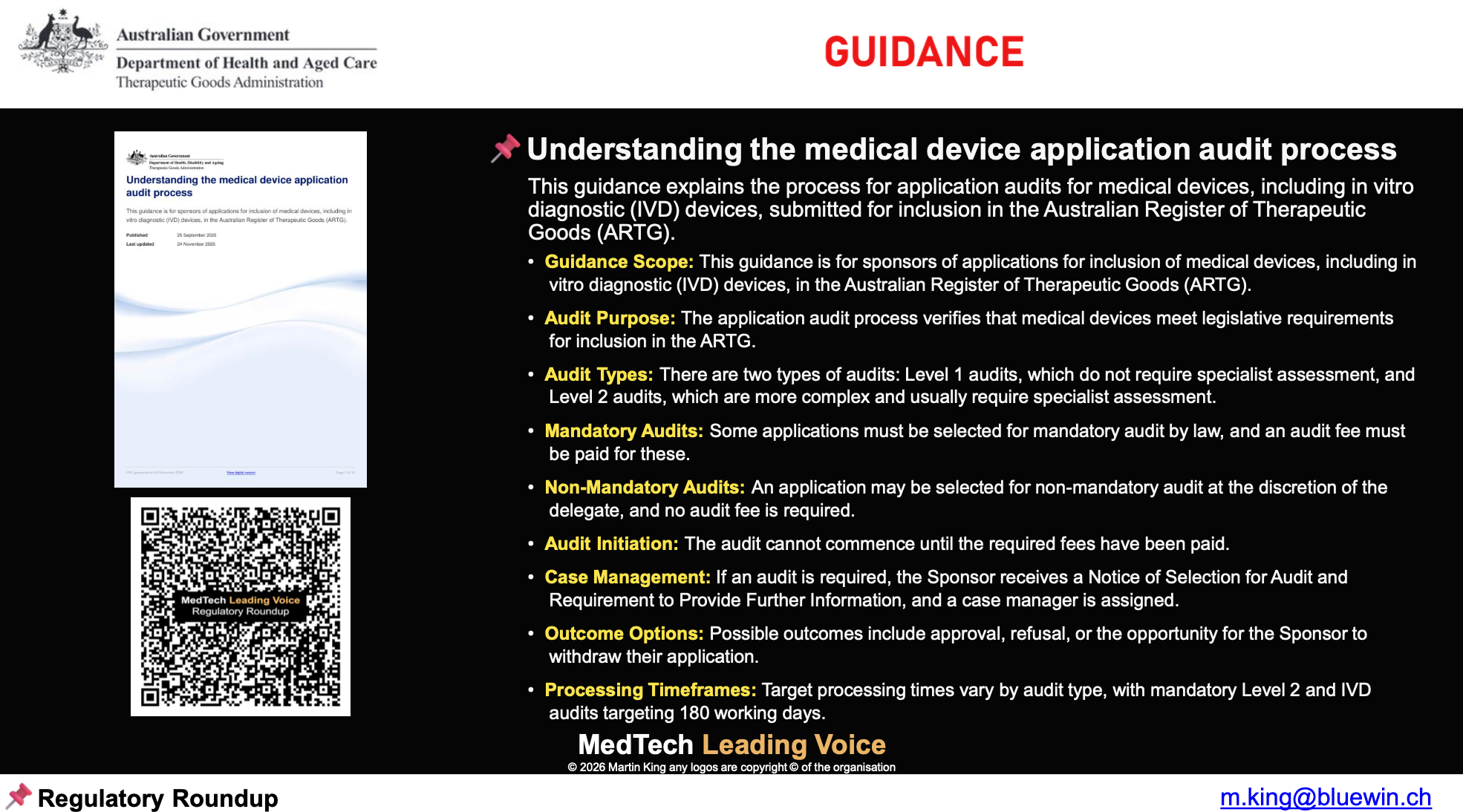
Australia’s Therapeutic Goods Administration (TGA) has clarified how the medical device application audit processoperates for medical devices and in vitro diagnostic (IVD) devices submitted for inclusion in the Australian Register of Therapeutic Goods (ARTG).
The guidance explains the purpose of application audits, the difference between Level 1 and Level 2 audits, when audits may be mandatory or discretionary, applicable fees, case-management arrangements and possible regulatory outcomes.
Purpose of the Application Audit
The application audit process is designed to verify whether a medical device meets the applicable legislative requirements for inclusion in the ARTG.
The guidance is relevant to sponsors submitting applications for:
medical devices;
in vitro diagnostic devices;
other products within the applicable ARTG medical device framework.
Two Main Audit Types
The TGA distinguishes between Level 1 and Level 2 application audits.
Level 1 Audits
Level 1 audits are generally less complex and do not require specialist assessment.
These audits may focus on confirming that the application and supporting documentation satisfy the relevant legislative and administrative requirements.
Level 2 Audits
Level 2 audits are more complex and usually require specialist assessment.
These assessments may involve deeper review of technical, clinical or regulatory documentation depending on the product and application type.
Mandatory Audits
Some applications must be selected for audit because this is required by law.
For these mandatory audits, an audit fee must be paid.
Sponsors should therefore identify early whether their application type is subject to mandatory audit requirements and budget accordingly.
Non-Mandatory Audits
The TGA may also select an application for a non-mandatory audit at the discretion of the delegate.
For these audits, the summary states that no audit fee is required.
This means that even where an application is not automatically subject to mandatory audit, it may still be selected for further review.
Audit Cannot Begin Until Required Fees Are Paid
Where an audit fee applies, the TGA cannot begin the audit until the required payment has been received.
This makes payment timing an important administrative step in the overall review process.
Delays in fee payment may delay commencement of the audit and therefore affect market-access timelines.
Notice of Selection for Audit
Where an application is selected for audit, the sponsor receives a Notice of Selection for Audit and Requirement to Provide Further Information.
This notice formally communicates that additional assessment is required and identifies the need for further supporting information.
A Case Manager Is Assigned
The guidance also states that a case manager is assigned where an audit is required.
This provides the sponsor with a point of contact during the audit process and helps coordinate information requests and review activities.
Sponsors Should Be Prepared for Further Information Requests
The application audit process may involve requests for additional documentation or clarification.
Sponsors should therefore ensure that relevant regulatory and technical documentation is:
complete;
current;
internally consistent;
readily available;
aligned with the submitted application.
An incomplete or poorly prepared submission can increase the risk of delays during the audit process.
Possible Outcomes
The TGA identifies several possible outcomes following an application audit.
These include:
approval;
refusal;
an opportunity for the sponsor to withdraw the application.
The audit therefore represents a substantive regulatory review step rather than a purely administrative check.
Approval
Where the TGA determines that the application satisfies applicable requirements, the device may proceed toward inclusion in the ARTG.
Sponsors should nevertheless ensure that all post-inclusion regulatory obligations remain addressed.
Refusal
Where the required legislative requirements are not met, the application may be refused.
This reinforces the importance of providing sufficient evidence and responding appropriately to TGA information requests during the audit.
Withdrawal
The sponsor may also be given an opportunity to withdraw the application.
Withdrawal may be relevant where significant deficiencies are identified and the sponsor determines that further work is needed before proceeding.
Processing Times Depend on Audit Type
The TGA notes that target processing times vary depending on the type of audit.
One particularly important timeframe is associated with:
mandatory Level 2 audits;
IVD audits.
These have a target processing time of 180 working days.
180 Working Days Can Significantly Affect Market Access
A target of 180 working days represents a substantial review period.
Manufacturers and sponsors should therefore account for the possibility of an audit when planning:
Australian launch dates;
commercial forecasts;
distributor agreements;
supply-chain preparation;
market-access strategy.
For higher-complexity devices and IVDs, audit timelines may become a critical component of regulatory planning.
Importance for IVD Manufacturers
The guidance specifically includes in vitro diagnostic devices within its scope.
IVD sponsors should therefore pay particular attention to:
applicable audit requirements;
supporting performance evidence;
technical documentation;
target processing timelines.
The 180-working-day target for certain IVD audits reinforces the importance of early submission planning.
Importance of Submission Readiness
Because an audit may involve specialist assessment, sponsors should avoid treating the ARTG application as a simple administrative registration exercise.
Prior to submission, organisations should confirm that the application is supported by appropriate documentation relating to:
device classification;
conformity assessment;
intended purpose;
clinical evidence;
performance evidence;
manufacturing information;
applicable standards;
labeling and instructions for use.
The exact documentation required will depend on the device and audit type.
Regulatory Strategy Should Consider Audit Risk
Sponsors should assess the likelihood of audit selection early in the Australian regulatory strategy.
Relevant considerations may include:
whether the application is subject to mandatory audit;
the device risk classification;
whether specialist assessment is likely;
whether the product is an IVD;
complexity of supporting evidence;
expected market-entry timeline.
Financial Planning Is Also Important
Mandatory audits require payment of an audit fee.
Manufacturers and sponsors should therefore include potential audit costs in regulatory budgets and ensure that payment processes do not create unnecessary delays.
Implications for Regulatory Affairs Teams
For regulatory teams, the guidance highlights several practical priorities:
determine whether the application may require an audit;
identify whether Level 1 or Level 2 review is likely;
prepare supporting documentation in advance;
monitor TGA information requests;
respond promptly to the assigned case manager;
account for fees and processing timelines;
maintain internal escalation procedures for deficiencies.
Implications for Market Access Planning
Because audit timelines may extend to 180 working days for certain application types, market-access teams should integrate regulatory audit scenarios into launch planning.
This may affect:
product launch sequencing;
commercial commitments;
inventory decisions;
distributor arrangements;
revenue forecasting.
Regulatory Takeaway
The TGA application audit process is an important part of the pathway to inclusion in the Australian Register of Therapeutic Goods.
Sponsors should understand whether their application may be subject to:
mandatory audit;
non-mandatory audit;
Level 1 assessment;
Level 2 specialist assessment.
They should also be prepared for further information requests and potential outcomes ranging from approval to refusal or withdrawal.
For mandatory Level 2 and certain IVD audits, the 180-working-day target processing timeframe should be factored into Australian market-access strategies.