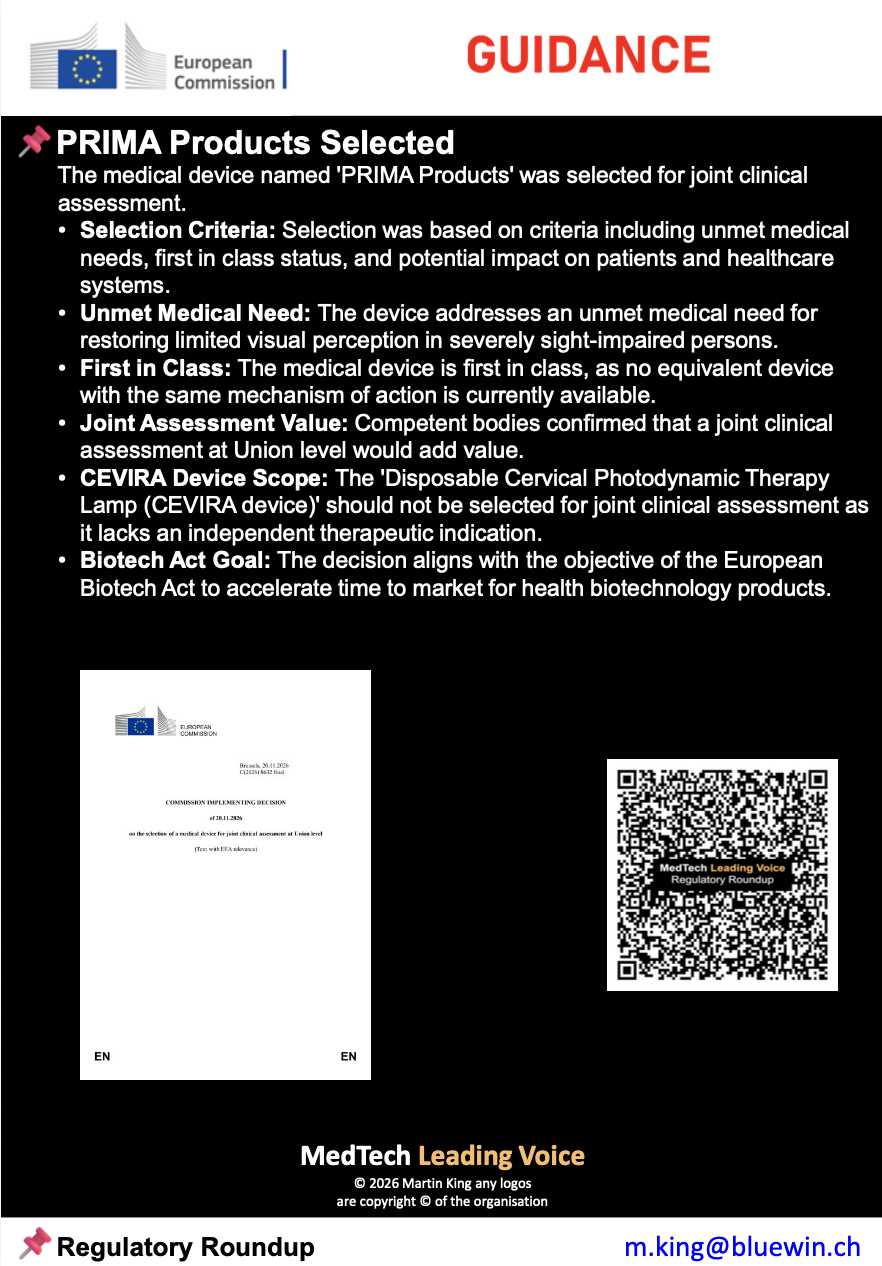
The European Commission has selected the medical device referred to as PRIMA Products for a joint clinical assessment at Union level, following an evaluation of its potential clinical and health-system relevance.
The selection reflects several factors, including:
unmet medical need;
first-in-class status;
potential impact on patients;
potential impact on healthcare systems.
The decision also reflects the view of competent bodies that conducting a joint assessment at EU level would provide added value.
PRIMA Addresses an Unmet Medical Need
A key factor behind the selection is the device’s potential to address an unmet medical need.
According to the summary, PRIMA Products are intended to support the restoration of limited visual perception in severely sight-impaired persons.
For patients with severe visual impairment and limited therapeutic alternatives, technologies capable of restoring even partial visual function may have significant clinical and quality-of-life implications.
First-in-Class Medical Device
The European Commission also identifies PRIMA as a first-in-class medical device.
The summary states that there is currently no equivalent device with the same mechanism of action available.
First-in-class technologies can create particular assessment challenges because existing comparators and established evidence pathways may be limited.
This can make coordinated assessment at EU level especially valuable.
Why Joint Clinical Assessment Matters
A joint clinical assessment is intended to support a more coordinated evaluation of clinical evidence across the European Union.
In this case, competent bodies concluded that an EU-level assessment would add value.
For innovative medical technologies, joint assessment may help reduce duplication and support greater consistency in how clinical evidence is evaluated across Member States.
Potential Impact on Patients and Healthcare Systems
The selection criteria also considered the potential impact of PRIMA Products on:
individual patients;
healthcare delivery;
health-system resources.
For a technology targeting severe sight impairment, the potential impact may extend beyond clinical outcomes and include areas such as:
patient independence;
quality of life;
rehabilitation needs;
long-term healthcare utilisation.
The source identifies potential impact on both patients and healthcare systems as a factor supporting selection.
CEVIRA Device Was Not Selected
The decision also considers another technology: the Disposable Cervical Photodynamic Therapy Lamp, or CEVIRA device.
According to the summary, CEVIRA should not be selected for joint clinical assessment because it does not have an independent therapeutic indication.
This distinction illustrates that not every innovative device automatically falls within the scope of EU-level joint clinical assessment.
The characteristics and therapeutic role of the technology remain important when determining eligibility and added value.
Importance of Independent Therapeutic Indication
The CEVIRA decision highlights the importance of clearly defining a device’s:
therapeutic role;
intended purpose;
clinical contribution;
relationship with associated medicinal or therapeutic interventions.
For manufacturers, this underlines how product positioning and indication can influence whether a technology is considered suitable for joint assessment.
Connection With the European Biotech Act
The decision is also linked in the source to the objectives of the European Biotech Act.
The stated policy objective is to help accelerate time to market for health biotechnology products.
The selection of innovative technologies for coordinated assessment may therefore form part of a broader European strategy to support faster and more efficient access to advanced health technologies.
Implications for Medical Device Manufacturers
The selection of PRIMA Products provides several important signals for manufacturers of highly innovative devices.
Technologies may attract greater EU-level assessment interest where they demonstrate:
significant unmet medical need;
first-in-class characteristics;
substantial patient impact;
meaningful healthcare-system impact;
added value from coordinated European assessment.
For developers of novel medical devices, these factors may become increasingly important when planning clinical and market-access strategies.
Implications for Clinical Evidence Strategies
Joint clinical assessment also reinforces the importance of robust clinical evidence.
Manufacturers should be prepared to clearly demonstrate:
the target population;
the unmet need;
clinical benefits;
safety profile;
relevant comparators;
patient-relevant outcomes;
healthcare-system implications.
For first-in-class devices, evidence-generation strategies may require particular attention because suitable comparators may be limited.
HTA and Regulatory Strategies Are Becoming More Connected
The decision also illustrates the increasingly close relationship between:
regulatory approval;
clinical evidence generation;
health technology assessment;
market access.
A device may successfully complete regulatory conformity assessment but still require strong clinical evidence to support broader assessment and adoption.
Manufacturers should therefore consider HTA requirements early in product development rather than only after regulatory approval.
Potential Benefit of EU-Level Coordination
An EU-level JCA may help provide a common clinical evidence foundation that can then support subsequent national processes.
This could help:
reduce duplicated assessment work;
improve consistency;
provide clearer evidence expectations;
support more coordinated access discussions.
For highly innovative technologies, this may be particularly important where only limited clinical experience is initially available.
Regulatory and Market Access Takeaway
The selection of PRIMA Products demonstrates that unmet medical need, first-in-class innovation and potential patient impact can be key factors in determining whether a medical device is suitable for EU-level joint clinical assessment.
For manufacturers, the decision reinforces the importance of aligning regulatory, clinical and market-access strategies from an early stage.
As EU health technology assessment mechanisms continue to evolve, coordinated evidence planning is likely to become increasingly important for innovative medical devices.