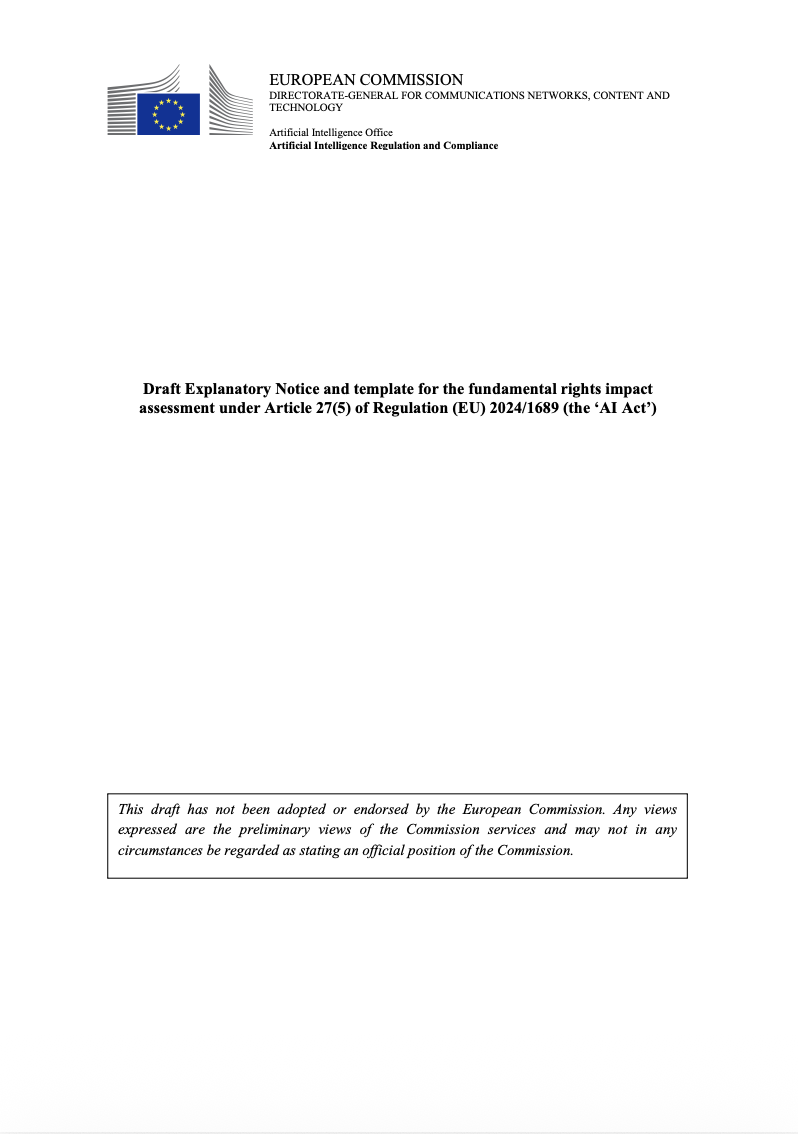
The European Commission AI Office has published a draft Explanatory Notice and template for the Fundamental Rights Impact Assessment (FRIA) required under Article 27 of Regulation (EU) 2024/1689, the AI Act.
The draft is intended to guide certain deployers of high-risk AI systems through the assessment of potential impacts on fundamental rights and to support notification of the FRIA results to the relevant market surveillance authority.
Importantly, the Commission explicitly states that the draft has not been adopted or endorsed and that the views expressed are preliminary and should not be regarded as an official Commission position.
What Is a FRIA?
Article 27 of the AI Act requires certain deployers of specific high-risk AI systems listed in Annex III to assess how the use of those systems may affect fundamental rights.
The FRIA is intended to capture risks arising not only from the AI system itself but also from the specific context in which the deployer uses it.
According to the draft, the assessment should cover:
the processes in which the high-risk AI system will be used;
the duration and frequency of use;
the categories of persons likely to be affected;
specific risks of harm to fundamental rights;
human oversight measures;
measures to be taken if identified risks materialise.
Who Must Conduct a FRIA?
Not every deployer of a high-risk AI system is required to conduct a FRIA.
The obligation applies to specific categories of deployers identified in Article 27(1), including:
bodies governed by public law;
private entities providing public services;
deployers of AI systems used to assess creditworthiness or establish credit scores, except where used for fraud detection;
deployers of AI systems used for risk assessment and pricing in life and health insurance.
High-risk AI systems falling under point 2 of Annex III are explicitly exempt from the FRIA obligation.
Healthcare May Fall Within Scope
The draft clarifies that private entities providing public services may be required to conduct a FRIA.
Recital 96 of the AI Act identifies examples of public services that may be provided privately, including:
education;
healthcare;
social services;
housing;
administration of justice.
This makes the draft particularly relevant to healthcare organisations deploying high-risk AI systems in contexts that qualify under Article 27.
FRIA Complements Provider Risk Management
The FRIA obligation applies to the deployer, but it complements the obligations of the AI system provider.
Under Article 9 of the AI Act, providers of high-risk AI systems must establish and maintain a risk management system addressing known and reasonably foreseeable risks to:
health;
safety;
fundamental rights.
The FRIA then focuses more specifically on risks arising from the actual deployment context.
Provider Information Can Support the FRIA
Deployers may rely on information contained in the provider’s:
instructions for use;
technical documentation;
risk management information.
The draft also notes that deployers may rely on previously conducted FRIAs or impact assessments where the AI system and risks are sufficiently similar.
Sharing provider impact assessments is not mandatory, but the Commission suggests that doing so may represent good practice.
FRIA and DPIA Are Complementary
The draft also explains the relationship between the FRIA and the Data Protection Impact Assessment (DPIA) under EU data protection law.
A DPIA focuses on risks arising from personal data processing, whereas the FRIA addresses a broader range of fundamental rights risks.
Where a DPIA has already been performed, deployers may:
cross-reference relevant DPIA sections;
incorporate relevant DPIA content directly into the FRIA.
This can help reduce duplication while preserving the broader scope of the FRIA.
FRIA Must Be Completed Before First Deployment
The FRIA must be conducted before the first deployment of the relevant high-risk AI system.
It should cover all purposes for which the system is used.
The assessment must also be updated when relevant factors change, including:
deployment processes;
affected persons;
system version;
underlying model;
circumstances making the assessment outdated.
Multidisciplinary Assessment Is Recommended
Before completing the FRIA, deployers are advised to consider establishing a multidisciplinary team combining:
fundamental rights expertise;
technical knowledge of the AI system;
operational understanding of the deployment context.
Roles, responsibilities and accountability for the final assessment should be clearly assigned.
Stakeholder Input May Be Useful
The draft also encourages deployers, where appropriate, to seek input from:
affected persons or groups;
independent experts;
authorities;
civil society organisations.
This may help identify risks that would not be apparent from technical documentation alone.
Notification to Market Surveillance Authorities
Once completed or updated, deployers generally need to notify the relevant market surveillance authority and attach the completed FRIA template.
An exemption may apply to the notification obligation in certain cases involving exceptional authorisation under Article 46(1), but this does not remove the obligation to conduct the FRIA itself.
Some FRIA Summaries Must Be Publicly Registered
Public authorities, EU institutions and certain persons acting on their behalf may also need to register a summary of their FRIA findings in the publicly accessible EU database of high-risk AI systems.
The draft includes a dedicated summary section for those deployers.
Section 1 — General Information
The draft template begins with basic organisational and system information.
Deployers are asked to provide information including:
organisation name;
type of organisation;
responsible person;
contact details;
AI system identification number;
deployer registration number, where applicable;
version and date.
The form also asks which Annex III area applies.
Areas of Use Covered by the Template
The draft includes the following categories:
biometrics;
education and vocational training;
employment and worker management;
access to essential private and public services and benefits;
law enforcement;
migration, asylum and border control;
administration of justice and democratic processes.
The template also asks whether the FRIA concerns the first deployment, an update, or reliance on a previous assessment.
Section 2 — Context of Use
Deployers must explain the intended purpose of the AI system and the specific processes or tasks in which it will be used.
The draft asks organisations to describe:
how the system supports or automates tasks;
how outputs are generated;
how outputs will be used in practice.
They must also specify the period and frequency of use.
Section 3 — Persons and Groups Likely to Be Affected
The template requires deployers to identify groups potentially affected by the AI system.
Examples include:
children;
older people;
women;
LGBTIQ+ persons;
persons with disabilities;
persons in vulnerable social or economic situations;
racial or ethnic minorities;
religious or belief groups;
third-country nationals, asylum seekers and refugees;
the general public.
This section makes the assessment explicitly context-dependent.
Section 4 — Fundamental Rights Risk Assessment
A substantial part of the template focuses on identifying and assessing risks of harm to fundamental rights.
The first part addresses the right to protection of personal data and integrates information from any existing DPIA.
For each risk, deployers must assess:
affected persons or groups;
likelihood;
severity;
preventive and mitigating measures;
residual risk after mitigation.
Low, Medium and High Risk Categories
The template uses Low, Medium and High scales for both likelihood and severity.
For other fundamental rights risks, the draft explains likelihood as:
Low — unlikely under foreseeable conditions;
Medium — plausible under some conditions;
High — highly probable or already observed in comparable deployments.
This provides deployers with a more structured methodology for documenting risk.
Broad Range of Fundamental Rights
The template asks organisations to assess potential impacts across a broad set of rights, including:
human dignity;
integrity of the person;
liberty and security;
privacy and family life;
personal data protection;
equality and non-discrimination;
freedom of expression;
freedom of religion;
education;
social security;
access to healthcare;
workers’ rights;
rights of children;
rights of elderly persons;
rights of persons with disabilities;
effective remedy and fair trial.
Right of Access to Healthcare Is Explicitly Included
Of particular relevance to healthcare AI, the template specifically includes the right of access to healthcare among the rights deployers should consider.
For organisations deploying AI in healthcare environments, this means risk assessments may need to address whether AI could create or amplify barriers to care.
Preventive and Mitigating Measures
For identified risks, the deployer must document the preventive or mitigating measures used to reduce harm.
The template then requires an assessment of the residual risk after those measures are implemented.
This creates a clear link between risk identification and operational mitigation.
Section 5 — Human Oversight
Human oversight is a dedicated section of the FRIA.
Deployers must describe how the human oversight measures identified in the provider’s instructions for use have been implemented.
The draft specifically asks deployers to explain:
who performs oversight;
their role in the organisation;
what authority they have;
whether they can override, disregard or reverse AI outputs;
the tools and procedures supporting oversight.
Competence, Training and Authority
The template also asks how organisations ensure that human overseers have the necessary:
competence;
training;
authority;
organisational support.
This includes consideration of AI literacy under Article 4 of the AI Act.
Section 6 — What Happens When Risks Materialise?
The FRIA must explain what monitoring, reporting and evaluation mechanisms are in place to detect whether a fundamental rights risk has materialised.
Potential response measures may include immediately suspending use of the AI system where appropriate.
The deployer must also consider relevant reporting obligations to the provider.
Complaints and Redress
The template requires deployers to describe procedures for:
receiving complaints;
processing complaints;
informing complainants of actions taken;
internal governance;
available redress mechanisms.
This reflects the AI Act’s focus on accountability throughout the deployment lifecycle.
Section 7 — Overall Conclusion
The final substantive section requires a short synthesis of the fundamental rights risks identified during the assessment.
The form then includes submission details and signature fields.
Public Summary of FRIA Findings
For deployers required to register their use of the AI system in the EU database, the draft contains a separate Summary of the FRIA Findings.
This summary may include:
information about the AI system;
affected persons or groups;
identified fundamental rights risks;
residual risks;
human oversight;
response measures;
overall conclusion.
The summary would be publicly accessible through the EU database in the cases covered by the relevant AI Act provisions.
Implications for Healthcare Organisations
Healthcare organisations deploying high-risk AI systems should pay particular attention to the FRIA framework.
Relevant risks may involve:
access to healthcare;
discrimination;
data protection;
human dignity;
patient autonomy;
human oversight;
vulnerable populations.
Organisations potentially within scope should begin considering how their existing:
AI governance;
clinical risk management;
data protection;
complaints management;
human oversight;
post-deployment monitoring
can support future FRIA obligations.
Implications for Medical Device and AI Providers
Although Article 27 primarily places the FRIA obligation on deployers, providers of high-risk AI systems are also likely to play an important supporting role.
Deployers will rely heavily on information provided through:
instructions for use;
technical documentation;
risk management files;
system limitations;
human oversight requirements.
Providers may therefore benefit from designing documentation that facilitates their customers’ FRIA obligations.
Regulatory Takeaway
The draft FRIA template provides an early indication of how the European Commission expects deployers to operationalise fundamental rights risk assessment under Article 27 of the AI Act.
The approach is highly structured and requires deployers to move beyond generic AI risk statements by documenting:
who may be affected;
how they may be harmed;
which fundamental rights are involved;
likelihood and severity;
mitigation measures;
residual risk;
human oversight;
monitoring;
complaints and redress.
For healthcare and other regulated sectors, this could become a significant additional layer of AI governance alongside existing requirements for data protection, safety and clinical risk management.