Team-NB clarifies transfer of surveillance for legacy devices under MDR Article 120
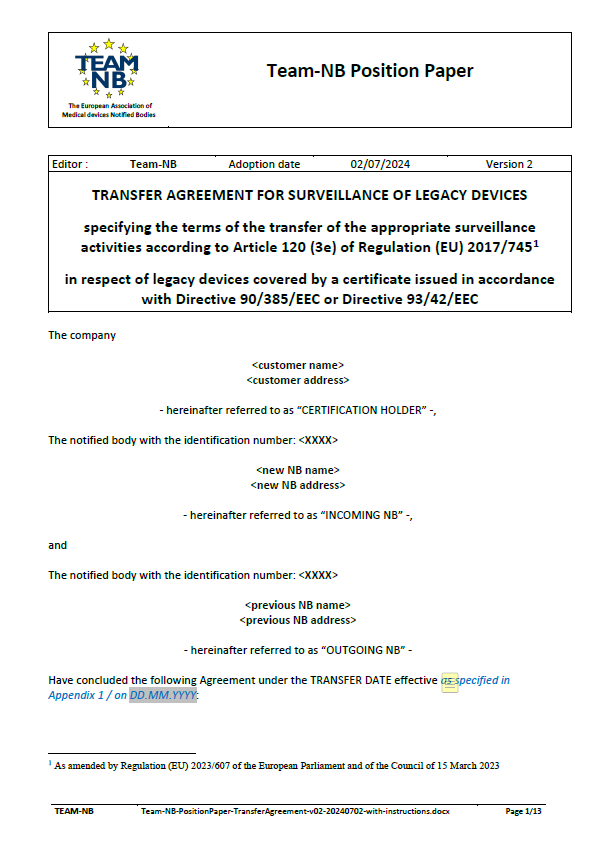
Team-NB has published a new position paper outlining a standardised transfer agreement for the surveillance of legacy devices under Article 120(3e) of Regulation (EU) 2017/745 (MDR).
The document defines how surveillance responsibilities can be transferred between notified bodies for devices certified under MDD or AIMDD that remain on the market during the MDR transition period.
Structured approach to notified body transfers
The position paper introduces a formal agreement between three parties:
The manufacturer (certification holder)
The outgoing notified body
The incoming notified body
It establishes the contractual and procedural conditions to ensure continuity of “appropriate surveillance” as required under MDR Article 120(3e).
A key element is the definition of a TRANSFER DATE, from which the incoming notified body assumes responsibility. This date must not exceed 26 September 2024.
Conditions for transferring surveillance
The transfer mechanism applies only under specific conditions:
Devices must qualify as legacy devices with valid MDD/AIMDD certificates under Article 120(2) MDR
Certificates that are withdrawn are excluded, while suspended or restricted certificates require case-by-case assessment by the incoming NB
The incoming NB must perform a pre-transfer assessment, including review of prior surveillance activities and identification of any unresolved issues
The agreement also ensures that surveillance activities remain continuous, with the incoming NB taking over activities such as audits, vigilance oversight, and change assessments from the transfer date.
Responsibilities before and after transfer
The document clearly separates responsibilities:
The outgoing NB remains responsible for certification and surveillance activities performed before the transfer date
The incoming NB assumes full responsibility for surveillance activities after the transfer date
Importantly, the incoming NB does not take responsibility for past conformity assessments carried out by the outgoing NB.
Implications for manufacturers
For manufacturers, the position paper highlights several operational requirements:
Data and documentation availability
Manufacturers must ensure access to and provision of comprehensive documentation, including:
Certificates and assessment reports
Audit findings and non-conformities
Vigilance and complaint data
Technical documentation
This information is required to support the incoming NB’s assessment and continued surveillance.
Contractual coordination
The transfer requires:
A signed agreement between all parties
Possible updates or termination of existing agreements with the outgoing NB after the transfer date
Labelling and traceability
Unless otherwise agreed:
Devices continue to bear the outgoing NB identification number
Any change in NB number must be:
Documented per device
Linked to serial or lot numbers
Managed during a defined sell-off period
Management of changes and device scope
After the transfer date:
The incoming NB is responsible for assessing device and QMS changes
Certain non-significant changes may allow additions within the scope of existing certificates, under defined conditions linked to MDR transition timelines
Alignment with MDR transition framework
The position paper is aligned with:
MDR Article 120, as amended by Regulation (EU) 2023/607
MDCG 2020-3 Rev.1 (significant changes)
MDCG 2022-4 (appropriate surveillance)
MDCG 2021-25 (legacy devices)
It also reflects the practical considerations described in the European Commission Q&A on MDR transitional provisions.
Final note
This position paper provides a clear and structured approach to transferring surveillance responsibilities, supporting continuity of compliance for legacy devices during the MDR transition.
For manufacturers, it reinforces the importance of early planning, documentation readiness, and coordination with notified bodies when considering or undergoing a transfer.
Read the full document below.