FDA expands TAP Pilot: increased scope and participation
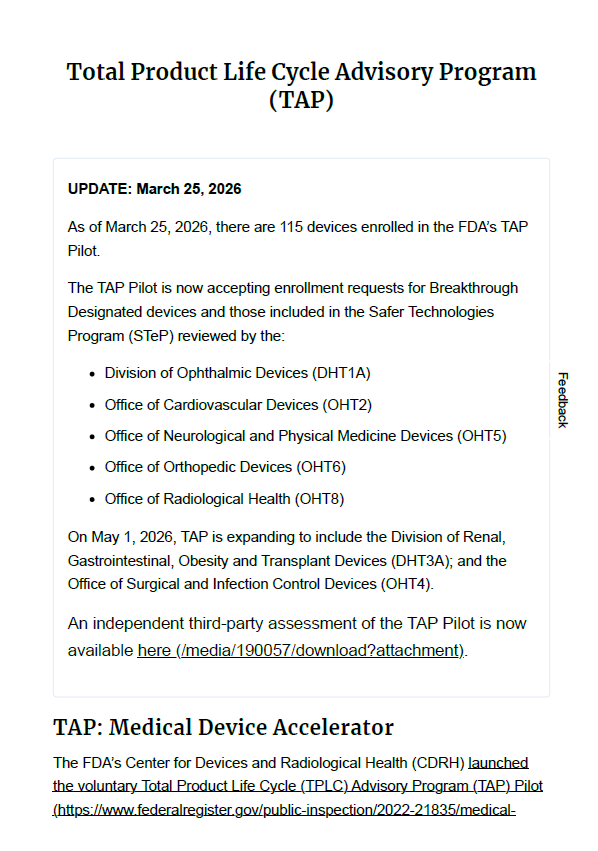
The U.S. Food and Drug Administration (FDA) has published an update on its Total Product Life Cycle Advisory Program (TAP) Pilot, confirming continued expansion and growing participation as of March 25, 2026.
Key facts from the FDA update
115 devices are currently enrolled in the TAP Pilot
The program is accepting new enrollment requests for:
Breakthrough Devices
Devices under the Safer Technologies Program (STeP)
Current participating FDA areas include:
Division of Ophthalmic Devices (DHT1A)
Office of Cardiovascular Devices (OHT2)
Office of Neurological and Physical Medicine Devices (OHT5)
Office of Orthopedic Devices (OHT6)
Office of Radiological Health (OHT8)
From May 1, 2026, the program will expand to include:
Division of Renal, Gastrointestinal, Obesity and Transplant Devices (DHT3A)
Office of Surgical and Infection Control Devices (OHT4)
An independent third-party assessment of the TAP Pilot is available
What is the TAP Pilot?
The TAP Pilot is a voluntary program led by the FDA’s Center for Devices and Radiological Health (CDRH), established under the MDUFA V commitments.
Its objective is to support the development of safe, effective, and innovative medical devices by:
Enabling early, frequent, and strategic communication with the FDA
Providing dedicated FDA advisors
Facilitating engagement with non-FDA stakeholders
Supporting developers across the total product lifecycle
Implications for manufacturers
While TAP is a U.S.-specific initiative, several elements may be relevant for manufacturers operating globally:
Earlier regulatory interaction
The program reinforces structured engagement with regulators early in development, particularly for innovative devices.Lifecycle-based approach
The focus on the total product lifecycle highlights the importance of aligning regulatory, clinical, and access strategies from early stages.Focus on innovation pathways
Eligibility linked to Breakthrough and STeP programs indicates continued prioritisation of devices addressing unmet medical needs.Program expansion
The inclusion of additional device areas may increase accessibility of the program to a broader range of manufacturers.
Takeaway
The latest FDA update confirms that the TAP Pilot is expanding in both scope and participation, with a continued focus on supporting innovative medical devices through enhanced regulatory interaction.
Read the full document below.