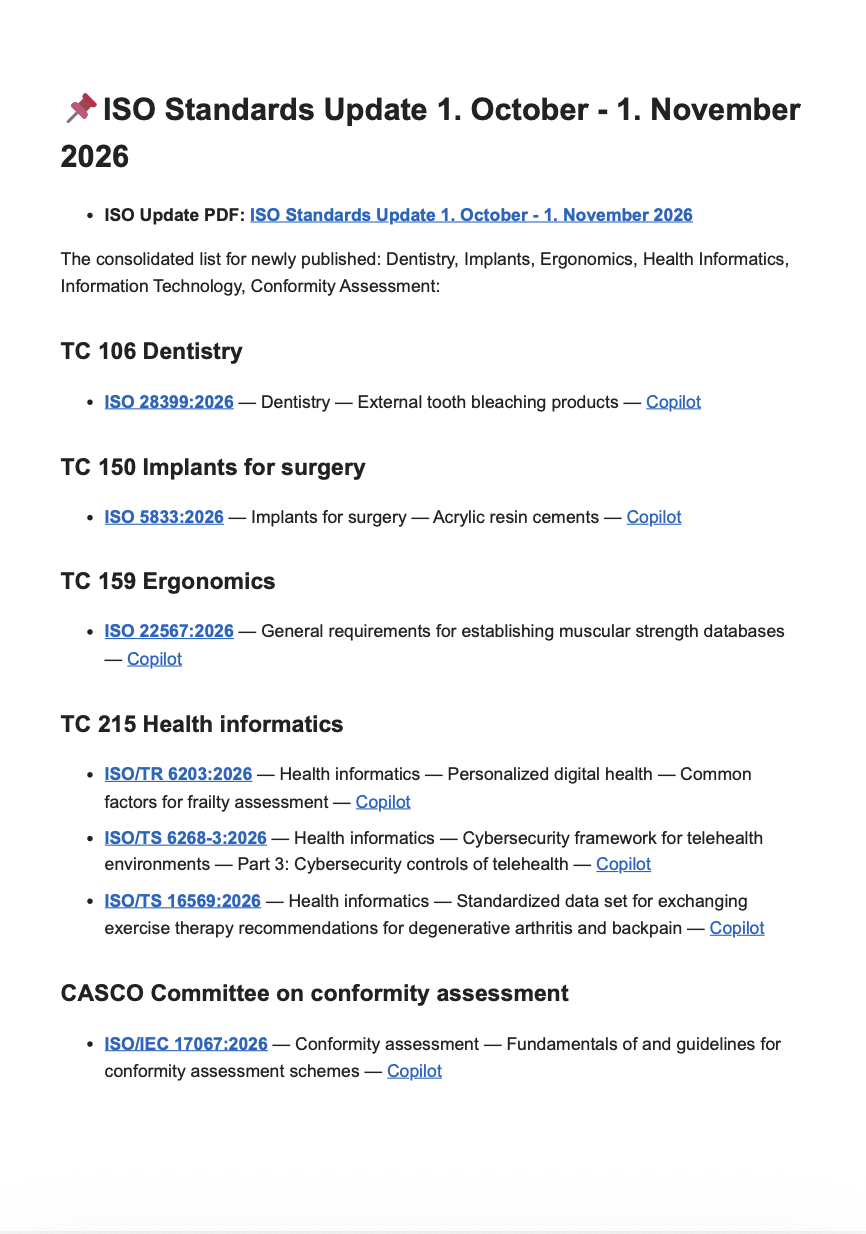
The latest monthly compilation of newly published ISO standards, covering the period from 1 October to 1 November 2026, highlights developments across several areas relevant to the medical device and healthcare technology sectors.
The update includes publications covering dentistry, surgical implants, ergonomics, health informatics, conformity assessment, information technology, cybersecurity and artificial intelligence security.
This recurring overview has been compiled and shared by Martin King, whose monthly work helps regulatory and medical device professionals keep track of newly published standards across multiple technical committees.
Dentistry
Under ISO/TC 106 — Dentistry, the update includes:
ISO 28399:2026 — Dentistry — External tooth bleaching products.
The publication is relevant to manufacturers and regulatory teams working with dental materials and products intended for external tooth bleaching.
Surgical Implants
Within ISO/TC 150 — Implants for surgery, the newly published standard highlighted is:
ISO 5833:2026 — Implants for surgery — Acrylic resin cements.
The standard is particularly relevant to organisations involved in implantable medical devices and materials used in surgical procedures.
Ergonomics
The update also includes a publication from ISO/TC 159 — Ergonomics:
ISO 22567:2026 — General requirements for establishing muscular strength databases.
This publication may be relevant to organisations working with human factors, ergonomics and the design of products or systems where physical capabilities are an important consideration.
Health Informatics
Several new publications are highlighted under ISO/TC 215 — Health informatics.
Personalized Digital Health and Frailty Assessment
ISO/TR 6203:2026 — Health informatics — Personalized digital health — Common factors for frailty assessment.
This publication reflects the continuing development of standards supporting personalised digital health applications and structured approaches to healthcare data.
Cybersecurity Controls for Telehealth
A particularly relevant publication for digital health and connected healthcare technologies is:
ISO/TS 6268-3:2026 — Health informatics — Cybersecurity framework for telehealth environments — Part 3: Cybersecurity controls of telehealth.
For manufacturers and healthcare technology providers, cybersecurity requirements continue to become increasingly important as telehealth platforms and connected medical technologies become more widely used.
Standardised Data for Exercise Therapy
The update also identifies:
ISO/TS 16569:2026 — Health informatics — Standardized data set for exchanging exercise therapy recommendations for degenerative arthritis and back pain.
The publication addresses standardisation of health information exchanged in the context of exercise therapy recommendations.
Conformity Assessment
The compilation includes an important publication from the CASCO Committee on conformity assessment:
ISO/IEC 17067:2026 — Conformity assessment — Fundamentals of and guidelines for conformity assessment schemes.
Conformity assessment standards can have broad relevance for organisations involved in certification, assessment schemes and regulatory compliance.
For medical device companies, developments in this area are particularly important because conformity assessment remains a fundamental element of demonstrating compliance with applicable regulatory requirements.
Information Technology
Several additional publications are highlighted under ISO/IEC JTC 1 — Information technology.
Technical Reviews and Audits
ISO/IEC/IEEE 24748-8:2026 — Systems and software engineering — Life cycle management — Part 8: Technical reviews and audits on defence programs.
Although not specifically focused on healthcare, lifecycle management, technical reviews and audit methodologies may be relevant to organisations operating complex software and systems engineering processes.
Data Provenance
Another significant publication is:
ISO/IEC 5181:2026 — Information security, cybersecurity and privacy protection — Data provenance.
Data provenance is becoming increasingly relevant across regulated digital environments.
For medical technology organisations, the ability to understand the origin, history and transformation of data can be particularly important in areas involving:
software;
digital health;
artificial intelligence;
clinical data;
cybersecurity;
regulatory evidence.
Anonymous Entity Authentication
The update also includes:
ISO/IEC 20009-4:2017/Amd 1:2026 — Information technology — Security techniques — Anonymous entity authentication — Part 4: Mechanisms based on weak secrets — Amendment 1.
This represents an amendment to an existing information security standard rather than a completely new publication.
Cybersecurity for Artificial Intelligence Systems
One of the most notable publications in the compilation is:
ISO/IEC 27090:2026 — Cybersecurity — Artificial intelligence (AI) — Addressing security threats and compromises to AI systems.
The publication reflects the growing focus on cybersecurity risks specific to AI systems.
This topic is increasingly relevant to medical device and digital health manufacturers integrating AI functionality into their products, particularly where security vulnerabilities could affect system integrity, data or performance.
Protection of Personally Identifiable Information
The compilation also highlights:
ISO/IEC 29151:2026 — Information security, cybersecurity and privacy protection — Controls, requirements, and guidance for personally identifiable information protection.
Protection of personally identifiable information remains a central consideration for healthcare technologies processing personal and patient-related data.
Why These Updates Matter for Medical Device Companies
Although not every standard included in the monthly update is specific to medical devices, several publications touch directly on areas that increasingly affect medical technology organisations.
These include:
implant materials;
health informatics;
telehealth cybersecurity;
conformity assessment;
data provenance;
AI cybersecurity;
privacy and personal information protection.
Regulatory and quality teams should therefore periodically monitor newly published standards to determine whether they affect their products, quality systems, technical documentation or regulatory strategies.
Increasing Convergence Between Medical Devices and Digital Standards
The October–November compilation also illustrates the growing convergence between traditional medical device standardisation and areas such as:
software engineering;
health data;
cybersecurity;
AI;
privacy;
digital health.
For manufacturers developing connected devices, Software as a Medical Device or AI-enabled medical technologies, monitoring standards outside traditional medical device technical committees is becoming increasingly important.
Credit to Martin King
Special thanks to Martin King for his continued work in compiling and sharing these monthly ISO standards updates.
His regular overview provides the medical device and regulatory community with a practical way to keep track of newly published standards across relevant technical committees and subject areas.
This monthly compilation is particularly useful as the number of standards affecting medical technology continues to expand beyond traditional device-specific topics into areas such as cybersecurity, information technology, AI and digital health.