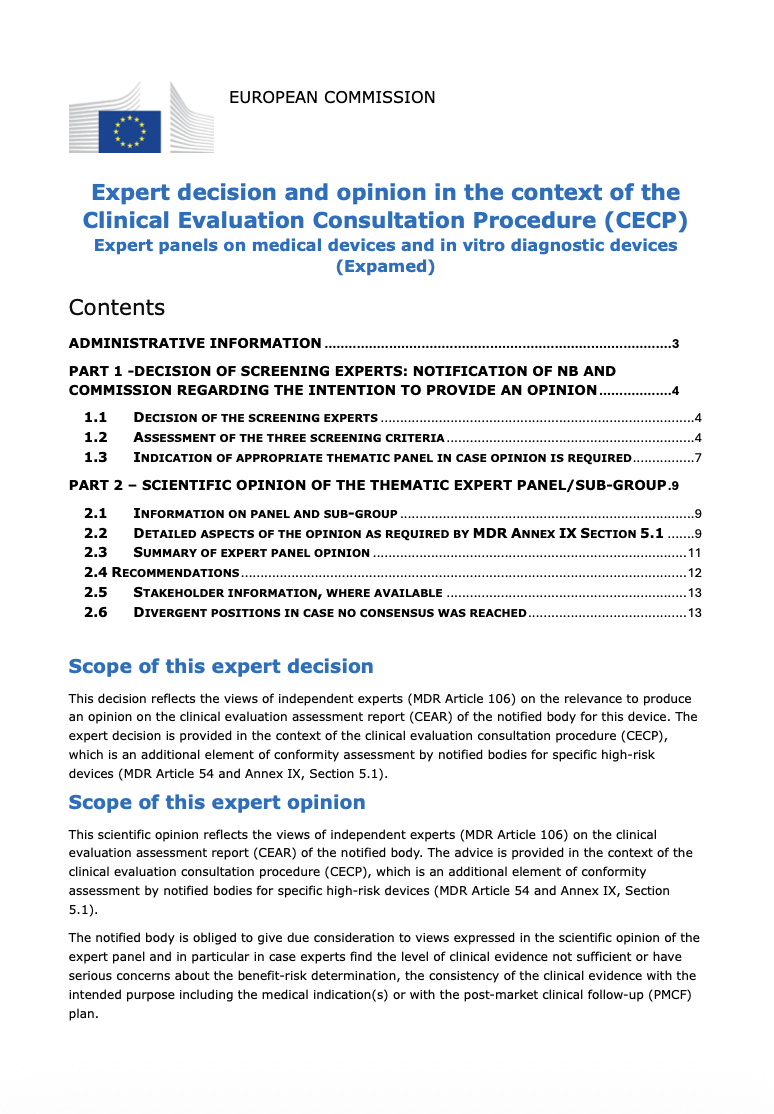
A European expert panel has issued a scientific opinion under the Clinical Evaluation Consultation Procedure (CECP)raising concerns about the clinical evidence supporting a novel Class III intra-articular medical device intended for patients with mild to moderate knee osteoarthritis.
The device, identified in the opinion as CCoat, is designed as a single intra-articular injection and uses a DSPC-based liposomal suspension combined with an MPC/PMPC-containing lipid-polymer conjugate.
CECP Review Triggered by High Novelty
The CECP screening experts considered the device to have a major level of novelty and a potential major clinical or health impact.
The novelty relates primarily to the combination and intended intra-articular use of the modified liposomal and lipid-polymer components.
The screening experts therefore recommended review by the relevant thematic expert panel.
Intended Use in Knee Osteoarthritis
The device is intended for use as an intra-articular injection in the knee joint of patients with mild to moderate osteoarthritis.
The claimed mechanism involves the formation of a hydrated liposomal layer on the cartilage surface, intended to support lubrication and reduce wear-related symptoms.
Pre-Market Clinical Evidence Reviewed
The manufacturer had conducted:
a first-in-human open-label study;
a randomised, double-blind, placebo-controlled clinical trial.
Patients were followed for 26 weeks after a single intra-articular injection.
The pivotal trial included 94 patients, with saline used as the placebo.
Few adverse events were reported in the studies, none of which were serious, and most resolved without complications.
Expert Panel Questions Superiority Claim
The most significant issue raised by the expert panel concerns the manufacturer’s claim that CCoat provides clinically meaningful improvement over placebo.
The expert panel concluded that the pivotal clinical investigation did not demonstrate superiority of CCoat over saline placebo.
The panel noted that the confidence intervals around the treatment effect were wide enough to include:
no clinically relevant benefit;
and, in some analyses, a potentially harmful effect.
KOOS and NRS Results Considered Inconclusive
The expert panel specifically disagreed with the notified body’s conclusion that the study demonstrated clinically meaningful improvement in:
KOOS;
Numeric Rating Scale (NRS).
According to the opinion, the lower confidence intervals did not exceed the predefined minimum clinically important difference threshold of more than 8 points.
The experts therefore concluded that the pivotal results were inconclusive and that any treatment effect was likely not clinically meaningful compared with saline injection.
Benefit-Risk Assessment Considered Incomplete
The expert panel also considered the notified body’s assessment of the manufacturer’s benefit-risk determination not comprehensive.
One concern relates to the novel lipid-polymer conjugate used in the device.
The experts noted a potential risk of foreign body synovitis, particularly because part of the material may remain non-resorbable.
Repeated injections could also potentially increase risks such as allergic reactions.
The panel recommended that this risk be further investigated through PMCF.
Promotional Claims Not Supported by Clinical Data
The manufacturer had made two additional claims:
CCoat reduces wear to enable smooth motion;
CCoat provides a long-lasting mechanical “cushion” to enable ease of movement.
According to the expert panel, these claims were supported only by pre-clinical evidence.
The panel therefore recommended that the claims should not be used in the IFU, online materials or promotional communications until supported by clinical data.
Intended Purpose Still Considered Supported
Despite concerns regarding benefit claims and clinical performance, the expert panel agreed with the notified body that the available clinical evidence was consistent with the intended purpose of the device for mild to moderate knee osteoarthritis.
This distinction is important: the panel did not reject the indication itself, but questioned whether the available evidence supported the claimed superiority and additional promotional benefits.
PMCF Plan Requires Strengthening
The expert panel also found the notified body’s assessment of the manufacturer’s PMCF plan not fully comprehensive.
The panel recommended several improvements.
Co-Medications and Co-Treatments Should Be Recorded
The experts stated that PMCF studies should record relevant co-medications and co-treatments, including:
physiotherapy;
diet;
other concurrent interventions.
These factors could significantly influence clinical outcomes and therefore need to be considered when assessing device performance.
Intended Population Should Not Be Expanded Prematurely
The expert panel also recommended defining what is meant by a “broader spectrum” of end users and patients.
Importantly, the intended use and population should not be expanded until sufficient evidence has been collected.
MRI Recommended to Evaluate Promotional Claims
To investigate the claims relating to cartilage wear and mechanical cushioning, the expert panel recommends adding cartilage-specific MRI assessments:
at baseline;
and at a minimum of one year after treatment.
This would provide more objective evidence regarding whether the device produces the claimed effects on cartilage.
Repeated Injections Require Further Investigation
The panel also recommends that the PMCF plan clearly specify whether repeated injections will be studied and at what frequency.
This should be directly linked to the assessment of the potential foreign body synovitis risk.
Expert Panel Calls for Stronger Clinical Evidence
In its summary, the panel states that the clinical evidence presented was insufficient to support all three product claims.
It therefore recommends additional post-market evidence generation.
New Randomised Controlled Trial Recommended
For the claimed clinical benefit and superiority over placebo, the experts recommend strengthening the evidence through a new study.
A possible approach would be a:
double-blind;
randomised controlled;
preferably three-arm trial;
comparing CCoat with current state-of-the-art treatment and placebo;
with at least one year of follow-up.
The study should also collect information on:
concurrent medications;
other treatments;
clinical scores;
adverse events.
Promotional Claims Should Be Suspended Until Demonstrated
The expert panel explicitly recommends that the two promotional claims regarding wear reduction and mechanical cushioning should not appear in:
Instructions for Use;
online communications;
promotional materials
until they are demonstrated and supported by appropriate clinical evidence.
PMCF Must Address Foreign Body Synovitis
The expert panel further recommends that the PMCF programme specifically characterise and evaluate the risk of foreign body synovitis.
This is particularly relevant where repeated injections may be considered in future clinical use.
Implications for Manufacturers
The opinion highlights several important lessons for manufacturers of novel Class III devices.
Clinical claims should be:
directly supported by clinical data;
statistically robust;
clinically meaningful;
aligned with the actual study design and endpoints.
Pre-clinical data alone may not be sufficient to support claims that imply a clinical or functional benefit.
Importance of Clinically Meaningful Endpoints
The opinion also reinforces the difference between statistical significance and clinical relevance.
For high-risk devices, manufacturers should ensure that treatment effects exceed clinically meaningful thresholds and that confidence intervals support the conclusions being claimed.
Where confidence intervals include no effect or potential harm, benefit claims may be difficult to justify.
Importance of PMCF Design
The case also demonstrates that PMCF should not simply repeat pre-market evidence collection.
Instead, PMCF should directly address:
unresolved methodological issues;
uncertain benefit;
emerging risks;
durability of performance;
repeated use;
unsupported promotional claims.
Role of the Notified Body
Under the CECP framework, notified bodies must give due consideration to the scientific opinion of the expert panel.
Where expert panels identify insufficient clinical evidence or concerns regarding benefit-risk determination, notified bodies may need to require actions such as:
additional PMCF studies;
changes to the IFU;
restrictions on claims;
limitations to intended purpose;
other conformity assessment measures.
If the notified body does not follow the expert panel’s advice, it must provide a full justification.
A Strong Signal on Clinical Claims Under the MDR
This CECP opinion provides a clear reminder that clinical and promotional claims for Class III devices must be proportionate to the quality and strength of the available evidence.
For manufacturers, it reinforces the importance of aligning:
clinical claims;
clinical investigation design;
statistical methodology;
benefit-risk assessment;
PMCF strategy;
promotional communications.
Where those elements are not aligned, CECP review may result in substantial additional evidence requirements.