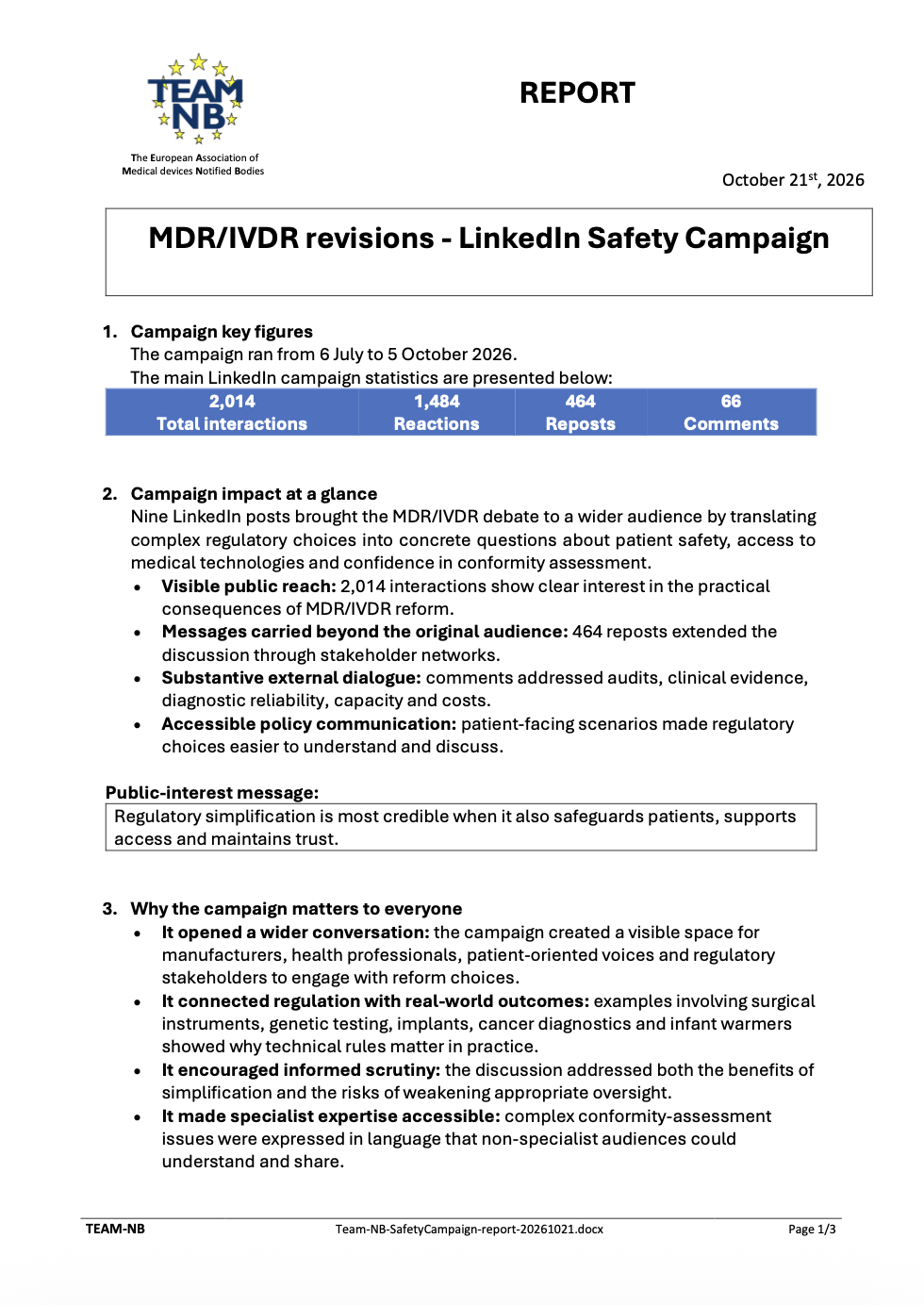
The European Association of Medical Devices Notified Bodies, Team-NB, has published a report on the impact of its MDR/IVDR revisions LinkedIn Safety Campaign, highlighting significant stakeholder engagement around the future of European medical device regulation.
The campaign ran from 6 July to 5 October 2026 and used a series of LinkedIn posts to translate complex regulatory issues into practical questions involving patient safety, access to medical technologies and confidence in conformity assessment.
More Than 2,000 Interactions
According to Team-NB, the campaign generated:
2,014 total interactions;
1,484 reactions;
464 reposts;
66 comments.
The nine LinkedIn posts were designed to broaden the MDR/IVDR debate beyond specialist regulatory audiences.
Linking Regulatory Reform to Patient Safety
A central message of the campaign was that regulatory simplification should not be considered independently from patient protection.
Team-NB summarises its public-interest message as follows: regulatory simplification is most credible when it also safeguards patients, supports access and maintains trust.
The campaign therefore sought to frame MDR and IVDR reform as a question of balancing:
efficiency;
access;
innovation;
patient protection;
confidence in conformity assessment.
Practical Scenarios Used to Explain Regulatory Choices
Rather than presenting MDR/IVDR reform only as a technical regulatory discussion, Team-NB used practical healthcare examples.
The campaign included scenarios involving:
surgical instruments;
genetic testing;
implants;
cancer diagnostics;
infant warmers.
According to the report, these examples helped show why changes to regulatory requirements can have direct consequences for healthcare delivery and patient outcomes.
Reposts Extended the Debate
Team-NB highlights the campaign’s 464 reposts as an indication that the content resonated beyond its original audience.
The organisation states that reposting helped extend the discussion through wider professional and stakeholder networks.
It also notes that strong redistribution suggests the topics were considered relevant enough for stakeholders to share further.
Comments Focused on Practical Regulatory Concerns
The report notes that comments addressed several recurring regulatory issues, including:
audits;
clinical evidence;
diagnostic reliability;
notified body capacity;
costs.
These discussions provided additional insight into concerns that stakeholders consider important when evaluating possible MDR/IVDR reforms.
A More Accessible Regulatory Debate
One of the goals of the campaign was to make specialist conformity-assessment issues understandable to non-specialist audiences.
Team-NB argues that shorter, visual and scenario-based communication helped broaden access to regulatory expertise.
The campaign was intended to encourage informed participation rather than limit discussions to regulators, manufacturers and notified bodies.
Balancing Simplification and Oversight
The campaign did not reject regulatory simplification.
Instead, Team-NB sought to promote scrutiny of both:
the potential benefits of simplification;
the potential risks of weakening appropriate regulatory oversight.
This distinction is particularly relevant as European institutions continue discussing possible amendments to MDR and IVDR.
Supporting Wider Policy Discussions
Team-NB states that the campaign contributes to the public debate by providing:
clearer understanding of regulatory trade-offs;
a balanced narrative around efficiency and patient protection;
practical examples;
a basis for continued stakeholder dialogue.
The campaign therefore functions not only as communication activity but also as a platform for gathering stakeholder perspectives.
Human Impact of Regulatory Decisions
Another important feature of the campaign was its focus on the real-world consequences of regulatory decisions.
Team-NB argues that recognisable patient and device scenarios help connect technical regulatory requirements with healthcare outcomes.
This approach may be particularly relevant in the MDR/IVDR debate, where issues such as certification capacity, clinical evidence and regulatory costs can otherwise remain highly technical.
Limitations of the Campaign Data
Team-NB also acknowledges limitations in its assessment.
The reported figures reflect observable interactions, but data on:
impressions;
clicks;
audience profiles
were not available.
The report therefore cautions that conclusions regarding overall campaign reach should be considered directional.
Broader Stakeholder Participation
The campaign was designed to create space for participation from:
manufacturers;
healthcare professionals;
patient-oriented voices;
regulatory stakeholders.
Team-NB argues that more accessible communication can help widen participation in discussions about European medical device reform.
Supporting More Grounded Policymaking
The report suggests that practical regulatory expertise and stakeholder reactions can complement formal institutional consultations.
Team-NB highlights several potential benefits:
more transparent regulatory choices;
more inclusive debate;
more grounded policymaking;
better-balanced communication;
longer-term stakeholder engagement.
MDR/IVDR Reform Remains a Public-Interest Issue
A key message from the report is that MDR and IVDR reform is not solely an industry or regulatory issue.
Changes to the framework can affect:
patient access;
availability of technologies;
clinical evidence requirements;
conformity assessment capacity;
costs;
trust in the regulatory system.
The campaign therefore sought to connect regulatory policy decisions with their broader public-health implications.
Impact on Manufacturers and Notified Bodies
For manufacturers and notified bodies, the report reinforces the importance of participating in the MDR/IVDR reform discussion with practical evidence.
Issues such as:
conformity-assessment efficiency;
clinical evidence expectations;
notified body capacity;
regulatory predictability;
cost pressures
remain central to the debate.
At the same time, Team-NB’s messaging emphasises that simplification should preserve the credibility and safety objectives of the regulatory framework.
Patient Safety as the Core Reference Point
The report repeatedly positions patient protection as the reference point against which simplification proposals should be assessed.
Rather than framing regulatory efficiency and patient safety as opposing objectives, Team-NB argues for a model in which simplification, innovation and efficiency remain connected to safety and public confidence.
Campaign Generates Strong Stakeholder Interest
In its conclusion, Team-NB states that the campaign demonstrated significant interest in MDR/IVDR reform beyond specialist regulatory circles.
The 2,014 interactions and 464 reposts indicate that discussions about medical device regulation can attract broader engagement when linked to real-world examples and patient outcomes.
The report concludes that the campaign successfully promoted a balanced narrative connecting:
simplification;
innovation;
efficiency;
patient protection;
trust.