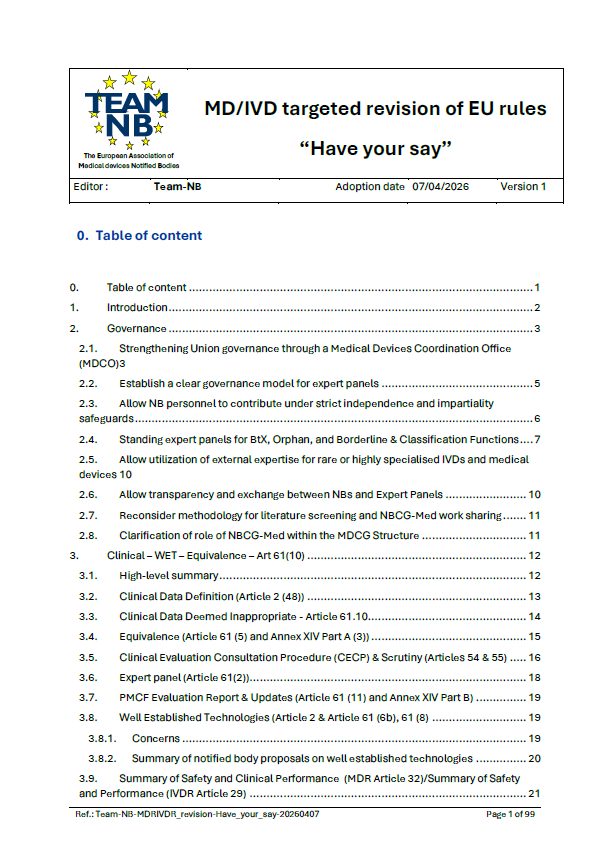
Notified Bodies Raise Concerns on Targeted MDR/IVDR Revision
A new position paper published by Team-NB outlines notified bodies’ consolidated feedback on the European Commission’s proposed targeted revision of the MDR and IVDR. The document reflects the experience of approximately 50 experts involved in conformity assessment across the EU.
The paper highlights that while improvements in efficiency, predictability, and coordination are needed, these should not be achieved by reducing preventive regulatory safeguards.
Strengthening EU Governance: Proposal for MDCO
One of the central proposals is the creation of a Medical Devices Coordination Office (MDCO) to support operational coordination at EU level.
According to the document, MDCO would:
Support regulatory workflows and timelines
Improve coordination between notified bodies, expert panels, and authorities
Reduce fragmentation across Member States
Importantly, MDCO would not take regulatory decisions but would act as an operational backbone to improve consistency and efficiency.
Clinical Evaluation: Need for Clarity and Predictability
The proposed changes to clinical evaluation requirements, including Article 61 and equivalence, raise several concerns.
Notified bodies highlight:
Lack of clarity in the use of non-clinical data
Risks linked to broader interpretation of equivalence criteria
Potential inconsistencies in how requirements are applied
The paper emphasises that unclear definitions may lead to:
Divergent interpretations between notified bodies
Uncertainty in regulatory expectations
Inefficiencies in clinical strategy planning
Well-Established Technologies (WET): Risk of Inconsistent Application
The proposed expansion of Well-Established Technologies (WET) is identified as a key area of concern.
Based on implementation experience, notified bodies warn that:
The definition is currently too broad and open to interpretation
This may lead to lack of harmonisation
Manufacturers may face late-stage disagreements during conformity assessment
To address this, the paper proposes:
A more precise legal definition, or
A binding EU list of WET devices
Reduced Oversight: Concerns on Patient Safety and System Robustness
Several proposed changes would reduce notified body involvement across the lifecycle, including:
Less frequent or reduced technical documentation reviews
Removal or reduction of certain audit activities
Increased reliance on “for-cause” mechanisms
Notified bodies caution that, taken together, these measures may:
Limit early detection of safety and performance issues
Shift the system toward a more reactive approach
Reduce the effectiveness of preventive controls
Notified Body Capacity and Financial Sustainability
The proposal also introduces changes with potential impact on the notified body system, including:
Additional costs linked to oversight activities
Measures affecting fee structures
The paper highlights that these changes may:
Affect the financial sustainability of notified bodies
Contribute to capacity constraints
Impact the availability of conformity assessment services
Alternative Approach: Performance-Based Oversight
As an alternative to reducing scrutiny, Team-NB proposes a performance-based regulatory model, where:
Oversight is adjusted based on demonstrated compliance performance
Strong controls are maintained during early and late lifecycle phases
This approach aims to:
Preserve patient safety
Improve predictability
Encourage high-quality compliance
Conclusion
The position paper concludes that efficiency gains should not come at the expense of regulatory robustness.
A balanced approach is needed to ensure:
Patient safety
Legal certainty
Sustainable functioning of the notified body system
The document provides a detailed set of proposals intended to support a revision of the MDR and IVDR that improves efficiency while maintaining the core principles of the current framework.
Read the full document below.