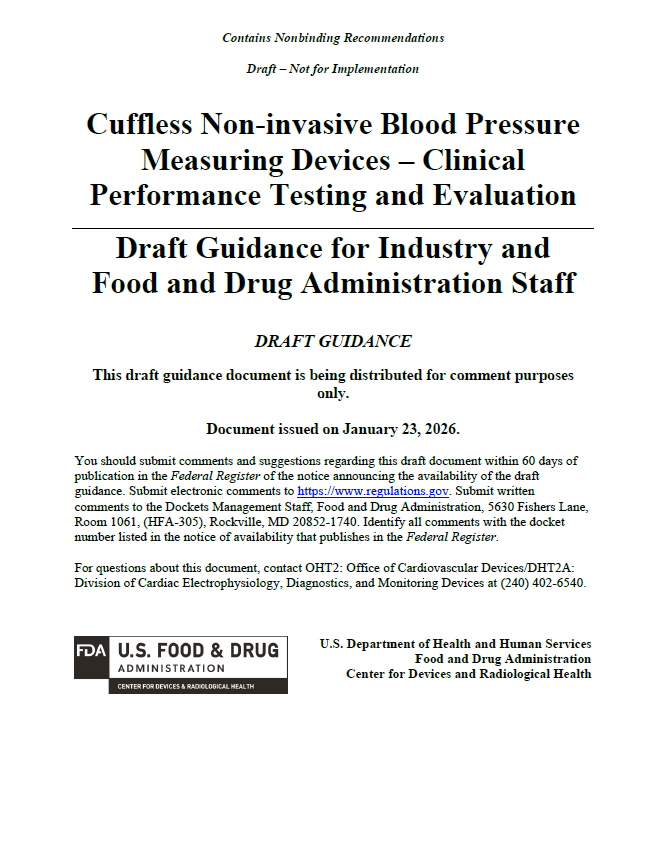
New FDA Draft Guidance Sets Bar for Cuffless Blood Pressure Devices – Clinical Performance Now in Focus
On January 23, 2026, the FDA released a draft guidance document proposing clinical performance testing requirements for cuffless non-invasive blood pressure (BP) devices—a move that signals growing regulatory scrutiny on emerging wearable and sensor-based monitoring technologies.
While the document is a draft for comment (not yet finalized), it clearly outlines the agency’s current thinking and is likely to shape expectations for clinical validation in future U.S. market submissions.
Why this matters for EU and UK manufacturers
Even if your primary market is the EU or UK, this guidance offers a valuable preview of how authorities may approach novel BP technologies—especially those that use AI, sensor fusion, or personalized calibration models. It's a useful reference for clinical evaluation reports under MDR, or performance evidence for UKCA marking.
Key Points from the Draft Guidance
Scope
The guidance applies to cuffless BP devices regulated under 21 CFR 870.1130 (product code DXN). This excludes traditional cuff-based monitors and neonatal ICU monitors.
Clinical Testing Expectations
The FDA now explicitly recommends that manufacturers conduct and submit results for the following three types of performance tests:
Static Test – Accuracy shortly after setup
Stability Test – Accuracy over time (e.g., up to 28 days post-calibration)
Change Test – Accuracy when blood pressure changes significantly (≥15 mmHg systolic or ≥10 mmHg diastolic)
These studies must demonstrate accuracy across all relevant subgroups, including age, BMI, sex, and skin tone (per the Monk Skin Tone scale).
Acceptance Criteria
Devices should meet the same standards as ISO 81060-2:
Mean error ≤ ±5.0 mmHg
Standard deviation < 8.0 mmHg
Special Populations
Manufacturers must address performance in special groups like:
Patients over 50
Those with arrhythmias or undergoing vasoactive therapy
Pregnant individuals
Pediatric populations (if applicable)
AI-driven Devices
If your device uses AI or ML, early engagement with the FDA via the Q-Submission Program is strongly encouraged to clarify expectations.
Strategic Takeaways
Design your clinical study early – especially if pursuing both FDA and EU/UK routes.
Use ISO 81060-2 and 81060-3 as the baseline, but note that the FDA recommends avoiding some clauses in IEEE 1708, citing lack of statistical validity.
Consider re-using data across jurisdictions—but align on endpoints and sampling to ensure compliance with both MDR and FDA expectations.
This guidance is a reminder that post-pandemic flexibility around remote monitoring is giving way to more structured performance demands. If your device relies on calibration, sensor-derived metrics (like PAT or PWTT), or adaptive algorithms, you’ll need robust and transparent evidence of accuracy.
Read the full draft guidance below.