FDA Releases Draft Guidance on Bayesian Methodology in Clinical Trials – What It Means for Innovative Study Designs
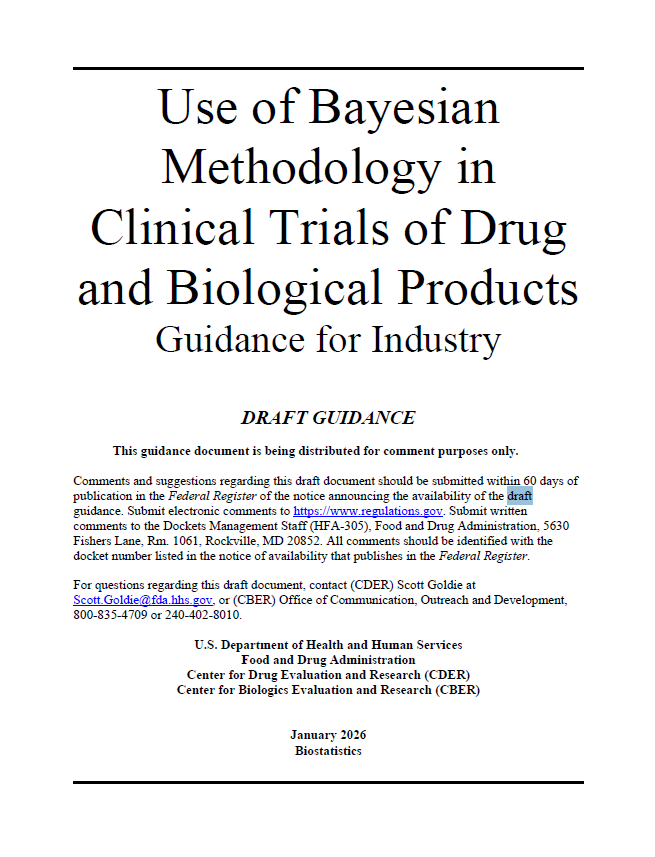
In January 2026, the U.S. Food and Drug Administration (FDA) published a draft guidance titled "Use of Bayesian Methodology in Clinical Trials of Drug and Biological Products". Although aimed at pharmaceutical and biologics development, this document may be of interest to medical device manufacturers, particularly those involved in adaptive clinical trials, pediatric extrapolation, or rare disease indications where Bayesian approaches are already more common.
Read the full draft guidance below: FDA Guidance (Draft, January 2026)
Key Points from the Draft
Bayesian methods are presented as a valid approach to support primary inference in clinical trials, including efficacy and safety claims.
The guidance highlights scenarios where Bayesian approaches are especially useful:
Pediatric extrapolation, including examples using empagliflozin and linagliptin.
Dose-finding studies in oncology, using models such as CRM and BOIN.
Subgroup analyses, platform trials, and studies with nonconcurrent controls.
It underscores the importance of justifying prior distributions, assessing operating characteristics (e.g. power, bias), and ensuring regulatory alignment early.
Borrowing external data must be supported by strong methodological and clinical rationale, especially regarding relevance and data quality.
Why this Matters to Medical Device Manufacturers
Although the guidance is directed at drugs and biologics, it reinforces a broader trend: regulators are increasingly open to Bayesian designs—including in medical devices, where such methodologies are already accepted under certain conditions (notably by the FDA’s CDRH).
For manufacturers of innovative or niche devices, especially those facing small sample sizes or ethical challenges in randomization, Bayesian designs can:
Enable more efficient use of existing data (e.g., from registries or prior studies),
Support adaptive trial designs,
Facilitate extrapolation in pediatric or rare disease contexts,
Enhance regulatory dialogue on evidence generation strategy.
This guidance provides valuable methodological clarity that could inform device clinical strategies—even if indirectly.
What’s Next?
This is a draft guidance, open for public comment. Sponsors are encouraged to engage with the FDA early if considering Bayesian methods.
For device-specific guidance, refer to: