MHRA Updates Pre-Submission Advice and Support for Innovative Medicines
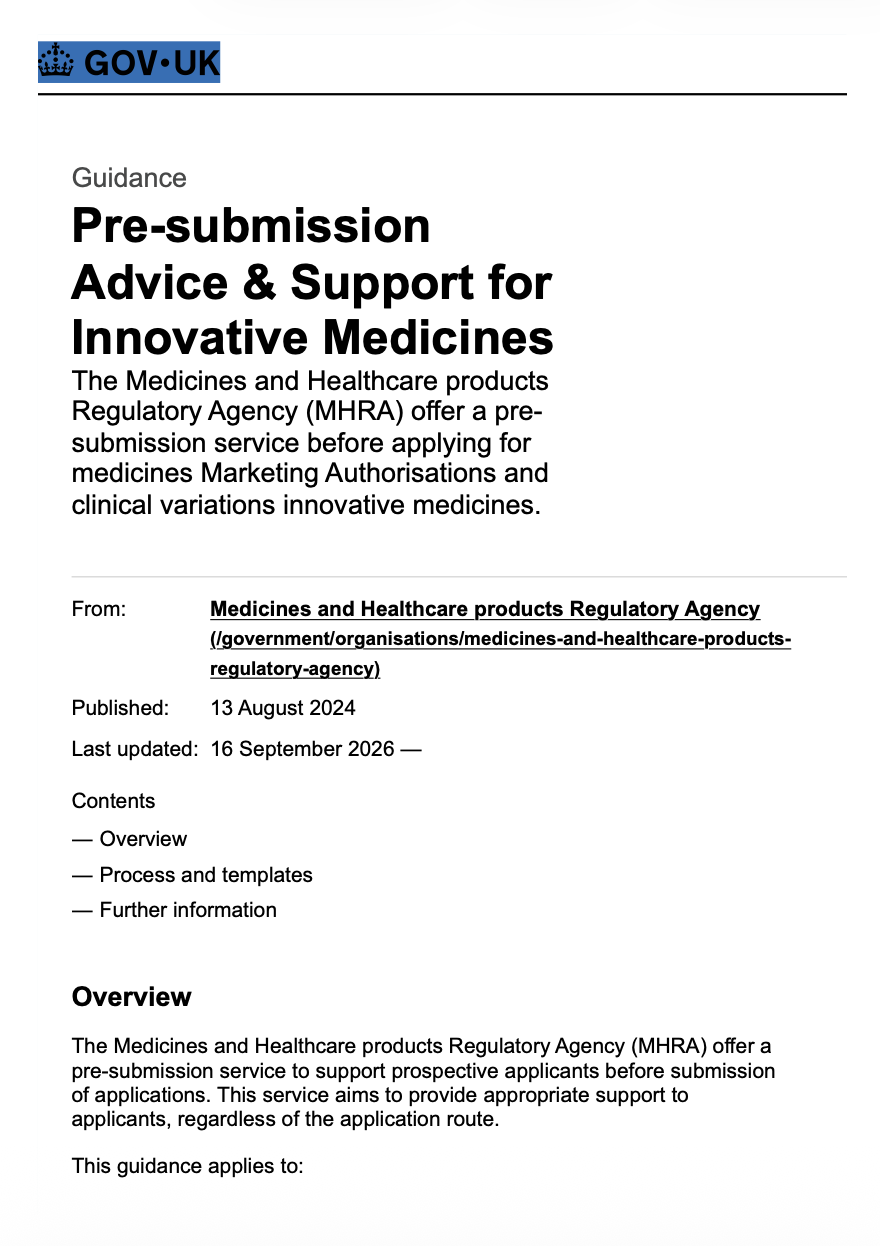
The Medicines and Healthcare products Regulatory Agency (MHRA) has updated its guidance “Pre-submission Advice & Support for Innovative Medicines.”
The guidance was originally published on 13 August 2024 and was last updated on 16 September 2026. It describes the MHRA’s pre-submission service for prospective applicants preparing marketing authorisation and variation applications for innovative medicines.
Scope of the Guidance
The guidance applies to:
initial Marketing Authorisation Applications (MAAs) for innovative medicines;
variation applications introducing new indications;
line extension applications.
For this guidance, innovative medicines include:
new chemical active substances;
biological medicines, including biosimilars;
medicines for orphan indications;
medicines for rare diseases;
products seeking conditional approval;
products seeking approval under exceptional circumstances.
Purpose of the Pre-Submission Service
The MHRA’s pre-submission service is intended to help applicants prepare for planned submissions and support the agency’s operational planning.
Applicants may request a pre-submission meeting to discuss procedural and regulatory aspects, introduce the product and explain the planned submission approach.
Where the MHRA considers a meeting necessary, applicants are strongly encouraged to attend. The guidance warns that failure to do so may increase the risk of validation issues, delayed validation and subsequent delays in assessment.
Pre-Submission Meetings Are Not Scientific Advice
The MHRA makes a clear distinction between pre-submission support and Scientific Advice.
Pre-submission meetings may identify high-level issues or areas requiring attention, but they do not constitute an assessment of the data package and should not be used to obtain confirmation on the acceptability or adequacy of a particular scientific, clinical or regulatory approach.
Where applicants need MHRA views on the adequacy of a data package, development programme or regulatory strategy, they should submit a formal Scientific Advice request.
Direct National Route: Three-Month Notification
For applications submitted through the Direct National Route, applicants planning an MAA, new indication variation or line extension for an innovative medicine must notify the MHRA of the intended submission date at least three months in advance.
The notification should be made using the pre-submission notification form.
Applicants are also strongly encouraged to request a pre-submission meeting through the form. The MHRA may respond by directing the applicant to relevant guidance, providing written advice or offering a meeting.
International Recognition Procedure: Eight-Week Notification
Different timelines apply under the International Recognition Procedure (IRP).
Applicants intending to submit an MAA, new indication variation or line extension for an innovative medicine through the IRP must notify the MHRA of the intended submission date at least eight weeks in advance.
This is done by completing the online IRP eligibility form and submitting the outcome to the MHRA.
Applicants may also request a pre-submission meeting by completing the dedicated Pre-submission Advice Form – International Recognition Procedure.
ACCESS and Project Orbis
For applications submitted through the ACCESS work-sharing initiative or Project Orbis, applicants must also notify the relevant teams through the applicable procedure-specific channels.
The guidance makes clear that pre-submission planning must therefore account for both the MHRA process and any additional route-specific requirements.
Format of Pre-Submission Meetings
The MHRA states that pre-submission meetings are intended to support submission readiness by enabling early dialogue on procedural, administrative and operational aspects.
They are not intended to review detailed scientific content or full regulatory dossiers.
Applicants should therefore avoid submitting extensive briefing packages, full study reports or comprehensive scientific justifications for these meetings.
Information Applicants Should Provide
Instead, the MHRA expects applicants to provide concise information sufficient to support discussion.
This should include:
the proposed submission;
UK and other geographic submission timelines;
planned submission routes;
key procedural or operational considerations;
specific regulatory points or questions for discussion.
Applicants must also submit the relevant pre-submission notification or meeting request form.
Recommended Slide Deck
The updated guidance recommends that applicants prepare a concise presentation deck, typically 10–15 slides.
The presentation should:
introduce the product;
outline the proposed submission strategy;
highlight key procedural or operational considerations;
identify specific regulatory questions for discussion.
Additional supporting documentation is not normally required, although the MHRA may request limited additional information for complex regulatory pathways or novel product types.
Meeting Minutes
The MHRA will not normally produce formal minutes of pre-submission meetings.
Applicants may take their own minutes and are encouraged to share them with the MHRA within five working days of the meeting.
The MHRA will generally not amend the minutes unless they inaccurately reflect the discussion or indicate that the applicant may have misunderstood the agency’s position.
Impact on Innovative Medicine Applicants
For pharmaceutical companies, regulatory affairs teams, consultants and organisations preparing innovative medicine applications in the UK, the guidance highlights the importance of early submission planning.
Stakeholders should pay particular attention to:
three-month notification for Direct National Route submissions;
eight-week notification for IRP applications;
early consideration of pre-submission meetings;
distinction between pre-submission support and Scientific Advice;
ACCESS and Project Orbis-specific requirements;
concise meeting preparation;
10–15 slide presentation decks;
submission route and timeline planning;
preparation of meeting minutes;
early identification of procedural and logistical risks.
The key message is that the MHRA expects applicants to engage early and provide clear, concise information so that both the applicant and the agency can prepare effectively for submission.