MHRA Updates Guidance on Patient and Public Involvement in Regulatory Decision-Making
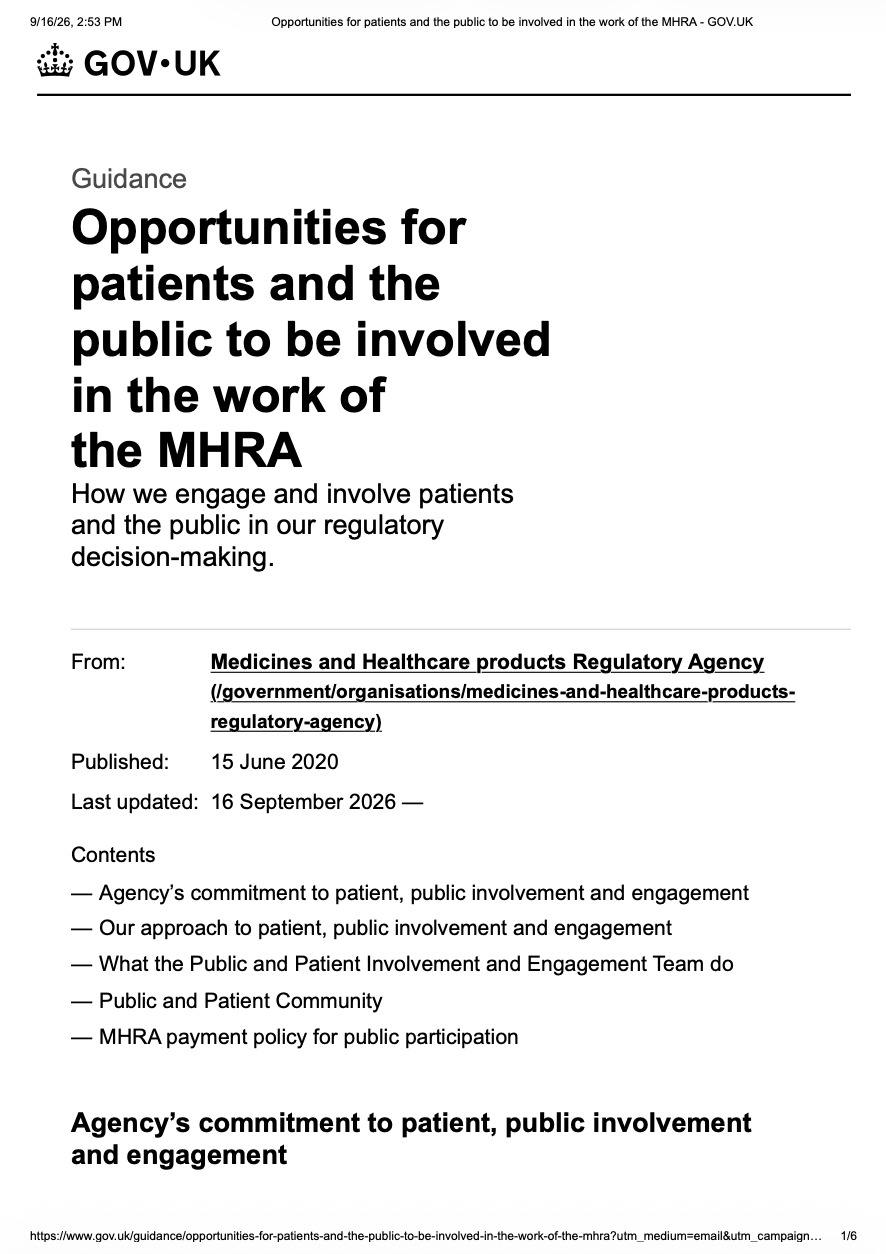
The Medicines and Healthcare products Regulatory Agency (MHRA) has updated its guidance on opportunities for patients and the public to be involved in the work of the agency.
The guidance was originally published on 15 June 2020 and was last updated on 16 September 2026, with the latest update addressing the agency’s commitment to patient and public involvement and engagement.
MHRA Commitment to Patient and Public Involvement
The MHRA states that patient and public involvement forms part of its broader organisational commitments.
The agency’s approach is reflected in its Corporate Plan 2023–26, and the MHRA is also a signatory to the shared commitment to public involvement in research.
The guidance reinforces the agency’s intention to incorporate patient and public perspectives into regulatory work rather than treating engagement as a separate activity.
Patient Involvement Strategy
The MHRA’s first Patient Involvement Strategy, published in October 2021, set out how the agency intended to involve patients and the public throughout the regulatory journey.
The strategy was informed by consultation with patients and by findings from the Independent Medicines and Medical Devices Safety Review, which identified areas where patient engagement could be strengthened.
Public and Patient Involvement and Engagement Team
The Patient, Public Involvement and Engagement Team (PPIE) acts as a centre of expertise within the MHRA.
Its role is to advise and support MHRA teams in planning, designing and delivering high-quality patient and public involvement and engagement activities.
This provides a dedicated internal structure for incorporating patient perspectives into regulatory and policy work.
Patient Involvement in Rare Disease Regulation
One area highlighted by the MHRA is its work on rare diseases.
The agency has established a Rare Disease Consortium involving a range of stakeholders, including patient representatives, to support development of a patient-focused regulatory framework for rare disease therapies.
Workshops and meetings have been held with patients and patient representatives to gather views on fundamental issues affecting the framework.
The MHRA notes that continued involvement from the rare disease community is important because patients bring lived experience and expertise that can help shape a framework suited to their needs.
Patient and Public Participation in ILAP
The guidance also describes patient and public involvement in the Innovative Licensing and Access Pathway (ILAP).
ILAP is focused on supporting faster access to transformative medicines within the UK health system.
In 2025, the MHRA recruited a pool of 20 Lay Members to work with the ILAP team over two years.
These members contribute public and patient perspectives to the assessment and selection of ILAP applications and receive induction and training to help them participate effectively.
The MHRA states that feedback from Lay Members has also helped improve the assessment process for future ILAP rounds.
Public Engagement in AI Healthcare Regulation
The guidance highlights patient and public participation in the National Commission into the Regulation of AI in Healthcare.
The Commission is described as an expert, non-statutory advisory body established by the MHRA to review existing regulations and provide recommendations for a future regulatory framework for artificial intelligence in healthcare.
Its engagement programme has included:
a call for evidence survey;
three deliberative sessions across the UK;
focus groups involving seldom-heard communities.
The targeted focus groups included young people, unpaid carers and people with learning difficulties.
Patient and Public Community
The MHRA’s Patient and Public Community (PPC) is another key mechanism for patient engagement.
Previously known as the Patient Group Consultative Forum, the PPC was established in October 2024 following a review of the MHRA’s patient involvement strategy.
The MHRA describes the PPC as an important tool for meaningful engagement with patients and patient organisations, helping inform policy development, regulatory work and scientific activities.
Who Can Join the PPC?
The Patient and Public Community is open to:
individuals interested in medicines and medical devices;
patients and carers;
patient groups;
organisations representing their members’ views.
Members are expected to participate in meetings and online engagement, use lived experience to support broader perspectives, respect confidentiality and promote patient safety and meaningful involvement.
Types of Membership
The guidance identifies two main membership categories:
Individual members, including patients or carers;
Voluntary and community sector organisations.
Interested participants are asked to complete an Expression of Interest form and review the MHRA’s Working Together Agreement before applying.
MHRA Payment Policy for Public Participation
The updated guidance also references the MHRA payment policy for public and patient participation.
The policy recognises the time, knowledge and lived experience contributed by patients and members of the public and explains when payments and expenses may be offered.
Its objectives include:
recognising and valuing people’s contributions;
reducing financial barriers to participation;
ensuring payments and expenses are offered fairly and consistently.
Impact on Medical Device and Healthcare Stakeholders
For medical device manufacturers, healthcare organisations, patient groups and regulatory teams, the guidance illustrates the increasing role of patient and public perspectives in MHRA regulatory work.
Stakeholders should pay particular attention to:
patient engagement throughout regulatory decision-making;
involvement in medicines and medical device policy;
Patient and Public Community participation;
rare disease regulatory initiatives;
public input into AI healthcare regulation;
patient participation in ILAP;
engagement with seldom-heard communities;
use of lived experience in regulatory and scientific work;
payment and expense policies for participants.
For organisations interacting with the MHRA, the broader message is that patient and public involvement is becoming increasingly embedded across regulatory policy development, assessment processes and emerging areas such as AI in healthcare.