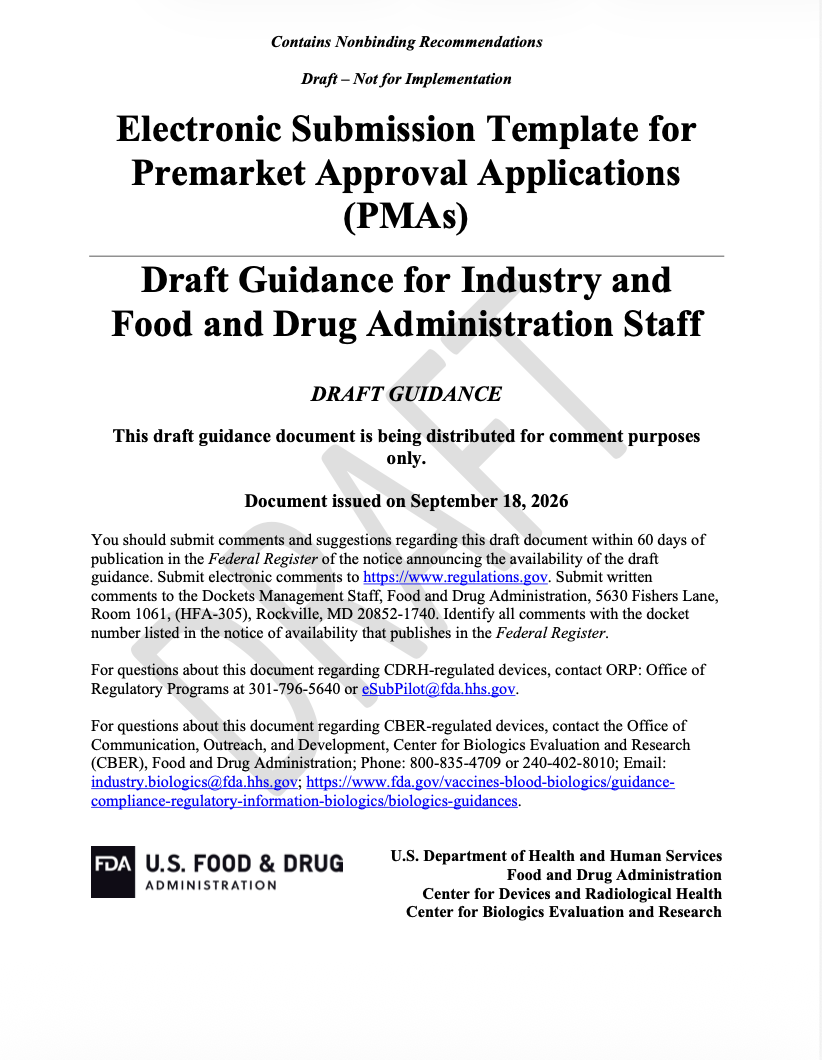
FDA Issues Draft Guidance on Electronic Submission Templates for PMAs
The U.S. Food and Drug Administration (FDA) has issued a new draft guidance titled “Electronic Submission Template for Premarket Approval Applications (PMAs).”
The draft was issued on 18 September 2026 and is open for public comment for 60 days following publication of the associated Federal Register notice.
The guidance applies to applicants preparing PMAs and certain PMA supplements for submission to the Center for Devices and Radiological Health (CDRH) and the Center for Biologics Evaluation and Research (CBER).
Application Types Covered
The draft guidance applies to several designated PMA submission types, including:
Original PMAs;
Panel-Track Supplements;
180-Day Supplements;
Real Time Supplements;
30-Day Notices / 135-Day Supplements.
The guidance does not currently cover PMA Modules or Modular Shells.
Role of eSTAR
The draft identifies eSTAR — electronic Submission Template And Resource — as the electronic submission template currently available for preparing PMAs and PMA supplements as electronic submissions.
eSTAR is a structured, dynamic PDF containing questions, prompts, logic and integrated resources that guide applicants through the preparation of a complete submission.
The system incorporates resources such as:
FDA product codes;
FDA-recognised consensus standards;
targeted submission questions;
regulatory references;
guidance links;
structured and unstructured data fields.
Objective of the Electronic Submission Template
FDA states that electronic submission templates are intended to improve submission consistency and increase review efficiency.
The draft also supports implementation of section 745A(b) of the Federal Food, Drug, and Cosmetic Act, which authorises FDA to establish standards and timelines for electronic medical device submissions.
When finalised, certain provisions relating to electronic submission standards, implementation timelines, waivers and exemptions will have binding effect.
Current Voluntary Use of eSTAR
During the transition period, applicants may continue to use eSTAR voluntarily for the designated PMA submission types.
FDA states that eSTAR is currently the only electronic submission template available for these application types.
Technical Screening
FDA proposes a technical screening process for eSTAR PMA submissions.
For PMAs and PMA supplements, technical screening is expected to occur within 15 calendar days after FDA receives the submission, provided the applicable user fee has been paid.
The screening is intended to verify whether the information entered in eSTAR accurately describes the device and whether required attachments have been included.
What Happens if a Submission Fails Technical Screening?
Where an eSTAR does not pass technical screening, FDA intends to notify the applicant electronically and identify the missing or incomplete information.
The PMA or supplement would then remain on hold until the applicant provides an updated eSTAR.
If the applicant responds within 360 days, the additional submission will be treated as an amendment.
If no response is received within 360 days after the technical screening deficiency notification, FDA intends to consider the PMA or supplement withdrawn.
Once the updated submission is received, the review clock restarts at day 0 and FDA conducts another technical screening.
Filing Review for Original PMAs and Panel-Track Supplements
Original PMAs and Panel-Track Supplements that pass technical screening will continue to undergo a filing review.
The guidance states that this filing review occurs within 45 calendar days after FDA receives the submission.
Structure of the PMA eSTAR
The draft guidance provides a detailed overview of the information expected within the PMA eSTAR.
Key sections include:
submission type;
cover letter and letters of reference;
applicant information;
pre-submission correspondence;
previous regulator interactions;
consensus standards;
device description;
proposed indications for use.
Additional sections address market history, benefit-risk considerations, labelling, reprocessing, sterility and shelf life.
Software, Cybersecurity and Interoperability
For devices involving software or firmware, the eSTAR structure includes sections for applicable software documentation.
The draft also requires applicable information addressing:
cybersecurity;
interoperability;
software functions;
electromagnetic compatibility;
electrical safety;
mechanical safety;
wireless safety;
thermal safety.
This reinforces the integration of software and cybersecurity considerations into PMA submission preparation.
Performance Testing
For non-IVD medical devices, applicants are expected to provide information on non-clinical and clinical testing relied upon to demonstrate reasonable assurance of safety and effectiveness.
For IVDs, the eSTAR structure includes:
analytical performance;
comparison studies;
reference ranges or expected values;
clinical study information.
Quality Management System Information
The electronic submission structure also includes information relating to the Quality Management System Regulation (QMSR).
Applicants may need to provide information regarding the methods, facilities and controls used for:
design;
manufacturing;
packaging;
labelling;
storage;
installation;
servicing of the device.
Post-Market Study Plans
Where applicable, eSTAR also includes information about post-market study plans.
The guidance defines these as post-market clinical or nonclinical studies that may be required as a condition of PMA approval, also referred to as post-approval studies (PAS).
Applicants may be asked to provide details such as protocols, statistical approaches, milestones and study design.
Exemptions From Electronic Submission Requirements
The draft proposes exemptions for certain information or submission activities.
Examples include:
interactive review responses;
certain amendments;
appeals or requests for supervisory review;
substantive summary requests;
correspondent or legal entity changes;
post-decision amendments;
withdrawal requests;
annual or periodic reports;
post-approval study reports.
Some of these submission types may remain subject to separate eCopy requirements.
Waivers
FDA states that it has not currently identified circumstances that would justify waivers from the electronic submission requirements for the designated PMA application types.
The Agency considers that the broad availability of the PMA eSTAR PDF should allow applicants to prepare electronic submissions.
Future Mandatory Electronic Submission
Once the guidance is finalised, FDA intends to establish a transition period of at least one year before electronic submissions become mandatory for the designated application types.
During this transition period, use of eSTAR will remain voluntary.
After implementation, designated application types that are not submitted electronically and do not qualify for an exemption would not be considered received by FDA.
Submission Channels
For CDRH-regulated devices, eSTAR submissions are generally expected to be transmitted through the FDA electronic portal.
For CBER-regulated products, submissions should follow the applicable Electronic Submissions Gateway process.
The draft also notes that some known technical circumstances may currently prevent submission through the CDRH Portal, in which case affected submissions may need to be sent to the Document Control Center.
Impact on Medical Device Manufacturers
For manufacturers preparing PMAs and PMA supplements in the United States, the draft guidance signals an important transition toward a more structured and increasingly mandatory electronic submission model.
Stakeholders should pay particular attention to:
eSTAR readiness;
designated PMA submission types;
technical screening requirements;
submission completeness;
structured and unstructured data;
software and cybersecurity documentation;
performance testing;
QMSR information;
post-market study planning;
electronic submission exemptions;
future mandatory implementation timelines;
internal regulatory submission workflows.
For companies preparing high-risk medical device submissions, the key message is that eSTAR is becoming central to the PMA submission process, and organisations should begin aligning their submission preparation processes, document structures and internal review workflows accordingly.
Comment Period
The draft guidance is being distributed for public comment.
FDA states that comments and suggestions should be submitted within 60 days of publication of the Federal Register notice announcing availability of the draft guidance.