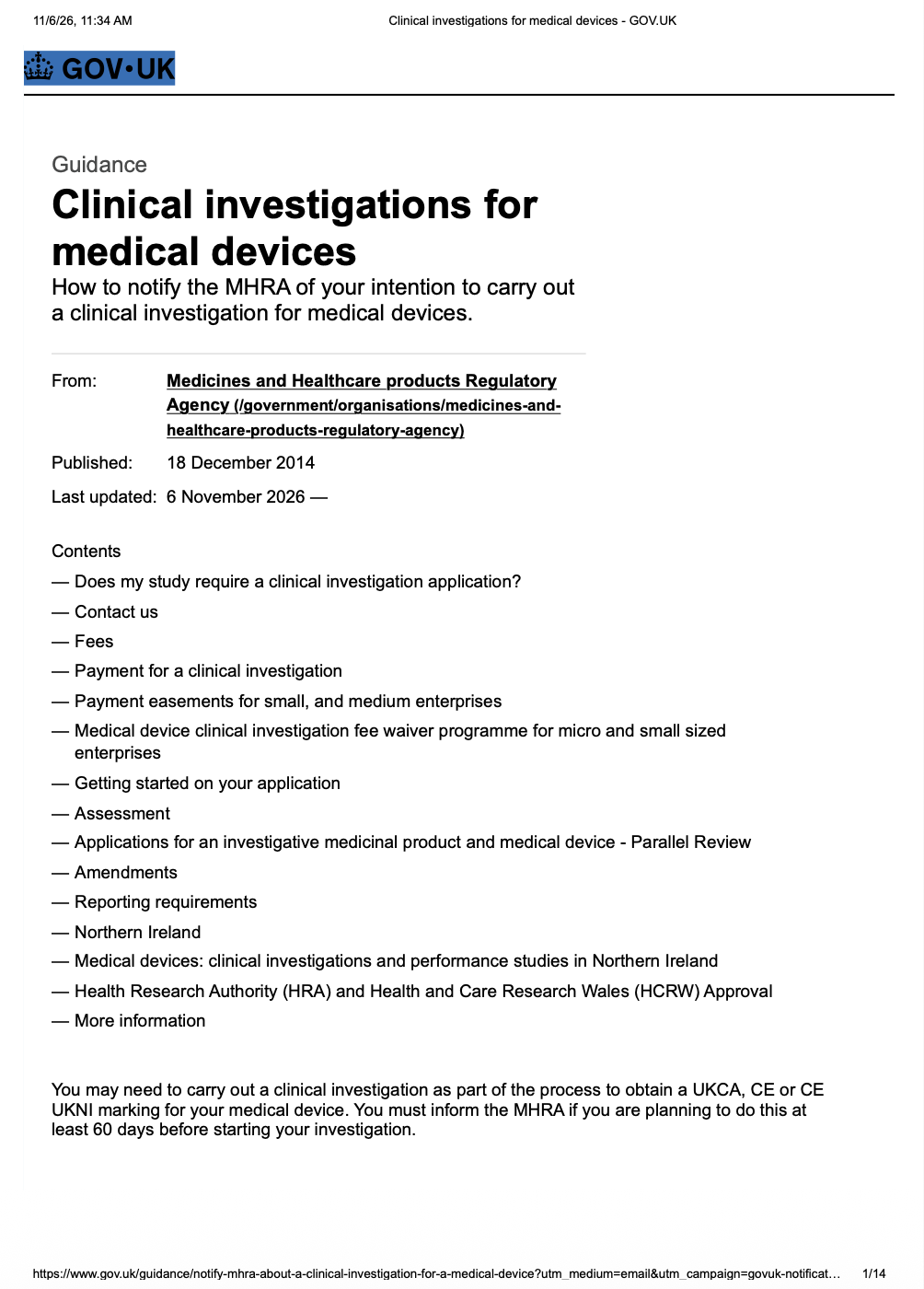
The UK Medicines and Healthcare products Regulatory Agency (MHRA) has updated its guidance on clinical investigations for medical devices, providing revised information on when notification is required, application procedures, assessment timelines, reporting obligations, amendments, fees and specific arrangements for Northern Ireland.
The guidance was last updated on 6 November 2026.
MHRA Notification May Be Required Before a Clinical Investigation
Medical device manufacturers may need to conduct a clinical investigation as part of the process of obtaining a UKCA, CE or CE UKNI marking.
Where notification is required, the MHRA must generally be informed at least 60 days before the investigation begins.
Updated Flow Charts for Great Britain
For studies in Great Britain, sponsors should use the MHRA flow chart and accompanying guidance to determine whether a clinical investigation application is required.
The MHRA notes that updated versions of these documents were published in August 2025 and should be reviewed when planning new applications.
A notification is generally not required where the medical device is already UKCA, CE or CE UKNI marked for the purpose being investigated.
Annex XVI Devices Cannot Be Accepted in Great Britain
The guidance confirms that applications under Annex XVI of Regulation (EU) 2017/745 for products without an intended medical purpose cannot be accepted in Great Britain.
Special Rules for In-House Devices
Healthcare establishments may not need to notify the MHRA where they have manufactured a medical device in-house for their own patients with no intention to place it on the market.
However, notification may become necessary where the organisation intends to provide the device to another organisation in order to generate data supporting the safety and performance of a commercial product.
Clinical Investigation Fees
The MHRA confirms that clinical investigation fees must accompany the notification under the Medical Devices Regulations 2002.
The guidance also explains that the MHRA will not issue a final regulatory decision until payment has been received.
Payment Easements for SMEs
Small and medium-sized enterprises may benefit from payment easements.
Where approved, the applicant pays:
50% of the fee following validation;
the remaining 50% within six months of the first invoice.
If the outstanding balance is not paid, an approval letter may be revoked and the investigation may have to stop.
Fee Waiver Programme Extended into 2026–2027
One of the most relevant updates is the continuation of the medical device clinical investigation fee waiver programmefor micro and small enterprises.
The MHRA states that the programme runs from 20 April 2026 until 5 April 2027, or until all waivers have been granted.
A total of 10 fee waivers are available.
Class III Devices Now Included
The waiver programme covers:
Class I devices;
Class IIa devices;
Class IIb devices;
Class III devices.
Active implantable devices remain excluded.
Successful applicants receive a complete waiver of the usual clinical investigation application fee.
Criteria for an Innovative Device
To qualify for the waiver, the applicant must demonstrate that the device meets the MHRA’s criteria for an innovative device.
The device must:
be new or represent a novel modification of an existing technology;
address a clinical need for which no UK-approved solution currently exists;
be scalable with the aim of benefiting patients, care providers or the health and social care system.
Applicants must also be based in the UK and already have micro or small enterprise status confirmed by the MHRA.
MHRA Review of Waiver Eligibility
Applicants seeking confirmation of innovative-device status should submit a cover letter containing:
a comprehensive device description;
an explanation of how the device meets the innovation criteria;
a brief summary of the planned clinical investigation.
The MHRA states that its Clinical Investigations team will review this information within 5 working days.
Applications Continue Through IRAS
Clinical investigation applications are submitted electronically through the Integrated Research Application System (IRAS).
The MHRA recommends that sponsors also review its dedicated guidance on:
compiling a submission;
clinical investigations in Great Britain;
clinical investigations in Northern Ireland;
investigator responsibilities;
software as a medical device;
electrically powered devices;
biological safety;
statistical considerations;
human factors and usability engineering.
Validation and 60-Day Assessment Period
Once an application has been submitted and validated, the MHRA will normally confirm within 5 working days whether the 60-day assessment period has started.
Day 1 begins on the day following acceptance of a valid application.
During assessment, MHRA experts review:
device safety;
device performance;
clinical investigation design.
The MHRA will issue an objection or no-objection decision by day 60.
Parallel Review for Combined Medicinal Product and Device Studies
The guidance also describes the Parallel Review pathway.
This applies to studies that are both:
a Clinical Trial of an Investigational Medicinal Product (CTIMP); and
a clinical investigation of a medical device.
The pathway is intended to bridge differences between the two legislative frameworks and support a more streamlined application process.
Amendments Require MHRA Notification
Once a no-objection letter has been issued, sponsors must notify the MHRA of proposed amendments before implementing them.
Changes may include:
modifications to the investigational device;
changes to the clinical investigation plan;
changes to study documentation;
changes to investigators or investigation sites;
ethics committee-requested changes.
Sponsors must wait for another no-objection letter before implementing the proposed change.
No Fee for Amendments
The guidance confirms that, under fees introduced in July 2025, there is currently no fee payable for clinical investigation amendments.
Serious Adverse Event Reporting
For studies involving Great Britain, all reportable events must be fully recorded and notified to the MHRA.
This includes:
all serious adverse events;
reportable events under MEDDEV 2.7/3;
relevant events occurring in third countries under the same clinical investigation plan.
SAE reporting should be submitted through the MHRA MORE portal.
Quarterly Summary Reports Are Required
In addition to individual SAE reporting, sponsors must submit Quarterly Summary Reports (QSRs) as a condition of MHRA approval.
These reports provide an update on the investigation’s overall safety profile.
For UK-only studies, the first QSR is generally expected one quarter after the first participant has been treated.
For global studies, the first QSR is expected one quarter after MHRA approval and should cover the safety profile across all study sites.
Study Deviations Must Be Reported
Sponsors must notify the MHRA of deviations affecting UK study sites as soon as they become aware of them.
The notification should include:
nature of the deviation;
timing;
location;
corrective and preventive actions.
The MHRA provides a dedicated protocol deviation tracker that should be maintained as a live document.
Early Termination and Temporary Halt
Sponsors must also notify the MHRA if a clinical investigation is terminated early or temporarily halted.
A final clinical investigation report must also be provided where required under the UK MDR 2002.
Separate Rules Continue to Apply in Northern Ireland
Northern Ireland remains aligned with the EU MDR and IVDR framework.
Clinical investigations involving sites in Northern Ireland must therefore comply with Regulation (EU) 2017/745requirements.
A single application can cover sites in both Northern Ireland and Great Britain where they form part of the same investigation.
Northern Ireland Assessment Timelines
For Northern Ireland applications, the MHRA will normally confirm validation within 10 calendar days.
Where issues are identified, applicants are given a 10-day period to respond.
Substantial modifications generally require additional MHRA authorisation before implementation.
Substantial Modifications in Northern Ireland
Examples include:
changes to the investigational device;
changes to study methodology;
changes to the risk-benefit assessment;
significant changes to study documentation;
new trial sites;
new principal investigators;
restart after a temporary halt;
extension of the study period.
SAE Reporting Under the EU MDR in Northern Ireland
For Northern Ireland-only studies, sponsors must follow the reporting requirements of EU MDR 2017/745.
This includes reporting:
serious adverse events with a causal or reasonably possible relationship;
relevant device deficiencies;
new findings relating to previously reported events.
Reports are submitted through the MORE portal using the MDCG 2020-10/2 SAE reporting table.
Notification of Early Termination in Northern Ireland
For Northern Ireland studies, temporary halts and early termination must be notified within 15 days, or within 24 hours when the decision is taken on safety grounds.
Post-Market Studies in Northern Ireland
Certain clinical investigations involving CE-marked devices used in Northern Ireland must also be notified where the study involves procedures that are:
additional to normal device use;
invasive;
or burdensome.
These notifications must be submitted at least 30 days before the study begins.
Sponsor Establishment Requirements
The MHRA has also clarified specific arrangements for investigations taking place in both Great Britain and Northern Ireland but not in an EU Member State.
In these circumstances, the usual requirement for the sponsor or legal representative to be established in Northern Ireland or the EU may be disapplied if certain conditions are met.
These conditions include having a sponsor or legal representative established in Great Britain and appointing a contact person in Northern Ireland.
Impact on Medical Device Manufacturers
For manufacturers and sponsors planning clinical investigations in the UK, the updated guidance reinforces the importance of:
determining early whether MHRA notification is required;
planning around the 60-day assessment period;
using IRAS for submission;
preparing for SAE and QSR reporting;
managing amendments carefully;
monitoring different requirements for Great Britain and Northern Ireland;
considering SME easements and fee waivers where eligible.
Opportunity for Small and Innovative Companies
The continuation of the fee waiver programme is particularly relevant for smaller UK medical device companies.
By extending eligibility to Class III devices, the MHRA is broadening the opportunity for small and micro enterprises developing higher-risk innovative technologies to reduce regulatory costs associated with clinical investigation applications.