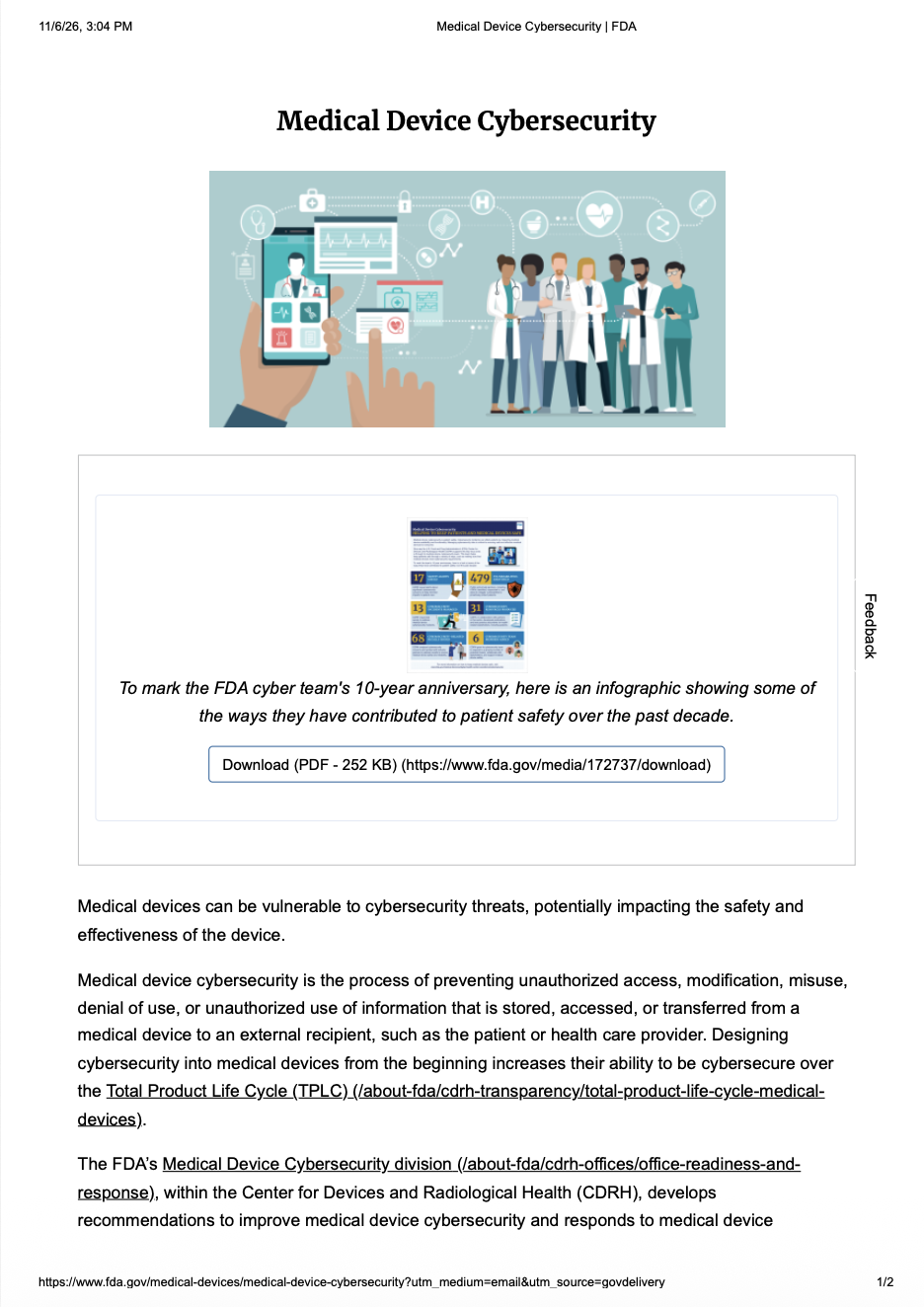
The U.S. Food and Drug Administration (FDA) is marking the 10-year anniversary of its medical device cybersecurity team, highlighting the role cybersecurity has played in supporting patient safety over the past decade.
The FDA has published an infographic showcasing some of the ways its cybersecurity team has contributed to patient protection and strengthened the cybersecurity of medical devices.
Cybersecurity Is a Patient Safety Issue
The FDA stresses that medical devices can be vulnerable to cybersecurity threats that may affect both their safety and effectiveness.
As medical devices become increasingly connected, software-driven and dependent on external networks, cybersecurity risks can directly affect device operation, availability and data integrity.
For regulators and manufacturers, cybersecurity is therefore no longer treated solely as an information technology issue but as an integral component of medical device safety.
What Medical Device Cybersecurity Means
The FDA defines medical device cybersecurity as the process of preventing:
unauthorized access;
modification;
misuse;
denial of use;
unauthorized use of information stored, accessed or transferred by a medical device.
This includes information exchanged between a medical device and external recipients such as patients or healthcare professionals.
Cybersecurity by Design
A central principle in the FDA’s approach is that cybersecurity should be incorporated into a medical device from the beginning of its development.
The agency states that designing cybersecurity into devices from the outset increases their ability to remain cybersecure throughout the Total Product Life Cycle (TPLC).
This means cybersecurity considerations should extend beyond premarket development and continue throughout:
design;
development;
manufacturing;
deployment;
maintenance;
post-market monitoring;
vulnerability management.
FDA Medical Device Cybersecurity Division
The FDA’s Medical Device Cybersecurity division, within the Center for Devices and Radiological Health (CDRH), is responsible for developing recommendations to improve medical device cybersecurity.
The team also responds to cybersecurity vulnerabilities and incidents affecting medical devices and works with both public and private stakeholders to advance cybersecurity practices.
A Decade of Cybersecurity Activity
The 10-year anniversary highlights how cybersecurity has evolved into a core regulatory area for connected medical devices.
Over the past decade, the FDA’s work has increasingly focused on:
cybersecurity-by-design;
vulnerability identification;
coordinated vulnerability response;
post-market monitoring;
stakeholder collaboration;
guidance for manufacturers;
resources for patients and users.
The anniversary infographic reflects this broader role in supporting patient safety.
Cybersecurity Across the Total Product Life Cycle
The FDA’s emphasis on the Total Product Life Cycle is particularly significant.
Cybersecurity risks can change long after a device has entered the market.
New vulnerabilities may emerge due to:
software updates;
third-party components;
network dependencies;
changing attack methods;
newly discovered weaknesses;
obsolescence of software or hardware.
Manufacturers therefore need processes capable of identifying and addressing cybersecurity risks throughout the device lifecycle.
Resources for Manufacturers
The FDA maintains dedicated cybersecurity resources for medical device manufacturers.
These resources are intended to support manufacturers in understanding regulatory expectations and implementing appropriate cybersecurity practices.
For regulatory and quality teams, they can provide important support when preparing submissions and maintaining cybersecurity documentation.
Resources for Patients and Users
The FDA also provides dedicated cybersecurity resources for patients and medical device users.
This reflects the importance of communicating cybersecurity risks beyond manufacturers and regulators.
Patients, healthcare professionals and healthcare institutions may all play a role in identifying and managing cybersecurity issues involving connected devices.
Cybersecurity Collaboration
The FDA highlights collaboration as another central element of its cybersecurity strategy.
The agency works with public and private organisations to advance medical device cybersecurity.
Such collaboration is particularly important because many cybersecurity risks involve interconnected ecosystems rather than a single device.
These ecosystems may include:
manufacturers;
healthcare institutions;
software vendors;
cloud providers;
cybersecurity researchers;
regulators;
patients.
Reporting Cybersecurity Vulnerabilities and Incidents
The FDA provides a dedicated point of contact for reporting medical device cybersecurity vulnerabilities or incidents.
The Medical Device Cybersecurity Division can also provide information regarding FDA cybersecurity policies and questions related to the cybersecurity section of the eSTAR template.
This supports more direct communication between manufacturers, security researchers and the regulator.
Device-Specific Cybersecurity Questions
For cybersecurity questions relating to a specific medical device, the FDA recommends using the Q-Submission programme.
This allows manufacturers to obtain regulatory feedback before or during development and may help clarify cybersecurity expectations before a formal submission.
Impact on Medical Device Manufacturers
For manufacturers, the FDA’s anniversary message reinforces several practical expectations.
Cybersecurity should be integrated into:
product design;
risk management;
software development;
verification and validation;
post-market surveillance;
vulnerability management;
regulatory submissions.
It should not be treated as a separate activity performed only at the end of product development.
Cybersecurity and Regulatory Submissions
The reference to the cybersecurity section of the eSTAR template highlights the increasing integration of cybersecurity into medical device regulatory submissions.
Manufacturers should therefore ensure that cybersecurity documentation is consistent with:
the device architecture;
identified threats;
risk controls;
software lifecycle activities;
post-market processes.
Cybersecurity as an Ongoing Responsibility
The FDA’s emphasis on the Total Product Life Cycle also reinforces that cybersecurity obligations continue after market launch.
Post-market responsibilities may include:
monitoring vulnerabilities;
assessing exploitability;
implementing patches and updates;
communicating with healthcare providers;
responding to incidents;
documenting corrective actions.
Implications for Regulatory and Quality Teams
Regulatory, quality and cybersecurity teams should work closely throughout product development and post-market activities.
For connected devices, effective cybersecurity governance may require coordination between:
regulatory affairs;
quality assurance;
software engineering;
risk management;
IT security;
post-market surveillance.
This cross-functional approach can help ensure that cybersecurity risks are addressed consistently across the product lifecycle.
Ten Years of Increasing Regulatory Focus
The FDA’s 10-year cybersecurity milestone reflects how significantly the regulatory landscape has evolved.
Medical device cybersecurity has moved from a specialist concern to a fundamental element of device safety and regulatory compliance.
As connected devices, software and AI-enabled technologies continue to expand, cybersecurity requirements are likely to remain a major focus for manufacturers and regulators.