MHRA Issues Updated Guidance on Submitting Clinical Investigation Proposals
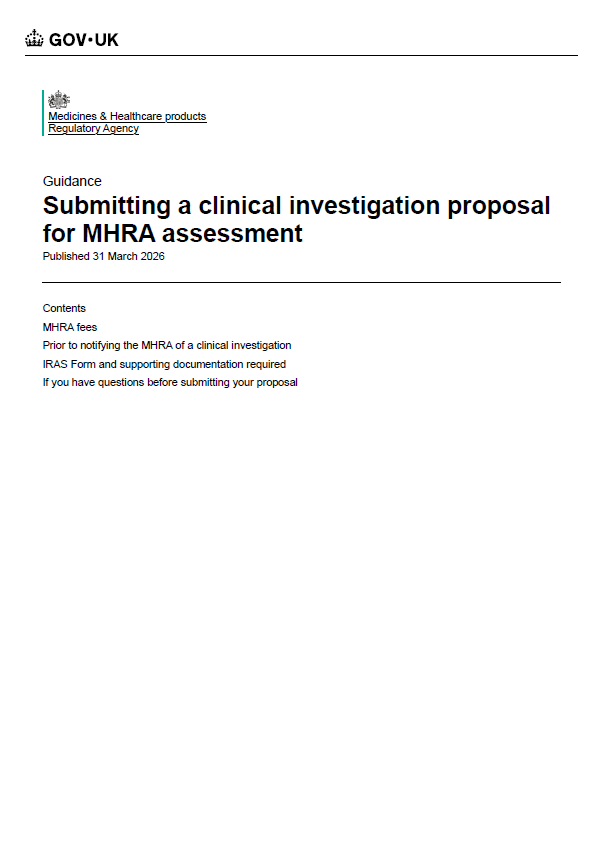
On 31 March 2026, the UK Medicines and Healthcare products Regulatory Agency (MHRA) published updated guidance detailing the requirements for submitting clinical investigation proposals for assessment.
The guidance applies to all clinical investigations conducted in the UK and provides clarification on regulatory pathways, submission processes, and required documentation.
Regulatory Framework Depends on Study Location
The guidance confirms that different regulatory frameworks apply depending on where the investigation is conducted:
Great Britain (England, Wales, Scotland):
Governed by the UK Medical Devices Regulations 2002 (UK MDR 2002)Northern Ireland:
Continues to follow EU MDR (2017/745) and IVDR (2017/746)Studies involving both Great Britain and Northern Ireland:
Must be submitted under EU MDR requirements, with a single MHRA application covering all sites
This distinction is explicitly outlined and remains a key consideration for manufacturers planning UK clinical investigations.
Submission via IRAS and Validation Timelines
All applications must be submitted through the Integrated Research Application System (IRAS).
The guidance specifies validation and assessment timelines:
Great Britain:
Validation within 5 working days
60-day assessment period starts after a valid application is confirmed
Northern Ireland (EU MDR pathway):
Validation confirmation within 10 calendar days
If issues are identified, a 10-day response period is provided before validation
The MHRA notes that the assessment period only begins once a valid application has been confirmed.
Emphasis on Complete and High-Quality Submissions
The MHRA highlights that a common reason for objection is the failure to provide all required data within statutory timelines.
Manufacturers are expected to ensure that:
The device has been manufactured and tested for safety and performance prior to submission
The submission includes sufficient evidence to demonstrate compliance with:
Essential Requirements (UK MDR), or
General Safety and Performance Requirements (EU MDR)
Detailed Documentation Requirements
The guidance provides a comprehensive list of required documents, including:
Clinical Investigation Plan (in line with ISO 14155:2020)
Investigator’s Brochure
Risk Analysis (aligned with ISO 14971:2019)
Device description and technical documentation
Bench and pre-clinical testing summaries
Clinical experience data (if available)
Instructions for Use and labelling
Checklist for Essential Requirements or GSPR
Additional documentation may be required depending on the device, including:
Software documentation
Biological safety assessments (ISO 10993 series)
Sterilisation validation reports
The guidance also specifies expectations for:
Study design and justification (including sample size)
Statistical methods and endpoints
Adverse event reporting procedures, referencing MEDDEV 2.7/3 and MDCG 2020-10/1
Key Considerations for Manufacturers
Based on the guidance, manufacturers should take into account:
Regulatory pathway selection:
The applicable framework (UK MDR vs EU MDR) depends on study locationSubmission readiness:
Applications must be complete and supported by appropriate technical and clinical evidenceDocumentation scope:
A broad set of technical, clinical, and risk management documents is requiredValidation dependency:
The assessment timeline will not start until the application is considered valid
MHRA Encourages Pre-Submission Interaction
The MHRA indicates that manufacturers may contact the agency with questions prior to submission and, where appropriate, request a pre-submission meeting.
Final Note
This guidance provides a detailed framework for preparing and submitting clinical investigation applications in the UK, with clear expectations on documentation, validation, and regulatory alignment.
Manufacturers planning clinical investigations should ensure that all required evidence and documentation are in place prior to submission to avoid delays during validation and assessment.
Read the full document below.