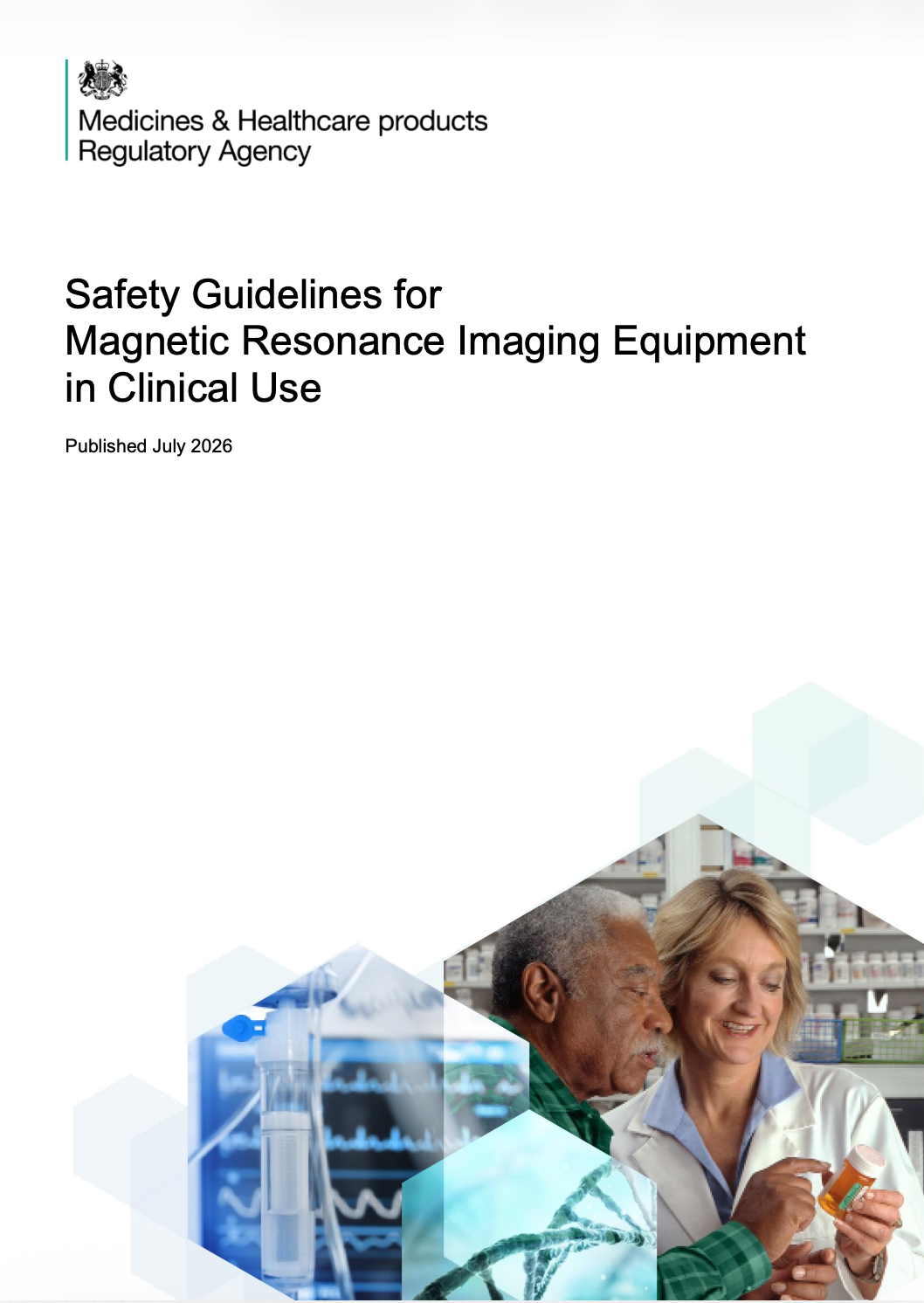
MHRA Issues 5th Edition Safety Guidelines for Magnetic Resonance Imaging Equipment in Clinical Use
The UK Medicines and Healthcare products Regulatory Agency (MHRA) has published the fifth edition of its flagship guidance, "Safety Guidelines for Magnetic Resonance Imaging Equipment in Clinical Use".
Replacing the previous 2014 edition, this comprehensive update reflects major technological advances, revised international standards—including ASTM F2503-26 and BS EN IEC 60601-2-33:2024—and updated exposure recommendations from the International Commission on Non-Ionizing Radiation Protection (ICNIRP).
The document serves as the UK benchmark for best practice across clinical, research, mobile, and specialist MRI facilities, outlining mandatory health and safety duties under the Health and Safety at Work etc. Act 1974 and the Control of Electromagnetic Fields at Work (CEMFAW) Regulations 2016.
Governance Framework and Defined Roles
A central pillar of the 5th edition is a clearly defined organizational governance structure to ensure accountability and safety oversight across MRI units:
MR Responsible Organisation & Employer: Holds legal responsibility for ensuring organizational arrangements, training, and equipment maintenance are in place.
MR Responsible Person: Delegated by executive management to handle day-to-day MR safety management within the facility.
MR Safety Expert (MRSE): A designated medical physics expert (typically a registered Clinical Scientist) who provides scientific advice on all technical and safety aspects of MRI.
MR Clinician: A registered medical practitioner (usually a radiologist or cardiologist) responsible for clinical oversight, referral appropriateness, and individual patient risk-benefit decisions.
MR Safety Committee: A multidisciplinary committee responsible for reviewing near misses, adverse events, and local safety policies.
Equipment Classification and Safety Marking
The guidance formally adopts the updated ASTM F2503-26 standard for marking medical devices and equipment intended for use in the MR environment:
MR SAFE: An item posing no known hazards in any MR environment (e.g., non-conductive, non-magnetic materials like silicone or cotton).
MR CONDITIONAL: An item demonstrated to be safe in the MR environment under specific conditions (e.g., field strength, spatial gradient, $B_1^+_{RMS}$, or SAR limits).
MR UNSAFE: An item posing unacceptable risks within the MR environment (e.g., ferromagnetic materials or unvalidated active implants).
MR UNLABELLED: Items lacking explicit safety labeling, which must be treated as MR UNSAFE until proven otherwise through formal risk assessment.
Primary Hazards and Exposure Management
The updated guidelines provide extensive technical detail on managing the primary physical hazards associated with MRI:
Static Magnetic Field ($B_0$): Addresses translational projectile forces and torque acting on ferromagnetic objects. The hazard area is defined by the 0.9 mT isocontour in line with updated IEC standards.
Radiofrequency (RF) Fields ($B_1$): Identifies RF burns as the most frequently reported MRI adverse incident. RF burns occur due to conductive contact, skin-to-skin loops, or coupling near the magnet bore wall.
Gradient Fields ($dB/dt$): Manages peripheral nerve stimulation (PNS) and acoustic noise through strict adherence to equipment operating limits.
Modes of Operation: Maintains the three-tier framework:
Normal Operating Mode: Default mode with minimal risk.
First Level Controlled Operating Mode: Higher exposure requiring deliberate operator action and clinical oversight.
Second Level Controlled Operating Mode: Research-level exposure requiring formal ethics committee approval.
Implanted Medical Devices and Off-Label Workflows
With the growing prevalence of cardiac pacemakers, neurostimulators, and orthopedic hardware, the guidance outlines structured pathways for managing patients with implants:
Generic Implant Safety Procedures (GISPs): Encourages facilities to establish standardized local protocols for low-risk, passive implants without requiring individual make/model verification.
Manufacturer Conditions: Scanning MR CONDITIONAL devices strictly within defined manufacturer parameters.
Off-Label and Unknown Device Risk Assessment: For unlabeled or non-compliant devices, a multidisciplinary team (MR Radiographer, MRSE, and MR Clinician) must perform a documented risk assessment weighing clinical necessity against potential harm before proceeding.
Considerations for Special Populations and Advanced Modalities
Pregnancy: Recommends scanning in Normal Operating Mode (preferably at 1.5 T in the first trimester), avoiding subject-specific RF shimming, minimizing acoustic/thermal exposure, and withholding Gadolinium-based contrast agents (GBCAs) unless clinically essential.
Ultra-High Field ($\ge 7\text{ T}$): Addresses heightened projectile risks, severe $B_1^+$ field inhomogeneity, and local SAR hotspot formation.
Point-of-Care (POC) & Low-Helium Systems: Outlines safety frameworks for ultra-low field bedside scanners and modern sealed, low-helium superconducting magnets that eliminate traditional quench pipe requirements.
Remote Scanning: Establishes governance, cybersecurity, and communication rules for command-center or off-site remote console operation, requiring a minimum of two staff members on-site per MR system.
Impact on Medical Device Manufacturers and Healthcare Providers
For medical device manufacturers, healthcare providers, and clinical engineering teams, the 5th edition of the MHRA guidelines requires immediate review of internal workflows:
Manufacturers and operators should focus on:
Updating medical device MR safety labeling and Instructions for Use (IFU) to reflect ASTM F2503-26 and IEC 60601-2-33:2024 parameters;
Ensuring clear documentation of $B_1^+_{RMS}$ and spatial field gradient limits for MR CONDITIONAL implants;
Reviewing local facility rules, emergency procedures, and annual audit checklists against MHRA governance recommendations;
Verification of MRSE appointment and training records across all operational clinical sites;
Participating in national incident learning taxonomies to monitor adverse events and near misses.
By adhering to the updated MHRA guidance, imaging facilities and device developers can maintain the highest standards of patient safety, reduce adverse incidents, and ensure full regulatory compliance across the UK healthcare landscape.