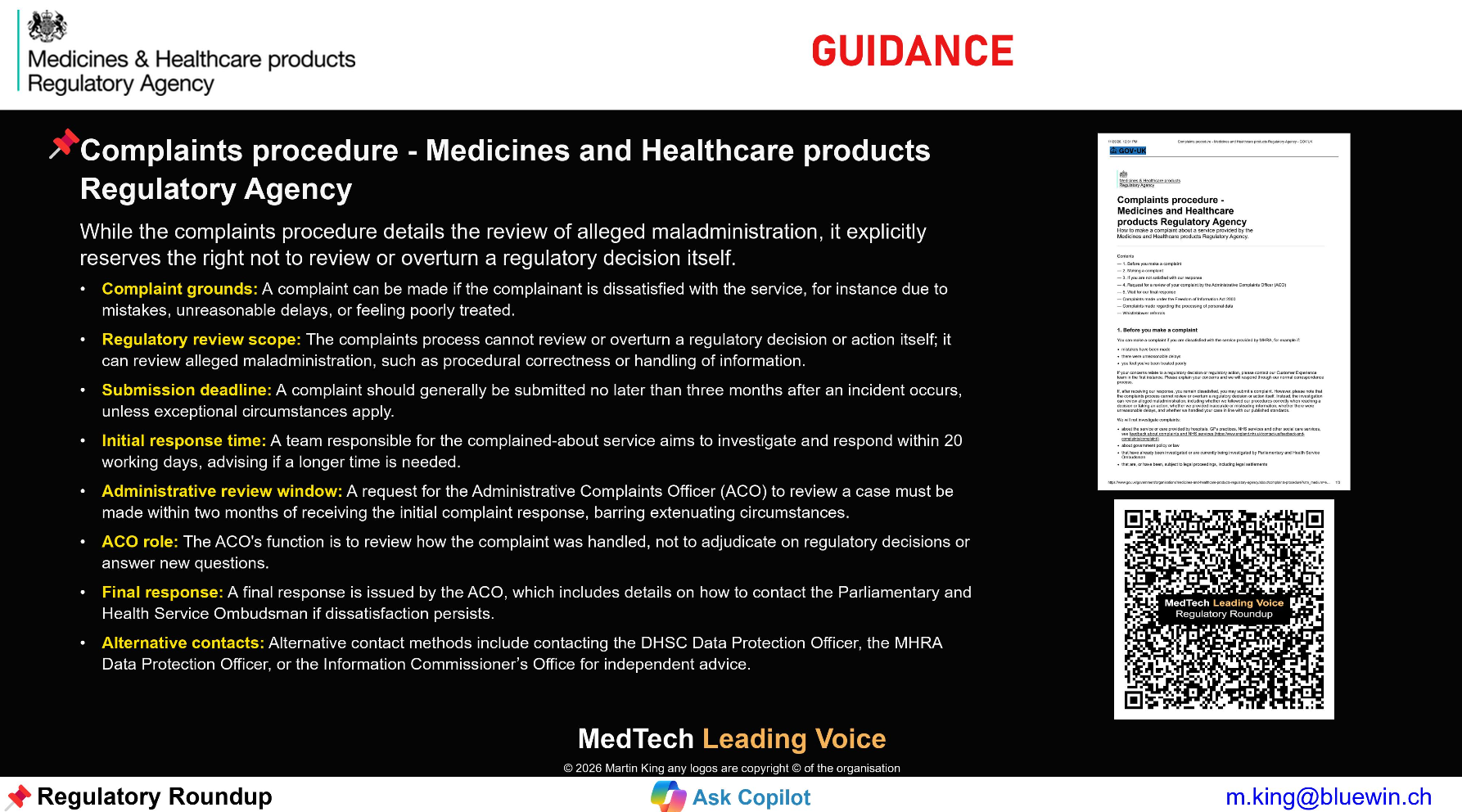
The UK Medicines and Healthcare products Regulatory Agency (MHRA) has outlined its complaints procedure, explaining how individuals and organisations can raise concerns about the way the Agency has provided a service or handled an administrative matter.
Importantly, the procedure distinguishes between complaints about maladministration or service quality and challenges to the substance of a regulatory decision.
What Can Be the Subject of a Complaint?
A complaint may be appropriate where a person is dissatisfied with the service received from the MHRA.
Examples highlighted in the guidance include:
mistakes;
unreasonable delays;
poor treatment;
concerns about how information was handled;
procedural or administrative shortcomings.
The focus of the complaints system is therefore on whether the Agency handled a matter appropriately rather than whether the complainant agrees with the underlying regulatory outcome.
Complaints Cannot Be Used to Overturn Regulatory Decisions
One of the most important distinctions in the procedure is that the complaints process cannot review or overturn a regulatory decision or action itself.
Instead, it can consider alleged maladministration associated with that decision, such as:
procedural errors;
inappropriate handling;
administrative failures;
deficiencies in communication.
This distinction is particularly important for companies interacting with the MHRA on regulatory submissions, licensing or medical-device matters.
Regulatory Appeals Remain Separate
Where an organisation disagrees with a regulatory decision, it must use the relevant regulatory review, appeal or challenge mechanism rather than the general complaints procedure.
The complaints route should therefore not be treated as an alternative regulatory appeal pathway.
Three-Month Submission Deadline
The MHRA indicates that complaints should generally be submitted within three months of the incident or event giving rise to the complaint.
Exceptions may be considered where there are exceptional circumstances.
For regulated organisations, this makes early identification and documentation of administrative concerns important.
Initial Response Target: 20 Working Days
Once a complaint has been submitted, a team responsible for the service complained about aims to:
investigate the matter;
prepare a response;
respond within 20 working days.
If the Agency expects the investigation to take longer, the complainant should be informed.
First Review Is Conducted by the Relevant Team
The initial complaint is normally considered by the part of the Agency responsible for the activity in question.
This gives the relevant team an opportunity to:
review what happened;
assess whether the service met expected standards;
explain the Agency’s position;
identify whether corrective action is appropriate.
Escalation to the Administrative Complaints Officer
If the complainant remains dissatisfied after receiving the initial response, they may request a review by the Administrative Complaints Officer (ACO).
According to the procedure, this request should generally be made within two months of receiving the initial complaint response, unless mitigating circumstances apply.
Role of the Administrative Complaints Officer
The ACO does not reconsider the regulatory merits of the original decision.
Instead, the ACO reviews how the complaint itself was handled.
This may include whether:
the process was fair;
relevant information was considered;
appropriate procedures were followed;
the response adequately addressed the complaint.
The ACO does not adjudicate new regulatory questions or substitute their own decision for the original regulatory assessment.
Final Response
Following the review, the ACO issues a final response.
Where the complainant remains dissatisfied, the final response should include information explaining how they may contact the Parliamentary and Health Service Ombudsman.
This provides a further route of external escalation.
Parliamentary and Health Service Ombudsman
The Parliamentary and Health Service Ombudsman can consider complaints about UK government departments and certain public bodies where maladministration or service failure may have occurred.
The MHRA procedure therefore provides a structured escalation pathway from:
initial complaint;
internal administrative review;
possible external Ombudsman consideration.
Alternative Routes for Data Protection Concerns
Where the issue concerns personal data or information rights, the complaints procedure also identifies alternative points of contact.
These may include:
the Department of Health and Social Care Data Protection Officer;
the MHRA Data Protection Officer;
the Information Commissioner’s Office.
This distinction is important because data-protection complaints may fall within different legal and procedural frameworks.
Importance for Regulated Companies
For pharmaceutical, medical-device and life-sciences companies, the MHRA complaints procedure may become relevant where concerns relate to:
administrative delays;
communication;
procedural handling;
incorrect administrative processing;
service standards.
However, the procedure should not be confused with a mechanism for challenging the scientific or regulatory substance of an MHRA decision.
Maintain Clear Records
Companies considering a complaint should maintain clear records of:
relevant correspondence;
dates;
submission history;
responses received;
actions taken;
individuals involved.
This can help demonstrate the basis for the complaint and whether relevant timelines were met.
Distinguish Service Concerns from Regulatory Disagreement
Before submitting a complaint, organisations should first determine whether the issue concerns:
how the MHRA handled the matter, or
the regulatory decision itself.
The former may fall within the complaints procedure.
The latter usually requires the appropriate regulatory or legal review mechanism.
Implications for Regulatory Affairs Teams
Regulatory affairs teams should ensure that internal escalation procedures distinguish between:
regulatory strategy;
formal appeals or reviews;
administrative complaints;
data-protection complaints.
Using the correct pathway can avoid delays and ensure that the issue reaches the appropriate MHRA function.
Practical Timeline
Based on the procedure, organisations should be aware of three important timing points:
within 3 months — complaint generally submitted after the incident;
within 20 working days — target for the initial complaint response;
within 2 months — request for ACO review following the initial response.
These timeframes should be incorporated into internal complaint and escalation tracking.
Regulatory Takeaway
The MHRA complaints procedure provides a structured mechanism for reviewing alleged maladministration or poor service, but it is not a route for overturning regulatory decisions.
For regulated organisations, the key is to identify the nature of the issue correctly and use the appropriate pathway.
The procedure also makes clear that complaints should be timely, documented and escalated through the correct channels where dissatisfaction remains.