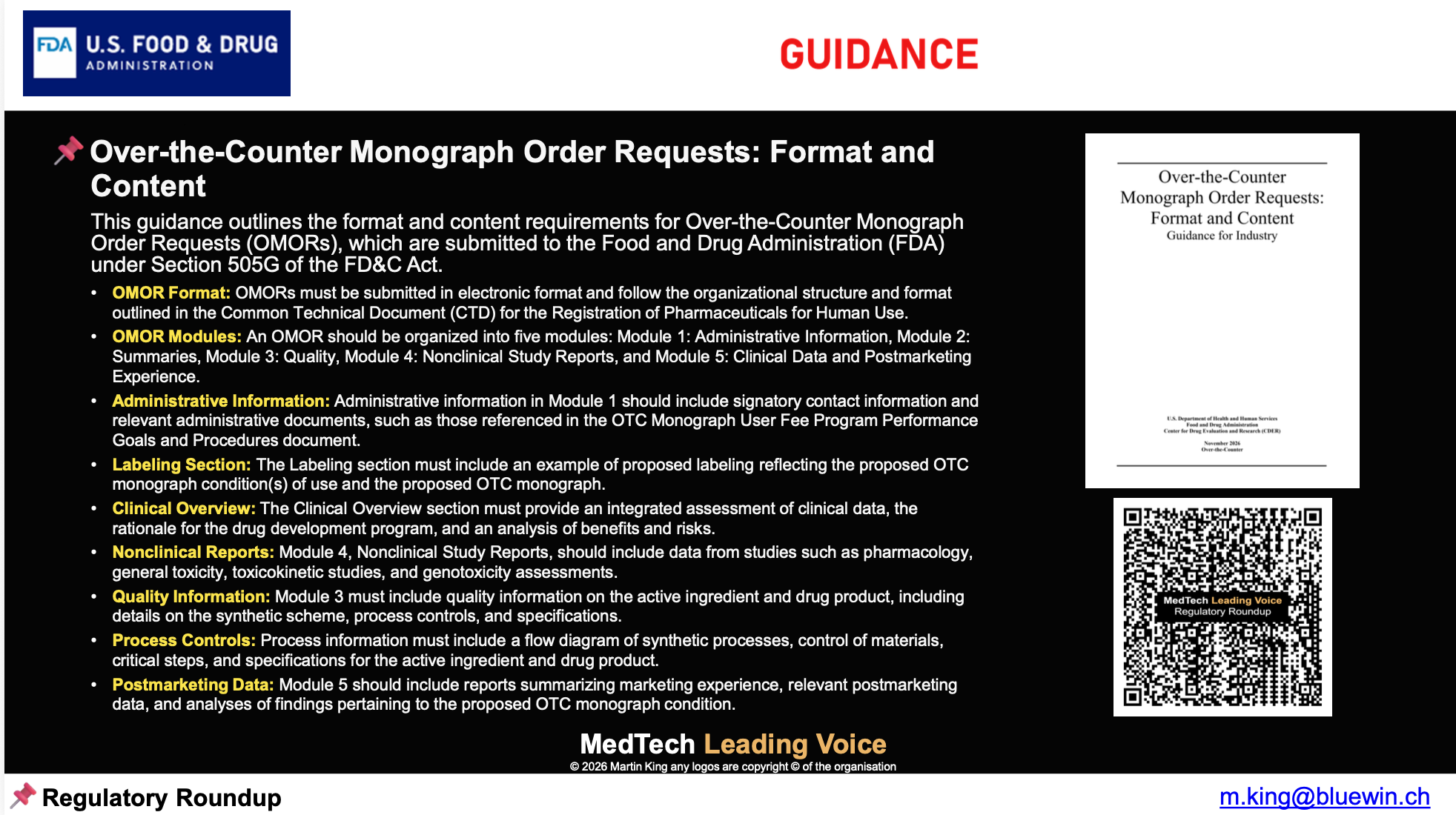
The U.S. Food and Drug Administration (FDA) has outlined the expected format and content of Over-the-Counter Monograph Order Requests (OMORs) submitted under Section 505G of the Federal Food, Drug, and Cosmetic Act.
The guidance provides a structured framework for preparing OMOR submissions and explains how administrative, quality, nonclinical, clinical, labeling and postmarketing information should be organised.
OMORs Must Follow the CTD Structure
FDA states that OMORs should be submitted in electronic format and organised according to the Common Technical Document (CTD) structure used for pharmaceuticals for human use.
This creates a standardised format that helps FDA review information consistently across submissions.
Five-Module Structure
An OMOR should be organised into five modules:
Module 1 — Administrative Information
Module 2 — Summaries
Module 3 — Quality
Module 4 — Nonclinical Study Reports
Module 5 — Clinical Data and Postmarketing Experience
This structure mirrors the familiar CTD framework used across pharmaceutical regulatory submissions.
Module 1 — Administrative Information
Module 1 should contain the administrative elements necessary to support the request.
According to the guidance summary, this includes:
signatory contact information;
relevant administrative documents;
documentation referenced in the OTC Monograph User Fee Program Performance Goals and Procedures.
Administrative completeness is therefore an important part of OMOR submission readiness.
Labeling Must Reflect the Proposed Monograph Condition
The labeling section should include an example of the proposed labeling reflecting:
the proposed OTC monograph condition or conditions of use;
the proposed OTC monograph itself.
This allows FDA to assess whether the proposed labeling appropriately reflects the requested monograph conditions.
Module 2 — Summaries
Module 2 is intended to provide high-level summaries and integrated analyses of the information contained in the detailed modules.
A particularly important component is the Clinical Overview.
The Clinical Overview should provide:
an integrated assessment of the clinical data;
the rationale for the drug development programme;
an analysis of benefits and risks.
This section is therefore central to explaining the regulatory and scientific rationale supporting the proposed monograph order.
Module 3 — Quality
Module 3 should contain comprehensive quality information relating to both:
the active ingredient;
the finished drug product.
FDA expects information covering areas such as:
synthetic scheme;
manufacturing process controls;
product specifications;
active ingredient specifications.
Manufacturing Process Information
The guidance places particular emphasis on process information.
This should include:
a flow diagram of synthetic processes;
control of materials;
identification of critical manufacturing steps;
specifications for the active ingredient;
specifications for the finished drug product.
This reinforces the need for OMOR applicants to provide a clear and controlled description of how the product is manufactured and maintained within specification.
Module 4 — Nonclinical Study Reports
Module 4 should include relevant nonclinical study reports.
Examples identified in the guidance include:
pharmacology studies;
general toxicity studies;
toxicokinetic studies;
genotoxicity assessments.
The exact nonclinical evidence required will depend on the proposed monograph condition and the available supporting data.
Module 5 — Clinical Data
Module 5 should contain the detailed clinical evidence supporting the OMOR.
This section supports the integrated clinical assessment presented in Module 2 and provides the underlying evidence needed to evaluate the proposed OTC monograph condition.
Clinical data should be presented in a way that allows FDA to assess both:
expected benefits;
potential risks.
Postmarketing Experience Is Also Required
Module 5 should also contain information on postmarketing experience.
The guidance summary identifies:
marketing experience reports;
relevant postmarketing data;
analyses of findings related to the proposed OTC monograph condition.
This is particularly important where an ingredient or product has an established history of use.
Why Postmarketing Data Matter
Postmarketing evidence can provide information that may not be fully captured in controlled clinical studies.
Relevant information may include:
safety signals;
patterns of use;
adverse events;
real-world exposure;
benefit-risk considerations.
For established OTC products, this evidence may be especially important when supporting changes or additions to a monograph.
Integrated Benefit-Risk Assessment
The requirement for an integrated clinical overview highlights FDA’s expectation that OMORs should not simply provide disconnected datasets.
Applicants should explain:
how clinical evidence supports the requested condition;
why the proposed use is appropriate for OTC status;
how benefits compare with identified risks;
how available data support safe consumer use.
Importance of Submission Organisation
The CTD-based structure provides a clear regulatory framework for OMOR preparation.
For applicants, this means submission planning should involve coordinated input from:
Regulatory Affairs;
CMC and Quality;
Toxicology;
Clinical Development;
Pharmacovigilance;
Labeling;
Medical Affairs.
A well-organised submission can help streamline review and reduce the risk of information gaps.
Implications for Quality Teams
Quality and CMC teams should ensure that Module 3 provides sufficient detail on:
active ingredient controls;
drug product controls;
synthetic pathways;
material controls;
critical process steps;
specifications.
Process documentation should be internally consistent with the overall manufacturing strategy.
Implications for Clinical and Safety Teams
Clinical teams should ensure that supporting evidence is clearly summarised and contextualised.
Pharmacovigilance teams should also ensure that relevant postmarketing data are appropriately incorporated into the submission.
The benefit-risk discussion should reflect both clinical trial data and real-world experience where available.
Implications for Labeling Teams
Because proposed labeling forms part of the OMOR package, labeling teams should be involved early.
The proposed labeling should accurately reflect:
the intended monograph condition;
conditions of use;
relevant warnings or limitations;
consumer-facing instructions.
Regulatory Takeaway
The FDA guidance reinforces that OMOR submissions require a structured, multidisciplinary and evidence-based package.
The key elements include:
electronic submission;
CTD organisation;
administrative documentation;
proposed labeling;
quality information;
nonclinical evidence;
clinical evidence;
postmarketing experience;
integrated benefit-risk analysis.
For applicants, preparing a complete OMOR requires coordination across regulatory, quality, clinical, nonclinical and safety functions.