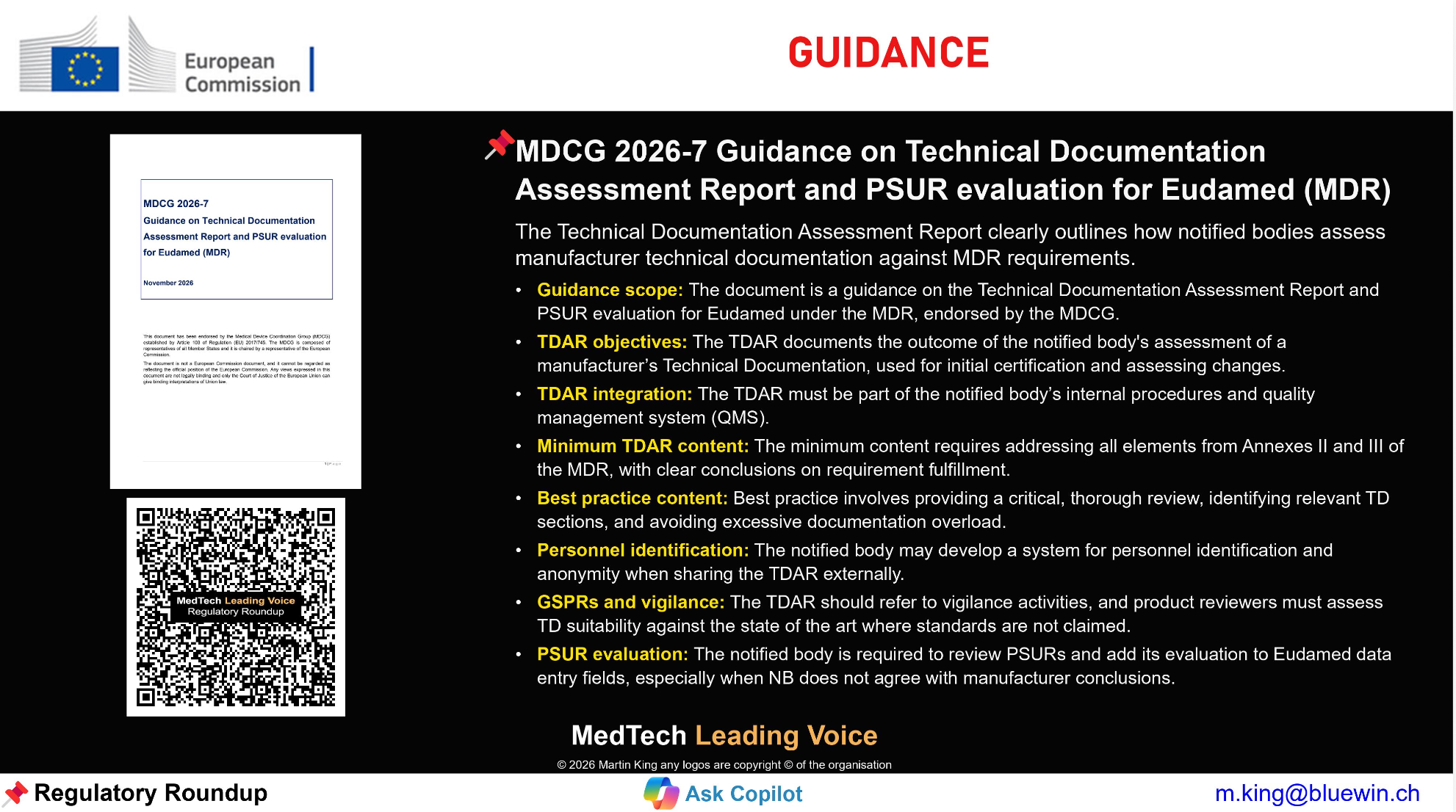
The Medical Device Coordination Group (MDCG) has published MDCG 2026-7, providing guidance on the Technical Documentation Assessment Report (TDAR) and the evaluation of Periodic Safety Update Reports (PSURs) for EUDAMED under the Medical Device Regulation (MDR).
The guidance focuses on how notified bodies should document their assessment of manufacturers’ technical documentation and how PSUR evaluations should be reflected in EUDAMED.
Technical Documentation Assessment Report
The TDAR is intended to document the outcome of the notified body’s assessment of a manufacturer’s Technical Documentation.
It may be used:
during initial certification;
when assessing changes;
as part of ongoing conformity-assessment activities.
The report therefore becomes an important record of how the notified body has assessed compliance with the MDR.
TDAR Must Be Integrated Into the Notified Body QMS
A key expectation is that the TDAR process should be integrated into the notified body’s own internal procedures and quality management system.
This means the report should not be treated as an isolated administrative document.
Instead, it should form part of the notified body’s controlled conformity-assessment processes.
Minimum TDAR Content
According to the summary, the TDAR should address the relevant elements of Annexes II and III of the MDR.
The minimum content should provide:
coverage of applicable technical documentation requirements;
clear conclusions;
confirmation of whether requirements have been met;
traceability to the documentation reviewed.
Avoiding Excessive Documentation
The guidance also promotes a proportionate approach to documentation.
Best practice is described as providing a:
critical review;
sufficiently thorough assessment;
clear identification of relevant technical-documentation sections;
concise record that avoids unnecessary duplication or excessive documentation.
This is an important point for notified bodies because completeness should not mean unnecessary volume.
Clear Assessment Conclusions
The TDAR should make it possible to understand:
what was reviewed;
which MDR requirements were assessed;
whether the documentation was considered sufficient;
whether additional action was required.
Clear conclusions are therefore essential for auditability and traceability.
Personnel Identification and Anonymity
The guidance also addresses the identification of personnel involved in technical-documentation assessment.
A notified body may establish systems that allow personnel to be identified internally while preserving anonymity where TDAR information is shared externally.
This approach can support both accountability and appropriate protection of individual reviewer information.
GSPR Assessment
The guidance highlights the importance of assessing the General Safety and Performance Requirements (GSPRs).
Product reviewers should verify whether the manufacturer has adequately demonstrated conformity with applicable GSPRs through:
standards;
common specifications;
alternative technical solutions;
other appropriate evidence.
State of the Art Where Standards Are Not Claimed
Where manufacturers do not claim compliance with recognised standards, the notified body should assess whether the technical documentation remains suitable against the state of the art.
This may require greater scrutiny of:
alternative methods;
scientific justification;
clinical evidence;
risk-management rationale.
The expectation reinforces that simply not using a standard does not remove the requirement to demonstrate compliance.
Vigilance Information Should Be Considered
The TDAR should also refer to relevant vigilance activities.
This helps ensure that assessment of technical documentation is not disconnected from the device’s real-world safety profile.
Relevant information may include:
serious incidents;
field safety corrective actions;
emerging safety signals;
trends;
post-market findings.
Link Between Technical Documentation and Post-Market Evidence
The guidance reinforces an important MDR principle: technical documentation is a living body of evidence.
It should continue to reflect information generated throughout the device lifecycle, including:
post-market surveillance;
vigilance;
PSURs;
clinical follow-up;
risk-management updates.
For notified bodies, this means technical-documentation assessment should remain connected to the manufacturer’s evolving post-market evidence.
PSUR Evaluation
MDCG 2026-7 also addresses how notified bodies should evaluate Periodic Safety Update Reports.
PSURs provide a structured summary of post-market surveillance information for applicable devices and may include:
conclusions from benefit-risk analysis;
main findings from post-market clinical follow-up;
sales or usage information;
population exposure;
corrective and preventive measures.
The notified body must review the PSUR and document its evaluation appropriately.
PSUR Evaluation in EUDAMED
The notified body is expected to add its PSUR evaluation to the relevant EUDAMED data-entry fields.
This supports greater consistency and traceability of PSUR oversight across the European regulatory system.
Disagreement With Manufacturer Conclusions
The guidance places particular importance on situations where the notified body does not agree with the manufacturer’s conclusions.
Where disagreement exists, this should be clearly reflected in the notified body’s evaluation in EUDAMED.
This is important because a notified body may identify concerns relating to:
benefit-risk conclusions;
safety signals;
adequacy of corrective actions;
interpretation of post-market data.
Implications for Manufacturers
Although the document primarily addresses notified bodies, it also has important implications for manufacturers.
Manufacturers should ensure their technical documentation is:
complete;
well structured;
traceable to MDR requirements;
consistent with post-market evidence;
updated as new information becomes available.
They should also anticipate that notified bodies will expect clear connections between:
technical documentation;
GSPR evidence;
risk management;
vigilance;
PSUR conclusions.
Implications for PSUR Preparation
Manufacturers should also strengthen the quality of PSURs.
Important areas include:
clear benefit-risk conclusions;
transparent safety-signal discussion;
accurate post-market data;
justification of corrective actions;
consistency with PMS and vigilance records.
A weak or poorly justified PSUR may lead to disagreement from the notified body and additional scrutiny.
Implications for Notified Bodies
For notified bodies, MDCG 2026-7 reinforces the need for consistency in how technical-documentation assessments are recorded.
Internal procedures should clearly define:
TDAR structure;
minimum content;
reviewer responsibilities;
GSPR evaluation;
handling of vigilance information;
PSUR evaluation;
EUDAMED data entry.
Importance of QMS Integration
The requirement to integrate TDAR activities into the notified body’s QMS is particularly important.
This supports:
consistency between reviewers;
controlled templates;
documented responsibilities;
traceability;
quality assurance;
readiness for oversight by designating authorities.
Regulatory Takeaway
MDCG 2026-7 reinforces the need for clear, critical and traceable technical-documentation assessment under the MDR.
The guidance highlights:
minimum TDAR content;
QMS integration;
clear conclusions;
GSPR assessment;
consideration of state of the art;
links to vigilance information;
PSUR evaluation;
accurate recording of notified body conclusions in EUDAMED.
For manufacturers, this means technical documentation and PSURs should be prepared with the expectation of a structured and documented notified-body assessment.