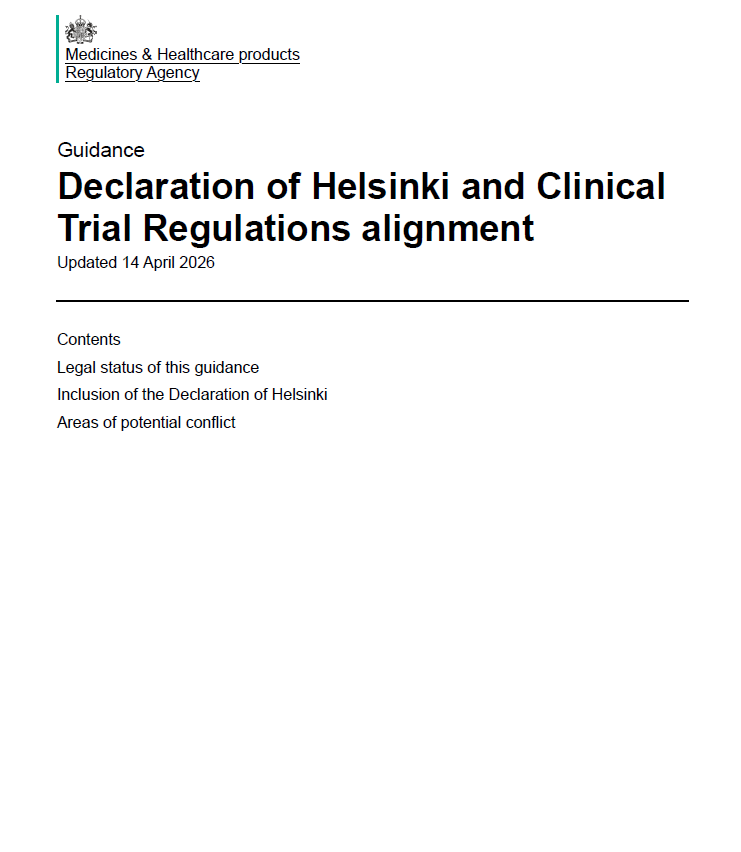
The UK Medicines and Healthcare products Regulatory Agency (MHRA) has published new guidance clarifying how the Declaration of Helsinki aligns with the amended Clinical Trials Regulations, which will come into force on 28 April 2026.
This update provides important clarification for sponsors and investigators—particularly manufacturers involved in clinical investigations—on how to balance international ethical principles with UK legal requirements.
Legal status and expectations
The guidance accompanies the amended Medicines for Human Use (Clinical Trials) Regulations 2004 (as amended in 2025). It confirms that:
Sponsors and investigators must consider all relevant guidance when conducting clinical trials
Compliance with this guidance is necessary to maintain regulatory compliance
Responsibility extends to any delegated parties involved in trial activities
For manufacturers: This reinforces the need for robust oversight of CROs and partners, ensuring alignment with both regulatory and ethical frameworks.
Declaration of Helsinki formally embedded
A key change is the explicit integration of the Declaration of Helsinki principles into UK law:
Compliance is required with the principles, not a specific version
These principles apply to all clinical trials, unless they conflict with UK regulations
Impact: Manufacturers must ensure that clinical strategies, protocols, and documentation reflect ethical principles such as patient protection, scientific validity, and transparency—even where not explicitly detailed in UK legislation.
Key areas of potential conflict
The MHRA highlights specific areas where tensions may arise between the Declaration and UK law:
1. Use of placebo
The Declaration restricts placebo use to limited scenarios
UK regulations allow more flexibility if:
The study is scientifically and ethically justified
Risk-benefit is acceptable
Participants are informed during consent
For manufacturers: Trial design decisions—especially comparator choice—must be carefully justified and documented, balancing ethical expectations with regulatory flexibility.
2. Urgent safety measures
UK regulations allow immediate implementation without prior ethics approval in urgent cases
This may conflict with the Declaration’s requirement for prior ethics review
Impact: Manufacturers need clear SOPs for safety events, ensuring:
Rapid action when required
Proper notification to authorities and ethics committees
Full documentation of decisions
3. Post-trial access
The Declaration expects continued access to beneficial treatments post-trial
UK law does not mandate this
Consideration: While not legally required, manufacturers may need to address this in ethical justifications, trial planning, and stakeholder expectations.
MHRA’s position: Law takes priority
The MHRA clarifies that:
Sponsors should aim to comply with both frameworks
Where conflicts arise, UK law must take precedence
Any deviation from the Declaration should be clearly justified and documented
What this means for manufacturers
This guidance does not introduce entirely new obligations, but it raises the bar on transparency and justification. Manufacturers should:
Review clinical trial protocols for alignment with Helsinki principles
Strengthen documentation and rationale for design decisions
Ensure internal processes address ethical-regulatory conflicts
Maintain clear oversight of delegated activities
Read the full document below.