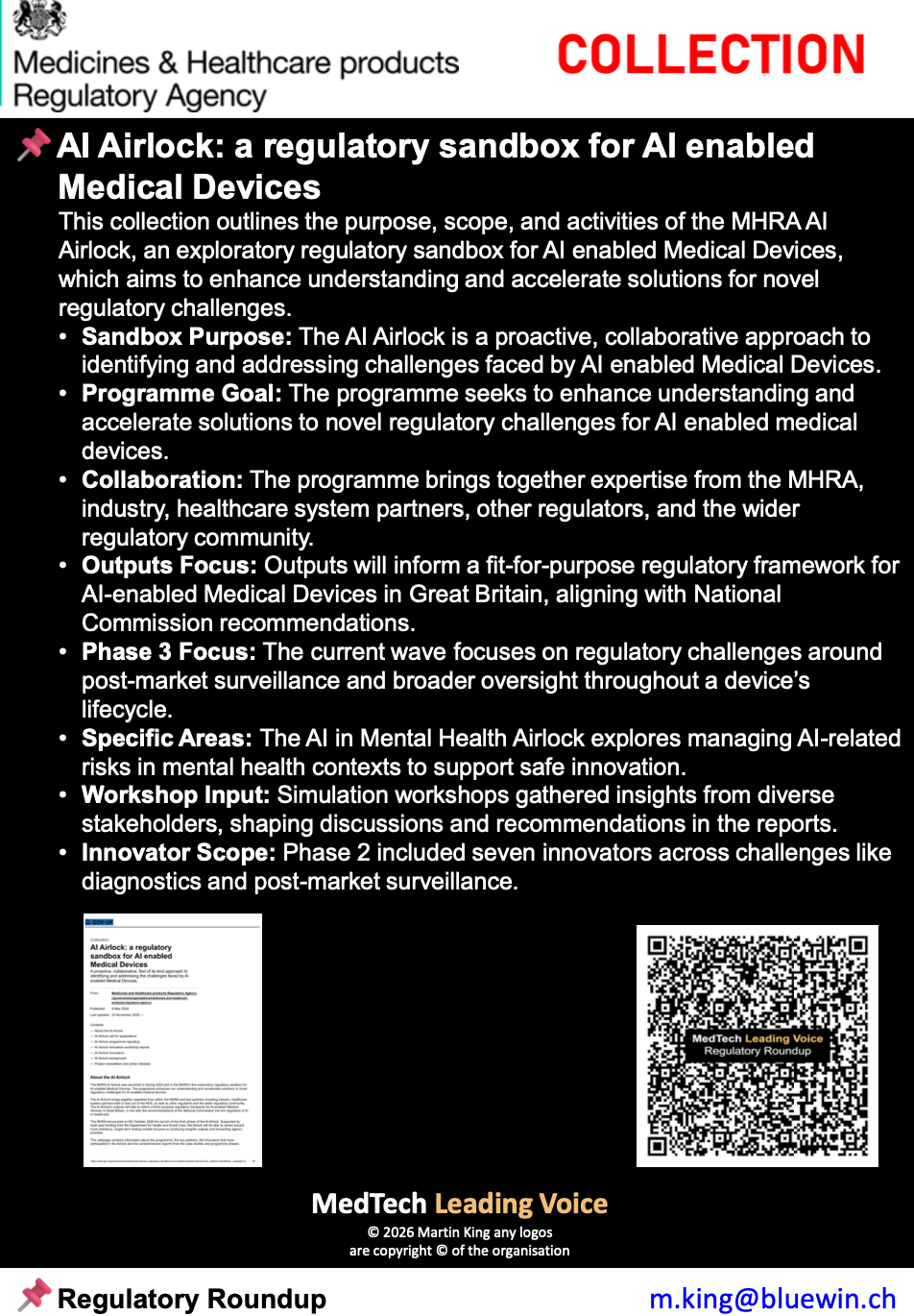
The UK Medicines and Healthcare products Regulatory Agency (MHRA) is continuing its AI Airlock programme, an exploratory regulatory sandbox designed to address emerging regulatory challenges associated with AI-enabled medical devices.
The initiative aims to improve regulatory understanding and accelerate practical solutions for novel issues arising from the use of artificial intelligence in medical technologies.
A Regulatory Sandbox for AI-Enabled Medical Devices
The AI Airlock is designed as a proactive and collaborative regulatory approach.
Rather than addressing regulatory challenges only after products reach the market, the sandbox brings stakeholders together to explore difficult questions earlier and develop potential regulatory solutions.
This approach is particularly relevant for AI-enabled devices, where software performance, data, algorithm behaviour and post-market changes can create regulatory challenges that do not always fit traditional device oversight models.
Collaboration Across the Regulatory Ecosystem
The programme brings together expertise from:
MHRA;
industry;
healthcare-system partners;
other regulators;
the wider regulatory community.
This multidisciplinary structure allows regulatory questions to be considered from technical, clinical, operational and policy perspectives.
Supporting a Fit-for-Purpose Regulatory Framework
A key objective of the programme is to generate outputs that can contribute to a fit-for-purpose regulatory framework for AI-enabled medical devices in Great Britain.
The work is also intended to align with relevant recommendations from the National Commission.
For manufacturers, this makes the AI Airlock more than an innovation-support initiative: its outputs may help shape future regulatory expectations for AI medical technologies.
Phase 3 Focuses on Post-Market Surveillance
The current phase of the programme places particular emphasis on post-market surveillance.
According to the summary, Phase 3 explores regulatory challenges involving:
post-market surveillance;
broader oversight throughout the device lifecycle.
This reflects a central challenge for AI-enabled devices: performance may continue to evolve after market entry, making lifecycle monitoring especially important.
Why Lifecycle Oversight Matters for AI
Traditional medical-device regulation often evaluates a relatively stable product configuration at a defined point in time.
AI-enabled medical devices may introduce additional considerations, such as:
changes in algorithm performance;
shifts in input data;
performance drift;
updates to software functionality;
changes in intended user populations;
emerging safety signals.
The AI Airlock’s lifecycle focus therefore reflects the need for regulatory approaches capable of addressing change over time.
AI in Mental Health Is a Specific Area of Focus
The programme also includes an AI in Mental Health Airlock.
This work explores how AI-related risks can be managed in mental-health settings while still enabling safe innovation.
Mental health can present particularly sensitive regulatory considerations because AI outputs may influence clinical decision-making, patient engagement and potentially vulnerable populations.
Simulation Workshops Support Regulatory Learning
The AI Airlock has also used simulation workshops to gather input from a diverse range of stakeholders.
These workshops have contributed insights that inform discussions and recommendations in programme reports.
This approach allows practical scenarios to be explored before they become widespread regulatory issues.
Phase 2 Included Seven Innovators
The previous phase included seven innovators working across regulatory challenges such as:
diagnostics;
post-market surveillance.
The participation of real-world innovators enables the sandbox to test regulatory concepts against practical product-development scenarios.
Implications for AI Medical Device Manufacturers
For manufacturers developing AI-enabled medical devices, the AI Airlock highlights several areas likely to remain important:
post-market performance monitoring;
lifecycle risk management;
regulatory change management;
safety signal detection;
documentation of AI-related risks;
engagement with regulators;
clinical and technical oversight.
Companies developing adaptive or frequently updated AI systems may need particularly robust processes to demonstrate ongoing safety and performance.
Post-Market Surveillance Is Becoming More Central
The Phase 3 focus also reinforces the growing regulatory importance of post-market evidence for AI-enabled technologies.
Manufacturers may need to consider how they monitor:
real-world performance;
adverse events;
unexpected behaviour;
performance across patient subgroups;
software changes;
data-related risks.
For AI systems, post-market surveillance may become an integral part of the overall regulatory strategy rather than simply a compliance activity after market entry.
Implications for Regulatory Affairs Teams
Regulatory teams should monitor developments from the AI Airlock closely.
Potential areas of impact include:
technical documentation;
post-market surveillance plans;
risk-management processes;
software change control;
clinical evidence;
regulatory submissions;
lifecycle governance.
The outputs of the sandbox may help shape future expectations for how AI-enabled medical devices are regulated in Great Britain.
Implications for Digital Health and Software Teams
The initiative is also relevant for teams working in:
Software as a Medical Device;
clinical decision-support software;
AI diagnostics;
digital therapeutics;
AI-enabled monitoring tools;
mental-health technologies.
These products may face regulatory questions that differ from those associated with traditional hardware-based medical devices.
Regulatory Sandboxes as a Policy Tool
The AI Airlock demonstrates how regulatory sandboxes can be used to explore emerging technologies in a controlled environment.
Rather than immediately applying fixed regulatory interpretations, regulators and innovators can examine:
novel risks;
regulatory gaps;
practical implementation issues;
potential oversight mechanisms.
This can help regulators develop more proportionate and workable frameworks.
Safe Innovation Remains the Central Objective
The programme is ultimately focused on balancing two objectives:
enabling innovation;
maintaining appropriate patient and public protection.
The AI in Mental Health work illustrates this balance particularly clearly by examining how AI-related risks can be managed while supporting safe development.
Regulatory Takeaway
The MHRA AI Airlock is becoming an important part of the UK’s evolving approach to AI-enabled medical devices.
Its current emphasis on post-market surveillance and lifecycle oversight suggests that future regulation of AI devices will likely place significant weight on how performance and risk are managed after initial market access.
For manufacturers, this reinforces the need to design regulatory, quality and post-market processes that can support continuous oversight of AI-enabled technologies throughout their lifecycle.