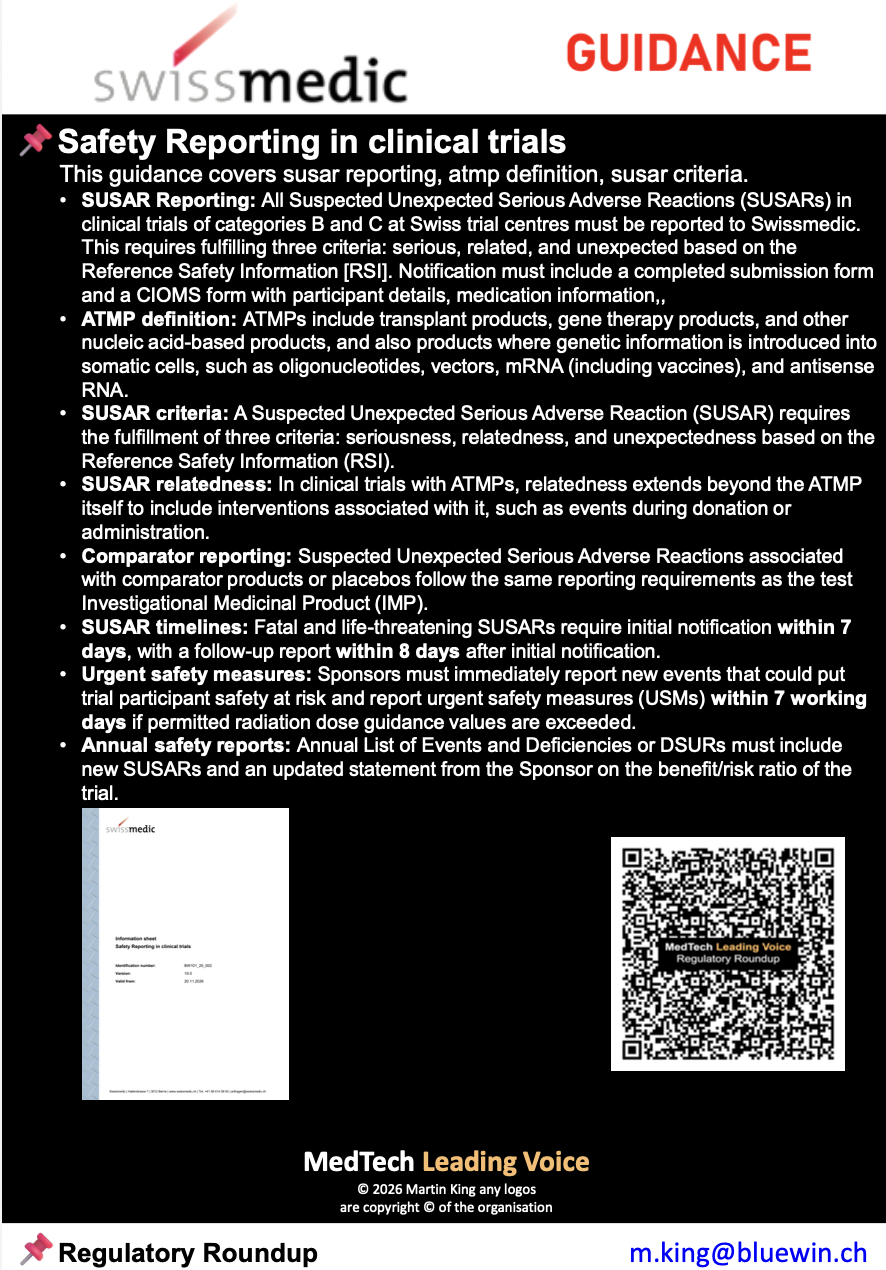
Swissmedic has outlined key requirements for safety reporting in clinical trials, with particular attention to Suspected Unexpected Serious Adverse Reactions (SUSARs), Advanced Therapy Medicinal Products (ATMPs), urgent safety measures and annual safety reporting.
The guidance applies important safety-reporting principles to clinical trials conducted at Swiss trial centres, particularly for category B and C clinical trials.
SUSAR Reporting for Category B and C Trials
According to the guidance summary, all SUSARs occurring in category B and C clinical trials at Swiss trial centresmust be reported to Swissmedic.
For an adverse reaction to qualify as a SUSAR, three criteria must be fulfilled:
seriousness;
relatedness;
unexpectedness.
Unexpectedness is assessed against the applicable Reference Safety Information (RSI).
Required Documentation
SUSAR notification should include the required submission documentation.
The summary identifies:
a completed submission form;
a CIOMS form;
participant information;
relevant medicinal product information.
This reinforces the need for sponsors to maintain complete and timely safety-reporting processes.
Swissmedic Clarifies the ATMP Definition
The guidance also addresses the definition of Advanced Therapy Medicinal Products (ATMPs).
The summary identifies ATMPs as including:
transplant products;
gene therapy products;
other nucleic acid-based products;
products in which genetic information is introduced into somatic cells;
oligonucleotides;
vectors;
mRNA products, including vaccines;
antisense RNA products.
This broad scope is particularly relevant to sponsors working with increasingly complex gene- and nucleic-acid-based technologies.
Relatedness Can Extend Beyond the ATMP Itself
For clinical trials involving ATMPs, the assessment of relatedness may extend beyond the investigational product itself.
Swissmedic’s approach includes adverse events associated with interventions linked to the ATMP, such as events arising during:
donation;
administration.
This means sponsors may need to consider the broader treatment pathway when determining whether an event is related to the investigational intervention.
Comparator Products and Placebos
The safety-reporting requirements are not limited to the investigational product.
According to the guidance summary, SUSARs associated with:
comparator products;
placebos
are subject to the same reporting requirements as SUSARs associated with the test Investigational Medicinal Product.
Sponsors should therefore ensure that safety surveillance systems capture events across all treatment arms.
Seven-Day Timeline for Fatal or Life-Threatening SUSARs
Swissmedic highlights expedited reporting requirements for the most serious cases.
Fatal and life-threatening SUSARs require an initial notification within 7 days.
A follow-up report must then be submitted within 8 days after the initial notification.
These timelines make rapid case assessment and escalation essential.
Sponsors Need Rapid Internal Escalation Processes
To meet these reporting timelines, sponsors should ensure that safety information moves quickly between:
investigators;
clinical operations;
pharmacovigilance;
medical monitoring;
regulatory affairs.
Delays in identifying whether a case is serious, related and unexpected could compromise timely regulatory reporting.
Urgent Safety Measures
The guidance also addresses urgent safety measures (USMs).
Sponsors must immediately report new events that could place trial participant safety at risk.
The summary further notes a 7-working-day reporting timeframe for urgent safety measures in situations involving exceeded permitted radiation-dose guidance values.
Safety Reporting Goes Beyond Individual SUSARs
The Swissmedic framework therefore covers both:
individual expedited adverse reaction reports;
broader safety developments requiring immediate action.
This distinction is important because a safety issue may require intervention even where it does not arise from a single reportable SUSAR.
Annual Safety Reporting
Sponsors also have periodic safety-reporting obligations.
The summary states that annual safety reports, including an Annual List of Events and Deficiencies or a Development Safety Update Report (DSUR), should contain:
new SUSARs;
an updated sponsor assessment of the trial’s benefit-risk balance.
The annual report therefore serves as a broader reassessment of accumulated safety information.
Benefit-Risk Must Remain Current
The requirement for an updated sponsor statement on the trial’s benefit-risk ratio reinforces the dynamic nature of clinical trial safety oversight.
Sponsors should continually assess whether new evidence changes:
known risks;
expected benefits;
participant protections;
monitoring requirements;
trial continuation decisions.
Importance of the Reference Safety Information
The Reference Safety Information plays a central role in deciding whether an adverse reaction is unexpected.
Sponsors should therefore ensure that the RSI:
is current;
reflects known safety information;
is controlled through appropriate document-management processes;
is consistently used during case assessment.
Poorly maintained RSI can create inconsistencies in SUSAR classification and reporting.
Implications for ATMP Developers
ATMP sponsors may face additional complexity because safety signals can arise not only from the medicinal product itself but also from associated procedures.
Relevant considerations may include:
product administration;
cell or tissue donation;
vector-related risks;
genetic or nucleic-acid-related effects;
procedure-related complications.
The wider interpretation of relatedness should therefore be integrated into pharmacovigilance procedures for ATMP programmes.
Implications for Pharmacovigilance Teams
Pharmacovigilance teams should confirm that their processes appropriately address:
SUSAR classification;
RSI assessment;
7-day reporting;
follow-up reporting;
comparator and placebo cases;
ATMP-associated interventions;
urgent safety measures;
annual safety reports;
ongoing benefit-risk assessment.
Implications for Clinical Operations
Clinical operations teams also play a critical role.
Sites need clear procedures for rapidly communicating serious adverse events to sponsors so that regulatory timelines can be met.
Training should therefore ensure that investigators understand:
what needs to be reported;
how quickly it must be escalated;
which documentation is required.
Regulatory Takeaway
The key message is that clinical trial safety reporting in Switzerland requires timely, structured and comprehensive oversight.
Sponsors must assess whether events meet the three SUSAR criteria of:
seriousness + relatedness + unexpectedness
while also accounting for ATMP-specific considerations, comparator products, urgent safety measures and periodic benefit-risk review.