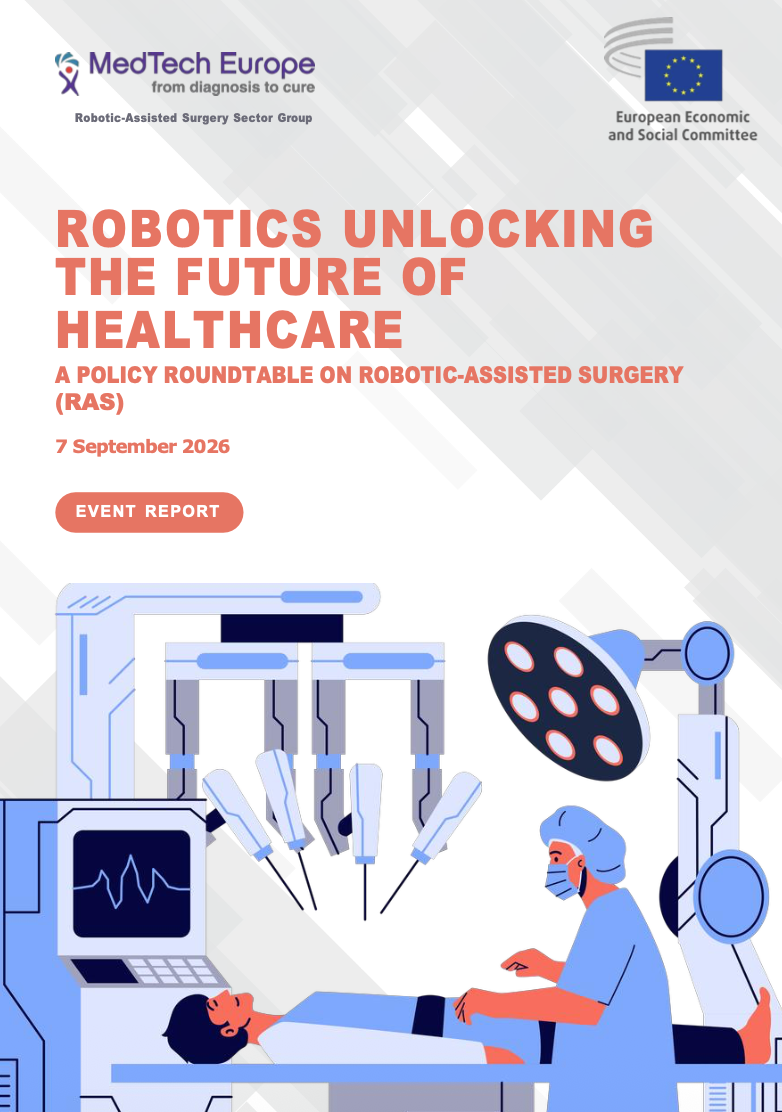
MedTech Europe Calls for Coordinated Adoption of Robotic-Assisted Surgery in Europe
1Participants therefore supported a more adaptive evidence model combining:
clinical trials;
registries;
real-world data;
continuous outcome monitoring.
The objective is not to reduce evidentiary standards, but to make evidence generation more responsive to the lifecycle of rapidly evolving technologies. 1791029301442
Real-World Data and Registries
The report places particular emphasis on registries and real-world evidence.
These sources can help assess what happens when robotic technologies move beyond specialist centres and into routine practice.
Relevant outcomes may include:
complications;
conversion to open surgery;
length of stay;
readmissions;
revisions;
return to work;
operating-room productivity;
workforce ergonomics;
patient-reported outcomes. 1791029301442
The report argues that healthcare systems should focus more strongly on outcomes rather than activity alone.
Data Generated by Robotic Systems
Robotic platforms themselves may contribute to evidence generation by producing structured data during routine clinical use.
The report highlights the potential to combine procedure-level data with:
patient-reported outcomes;
wearable-derived data;
clinical registry information. 1791029301442
Realising this potential will require appropriate data governance, interoperability and trusted data environments.
European Health Data Space
The European Health Data Space (EHDS) is presented as an important enabler for future evidence generation.
According to the report, the EHDS could support secure secondary use of health data for research and evidence generation by enabling access to larger and more representative datasets across Member States. 1791029301442
The report also links data policy to broader European regulatory and industrial priorities.
Medical Device Regulation and Regulatory Predictability
The roundtable also discussed the Medical Devices Regulation (MDR).
The report identifies the revision of the MDR as an opportunity to improve regulatory predictability and reduce unnecessary burden while maintaining patient safety.
Areas highlighted include:
clearer requirements;
simplification of duplicative procedures;
more reliable conformity-assessment timelines. 1791029301442
Cybersecurity and Human Oversight
Cybersecurity was identified as a key issue for surgical robotics.
The report stresses that governance frameworks must address control of robotic systems while ensuring that human judgment and professional responsibility remain central. 1791029301442
This is especially relevant as robotics becomes increasingly connected to software, digital infrastructure and AI-enabled functionality.
Training as a Core Requirement
Training emerged as one of the strongest themes in the report.
Participants supported standardised, proficiency-based progression instead of relying only on informal apprenticeship.
Under this model, surgeons move through measurable competency stages and demonstrate proficiency before advancing to more complex procedures. 1791029301442
Training should also continue beyond initial certification through procedure-specific education, proctoring and reassessment.
Multidisciplinary Training
The report stresses that training cannot be limited to surgeons.
Robotic-assisted surgery affects:
nurses;
anaesthetists;
sterilisation teams;
schedulers;
hospital managers;
other operating-room staff.
Safe and effective implementation therefore requires preparation of the entire multidisciplinary team. 1791029301442
Training and the Path to Adoption
The report further argues that adoption depends on:
professional competence;
multidisciplinary preparedness;
clinical leadership;
institutional capacity;
ongoing learning.
Successful implementation should therefore be understood as a continuous organisational process rather than a one-time technology deployment. 1791029301442
Best-Practice Examples: Denmark, Belgium and England
The report includes examples from Denmark, Belgium and England to illustrate different approaches to robotic-assisted surgery.
Despite differences in healthcare financing and organisation, all three examples showed that buying a robotic platform is only the starting point.
The key determinants of value were:
data;
reimbursement;
capacity planning;
multidisciplinary training;
clinical leadership. 1791029301442
Denmark: Registry-Based Expansion
The Danish example highlighted the use of nationwide registry data to support robotic-assisted hernia surgery.
The report notes evidence of:
fewer complications;
shorter hospital stays;
increased same-day discharge;
lower procedural costs associated with avoiding complications and readmissions. 1791029301442
It also showed that platform ownership does not necessarily translate into access if operating-room time and organisational capacity are insufficient.
Belgium: Reimbursement and Capacity
The Belgian example emphasised robotic surgery as a structured institutional process.
The report notes that restricted reimbursement may limit procedure volume and leave available robotic capacity underused, particularly where hospitals cannot absorb additional costs. 1791029301442
England: Clinical Leadership
The English example focused strongly on clinical leadership.
Successful adoption depends on clinicians defining the purpose of the technology, selecting appropriate patients and integrating robotics into existing care pathways.
Without a utilisation strategy or pathway redesign, robotic platforms risk becoming expensive and underused capacity. 1791029301442
Key Takeaways and Next Steps
The concluding page of the report summarises nine major priorities for Europe:
assess value across the entire care pathway;
build capacity alongside technology;
strengthen clinical leadership;
fund outcomes rather than activity alone;
make proficiency-based training the standard;
combine complementary forms of evidence;
embed data collection into routine care;
improve European coordination;
pursue consistency without imposing uniformity. 1791029301442
Impact on Surgical Robotics and Medical Device Stakeholders
For manufacturers of robotic surgical systems, hospitals, healthcare providers, policymakers and regulatory teams, the report highlights that successful adoption depends on more than device performance alone.
Stakeholders should pay particular attention to:
reimbursement strategy;
lifecycle evidence generation;
real-world evidence;
clinical registries;
proficiency-based training;
multidisciplinary team readiness;
cybersecurity;
health data interoperability;
EHDS opportunities;
MDR developments;
clinical leadership;
capacity planning;
outcome-based procurement and funding.
The broader message is that robotic-assisted surgery should be treated as a health-system transformation, requiring alignment between technology, evidence, funding, data, workforce and organisational design.