MHRA Updates Safety Guidelines for MRI Equipment in Clinical Use
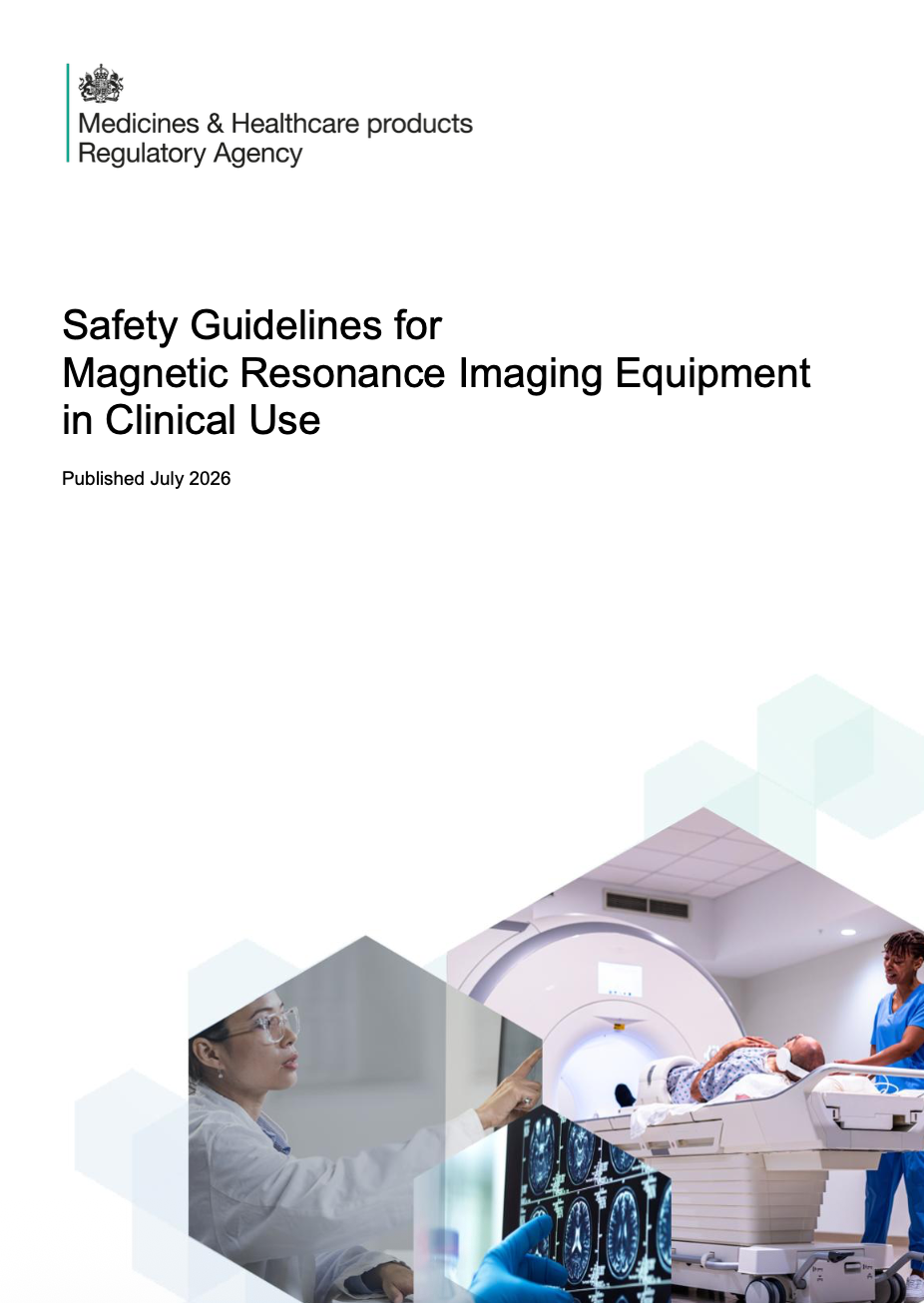
The Medicines and Healthcare products Regulatory Agency (MHRA) has published the fifth edition of its “Safety Guidelines for Magnetic Resonance Imaging Equipment in Clinical Use.”
The document represents best practice for the safe use and management of MRI equipment in UK clinical settings and is also relevant to certain academic, laboratory and veterinary MR environments. 1790832724062
The fifth edition was first published in July 2026. The revision history shows subsequent updates in August 2026 and September 2026, with the latest version, V5.0.3, including updated diagrams and other corrections. 1790832724062
A Comprehensive Rewrite of the MRI Safety Guidance
The fifth edition represents a full review and update of the previous guidance.
It was rewritten with input from multiple professional organisations, including:
British Institute of Physics and Engineering in Medicine;
Royal College of Radiologists;
Society of Radiographers;
British Institute of Radiology;
British Association of Magnetic Resonance Radiographers;
Royal College of Anaesthetists.
International MR safety experts also contributed to the revision. 1790832724062
Scope of the Guidelines
The guidance covers the full spectrum of MRI safety management, including:
MRI hazards;
patient and occupational exposure;
governance;
controlled access;
emergency procedures;
patient preparation;
implanted medical devices;
anaesthesia and contrast agents;
incident reporting;
equipment procurement and lifecycle;
cryogens and quench systems;
training;
exposure limits;
equipment labelling. 1790832724062
The document is intended to bring together legislation, technical standards and professional guidance into a single UK-focused safety reference. 1790832724062
MRI Hazards
MHRA structures the principal MRI hazards around the three electromagnetic fields generated by an MR system:
the static magnetic field;
time-varying magnetic field gradients;
radiofrequency magnetic fields. 1790832724062
Each can create distinct risks for patients, staff, medical devices and equipment.
Projectile Risk from the Static Magnetic Field
The static magnetic field is permanently present in superconducting and permanent-magnet MR systems.
Ferromagnetic objects can experience strong attractive forces and become projectiles when brought close to the magnet. 1790832724062
The updated guidance highlights reported fatalities and serious injuries involving MR-unsafe objects entering the MR environment, reinforcing the importance of strict control over people and equipment. 1790832724062
MR SAFE, MR CONDITIONAL and MR UNSAFE
The guidance adopts the latest MR safety terminology from ASTM F2503-26.
Items may be classified as:
MR SAFE — presenting no known hazards in the MR environment;
MR CONDITIONAL — demonstrated to be safe under defined conditions;
MR UNSAFE — posing unacceptable risk in the MR environment. 1790832724062
MHRA also uses the term MR UNLABELLED for items without one of these safety classifications. 1790832724062
RF Burns Remain a Major Safety Concern
Radiofrequency fields can deposit energy in body tissues and cause thermal injury.
The guidance states that RF burns are the most frequently reported MRI-related adverse incident in the UK. 1790832724062
Potential mechanisms include:
contact with metallic or conductive materials;
conductive loops formed by touching limbs;
coupling with the bore wall or conductive surfaces.
The guidance also notes that patients may not immediately perceive RF-induced burns, meaning significant injury can occur before discomfort is reported. 1790832724062
Acoustic Noise
MRI gradient switching can generate very high acoustic noise levels.
MHRA notes that noise inside the magnet bore may exceed 100 dB and can approach levels comparable with a nearby aircraft take-off. 1790832724062
Hearing protection should be:
available whenever noise may exceed 80 dB(A);
worn when procedures exceed 85 dB(A). 1790832724062
Implanted Medical Devices
One of the most important areas of the guidance concerns interaction between MRI equipment and implanted or external medical devices.
Possible effects include:
device reset;
incorrect measurements;
reprogramming;
battery drain;
permanent damage;
movement or torque;
heating;
unintended stimulation. 1790832724062
Examples include pacemakers, implantable defibrillators, neurostimulation systems, infusion pumps, ventilators and monitoring equipment. 1790832724062
Heating Around Implants
The guidance provides detailed discussion of implant heating caused by gradient and RF fields.
Conductive components such as leads, wires, stents, plates and coils may concentrate RF-related heating at tissue interfaces.
MHRA notes that local heating can occur even where system-reported SAR or B1+RMS values remain within nominal limits because local electromagnetic field conditions can dominate. 1790832724062
MRI During Pregnancy
The fifth edition contains detailed recommendations for both pregnant patients and staff.
For pregnant patients, MHRA recommends:
using Normal Mode whenever possible;
preferring 1.5 T in the first trimester where both 1.5 T and 3 T are available;
avoiding RF shimming unless specifically justified;
using reduced-noise techniques where possible;
avoiding gadolinium-based contrast unless clinically essential. 1790832724062
For pregnant staff, normal duties may generally continue, but MHRA recommends avoiding remaining in the MR examination room while scanning is in progress because of concerns about foetal acoustic noise exposure. 1790832724062
Exposure Management
The guidance adopts three modes of MRI operation:
Normal Mode;
First Level Controlled Operating Mode;
Second Level Controlled Operating Mode. 1790832724062
These modes progressively permit higher exposure levels while requiring increasing levels of justification, monitoring and control.
For example, the guidance identifies whole-body SAR limits of:
2 W/kg in Normal Mode;
4 W/kg in First Level Controlled Operating Mode. 1790832724062
MR Equipment Output Conditioning
The guidance also addresses MR Equipment Output Conditioning (MROC).
MROC allows operators to configure MR system output limits to help comply with the conditions specified in MR CONDITIONAL implant labelling.
IEC requires MROC functionality on new superconducting cylindrical 1.5 T and 3 T systems intended for patients with MR CONDITIONAL implants. 1790832724062
Governance Responsibilities
The updated guidance places strong emphasis on organisational governance.
The employer and the MR RESPONSIBLE ORGANISATION retain overall responsibility for safe operation of MRI equipment, including:
staff training;
competency;
safety procedures;
equipment installation;
equipment use;
access control. 1790832724062
MHRA recommends delegating day-to-day management of MR safety to an MR RESPONSIBLE PERSON. 1790832724062
MR Safety Expert
MRI units should appoint an MR SAFETY EXPERT to provide scientific advice on all aspects of MR safety.
The expert should have appropriate training, knowledge and experience, and MHRA recommends certification through a scheme that assesses both knowledge and practical experience. 1790832724062
MR Safety Committee
MHRA recommends that each MRI unit report to an MR SAFETY COMMITTEE.
Membership should include key safety roles such as:
MR RESPONSIBLE PERSON;
MR SAFETY EXPERT;
MR SAFETY MEDICAL ADVISER;
relevant management representatives. 1790832724062
The committee should support local safety governance and review near misses and adverse events. 1790832724062
Local Rules and Annual Safety Audits
Each MRI unit should maintain written Local Rules governing safety, work instructions and emergency procedures.
These should be regularly reviewed and updated following significant changes to equipment or working practices. 1790832724062
Risk assessments should be performed at least annually, and safety audits should consider areas such as:
signage;
training records;
equipment labelling;
quench pipes;
oxygen monitoring;
controlled access;
manufacturer requirements. 1790832724062
Controlled Access Areas
The guidelines define two important controlled zones:
MR CONTROLLED ACCESS AREA;
MR ENVIRONMENT.
Access to the controlled area should be restricted, with unrestricted access limited to MR AUTHORISED PERSONS. Other individuals must be screened and supervised. 1790832724062
The diagram on page 33 illustrates these zones together with the 0.5 mT contour, 0.9 mT B0 Hazard Area and Faraday-shielded volume, providing a visual reference for MRI suite access control. 1790832724062
Equipment Entering the MR Environment
MHRA states that equipment taken into the MR environment should normally be labelled MR SAFE or MR CONDITIONAL, with all specified conditions met.
Where equipment does not meet these requirements, sites should have specific local procedures addressing risks such as projectile effects and malfunction. 1790832724062
MRI units should also maintain an inventory of equipment used in the MR environment, including its safety classification and applicable conditions. 1790832724062
Equipment Lifecycle and Quality Assurance
The guidance extends beyond clinical scanning to the entire equipment lifecycle.
It covers:
procurement;
unit design;
installation;
commissioning;
maintenance;
equipment failure;
upgrade;
replacement;
decommissioning. 1790832724062
Each site should maintain a documented quality assurance programme covering image quality, acceptance criteria, responsibilities and escalation of out-of-tolerance results.
Incident and Near-Miss Reporting
MRI-related equipment incidents and near misses should be reported through local systems and, where applicable, to:
the manufacturer;
MHRA or the relevant devolved authority.
The guidance also recommends investigation and review through the MR Safety Committee.
Incidents that caused, or had the potential to cause, harm may additionally require reporting through the MHRA Yellow Card scheme.
Training
Training is a major component of the fifth edition.
Dedicated sections cover training frameworks for:
MRI unit staff;
radiographers;
clinical scientists;
radiologists;
referring clinicians. 1790832724062
The guidance emphasises that MR safety training should be repeated periodically where appropriate and aligned with the individual's responsibilities. 1790832724062
Impact on Healthcare Providers and Medical Device Stakeholders
For hospitals, diagnostic imaging providers, MRI manufacturers and manufacturers of implantable or MR CONDITIONAL medical devices, the updated guidance reinforces several practical priorities:
accurate MR safety labelling;
clear MR CONDITIONAL operating limits;
implant compatibility information;
controlled-access procedures;
robust patient screening;
RF burn prevention;
hearing protection;
pregnancy protocols;
governance and defined safety roles;
annual risk assessments;
safety audits;
equipment QA and lifecycle control;
incident and near-miss reporting;
ongoing staff training.
For medical device manufacturers, clear and complete MR safety information is particularly important because healthcare providers rely on manufacturer-defined conditions to determine whether devices can safely enter or operate within the MR environment.
Latest Revision
The fifth edition was first issued as V5.0.1 in July 2026 following a full review and update.
The revision history then records:
V5.0.2 — August 2026: new cover image, UKAS update and corrections;
V5.0.3 — September 2026: updated diagrams and other corrections.