FDA List Highlights Authorized Companion Diagnostic Devices and Group Labeling
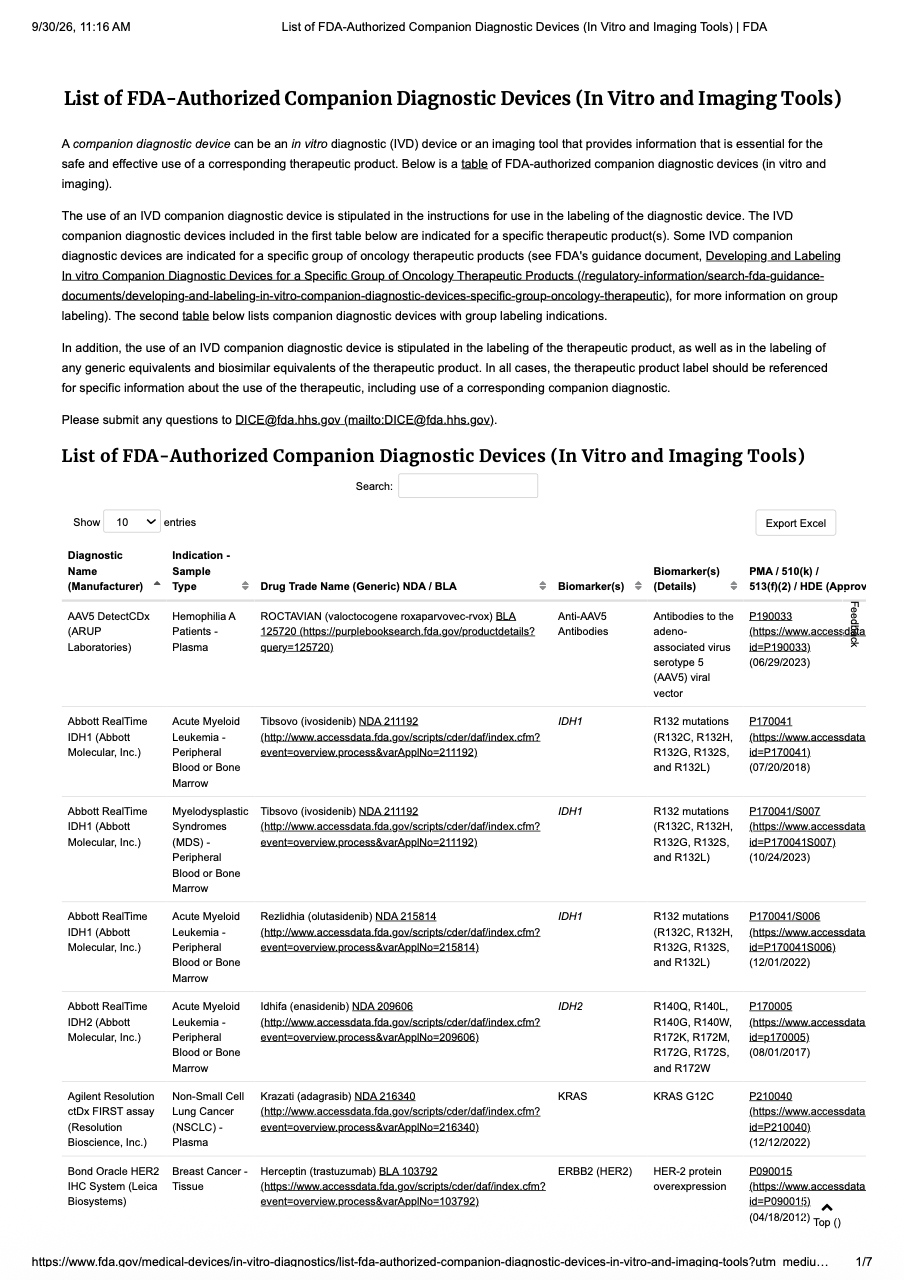
The U.S. Food and Drug Administration (FDA) maintains a public list of authorized companion diagnostic devices, covering both in vitro diagnostic (IVD) devices and imaging tools.
FDA describes a companion diagnostic as a device that provides information essential for the safe and effective use of a corresponding therapeutic product. 1790836747184
The current list contains 232 entries in the main companion diagnostic table and also includes a separate section for devices authorized with group labeling indications in oncology. 1790836747184
Companion Diagnostics and Therapeutic Product Labeling
FDA notes that the use of an IVD companion diagnostic is specified in the labeling of the diagnostic device itself.
The corresponding therapeutic product labeling, including relevant generic or biosimilar equivalents, also identifies the use of the companion diagnostic where applicable. 1790836747184
This creates a regulatory link between the diagnostic test and the therapeutic decision it supports.
What Information Does the FDA List Provide?
The FDA table provides several key pieces of information for each authorized companion diagnostic, including:
diagnostic name and manufacturer;
disease indication;
sample type;
corresponding therapeutic product;
NDA or BLA information;
biomarker;
biomarker details;
PMA, 510(k), De Novo or HDE authorization information.
The visible entries include companion diagnostics for diseases such as:
acute myeloid leukemia;
myelodysplastic syndromes;
non-small cell lung cancer;
breast cancer;
ovarian cancer;
melanoma. 1790836747184 1790836747184
Biomarkers Covered
The list illustrates the range of biomarkers currently used to guide targeted treatment decisions.
Examples include:
IDH1;
IDH2;
KRAS G12C;
HER2 / ERBB2;
BRCA1 and BRCA2;
BRAF V600E and V600K;
EGFR exon 19 deletions and exon 21 L858R mutations. 1790836747184 1790836747184
These biomarker-device-treatment relationships illustrate the central role of companion diagnostics in precision medicine.
Group Labeling for Oncology Companion Diagnostics
FDA also maintains a separate table for companion diagnostic devices with group labeling indications.
Instead of linking a diagnostic solely to one named therapeutic product, this approach can allow the device to identify patients suitable for a specific group of FDA-approved oncology therapies. 1790836747184
This model is particularly relevant where multiple therapies share the same biomarker-driven indication.
New 2026 Authorization: PGDx elio tissue complete CDx
One of the most recent entries shown in the group-labeling table is PGDx elio tissue complete CDx, manufactured by Personal Genome Diagnostics.
The device received PMA P250036 on 30 July 2026 for use with melanoma tissue. 1790836747184
The indication includes identifying melanoma patients whose tumors carry BRAF V600E or V600K mutations and who may be suitable for certain FDA-approved BRAF or BRAF/MEK inhibitor therapies. 1790836747184
Therapies Listed for the PGDx Device
The group-labeling entry identifies several FDA-approved treatment options.
For BRAF inhibitor use, the table includes:
Tafinlar (dabrafenib);
Zelboraf (vemurafenib).
For BRAF/MEK inhibitor combinations, it includes:
Cotellic + Zelboraf;
Braftovi + Mektovi;
Tafinlar + Mekinist. 1790836747184
This illustrates how group labeling can support a broader biomarker-driven therapeutic category rather than a single drug-device pairing.
EGFR Companion Diagnostics for NSCLC
The list also shows several companion diagnostics used to identify patients with non-small cell lung cancer (NSCLC)carrying specific EGFR mutations.
For example, the cobas EGFR Mutation Test v2 may be used with tissue or plasma samples to identify patients with:
EGFR exon 19 deletions;
EGFR exon 21 L858R substitution mutations. 1790836747184
The corresponding group-labeling entry lists multiple approved tyrosine kinase inhibitors, including Tarceva, Tagrisso, Iressa, Gilotrif, Vizimpro and Lazcluze in applicable settings. 1790836747184
Tissue and Liquid Biopsy Approaches
The list reflects the growing use of different sample types for biomarker testing.
Examples include:
tumor tissue;
plasma;
whole blood;
peripheral blood;
bone marrow. 1790836747184 1790836747184
For NSCLC, FDA-authorized companion diagnostics include both tissue-based and plasma-based approaches.
FoundationOne Liquid CDx, for example, is listed for plasma-based EGFR testing in NSCLC. 1790836747184
Multiple Diagnostic Platforms for Similar Biomarkers
The FDA list also demonstrates that multiple authorized diagnostic platforms may support similar biomarker-defined treatment decisions.
For EGFR-positive NSCLC, listed group-labeling devices include:
cobas EGFR Mutation Test v2;
FoundationOne CDx;
FoundationOne Liquid CDx;
ONCO/Reveal Dx Lung & Colon Cancer Assay;
MI Cancer Seek. 1790836747184 1790836747184 1790836747184
This highlights the increasing diversity of molecular diagnostic technologies available to support targeted oncology treatment.
MI Cancer Seek
The list also includes MI Cancer Seek, manufactured by Caris Life Sciences.
The device is listed under PMA P240010, approved on 5 November 2024, with group-labeling indications covering both melanoma and NSCLC. 1790836747184 1790836747184
For melanoma, it supports identification of patients with BRAF V600E and V600K mutations for relevant BRAF or BRAF/MEK inhibitor therapies. 1790836747184
For NSCLC, it supports identification of EGFR exon 19 deletions and exon 21 L858R substitutions for applicable FDA-approved tyrosine kinase inhibitors. 1790836747184
Importance of Group Labeling
Group labeling is particularly relevant in oncology because treatment landscapes can evolve rapidly.
Where several approved medicines target the same biomarker-defined patient population, group labeling may allow a companion diagnostic to support a broader therapeutic category rather than being restricted to one product.
FDA specifically references its guidance on Developing and Labeling In Vitro Companion Diagnostic Devices for a Specific Group of Oncology Therapeutic Products in explaining this approach. 1790836747184
Impact on IVD and Pharmaceutical Manufacturers
For IVD manufacturers, pharmaceutical companies and regulatory teams, the FDA list provides an important reference for understanding existing diagnostic-therapeutic relationships.
Stakeholders should pay particular attention to:
biomarker selection;
companion diagnostic indications;
therapeutic product labeling;
group labeling strategies;
PMA authorization pathways;
tissue versus liquid biopsy approaches;
alignment between diagnostic and drug development;
oncology treatment evolution;
regulatory lifecycle management.
For developers of new precision medicine technologies, the list also provides insight into how FDA structures indications where one diagnostic may support multiple therapies targeting the same biomarker.
Importance of Checking Current Product Labeling
FDA emphasises that the therapeutic product label should always be consulted for specific information on treatment use and the corresponding companion diagnostic. 1790836747184
This is particularly important because indications, therapeutic options and labeling relationships can evolve over time.