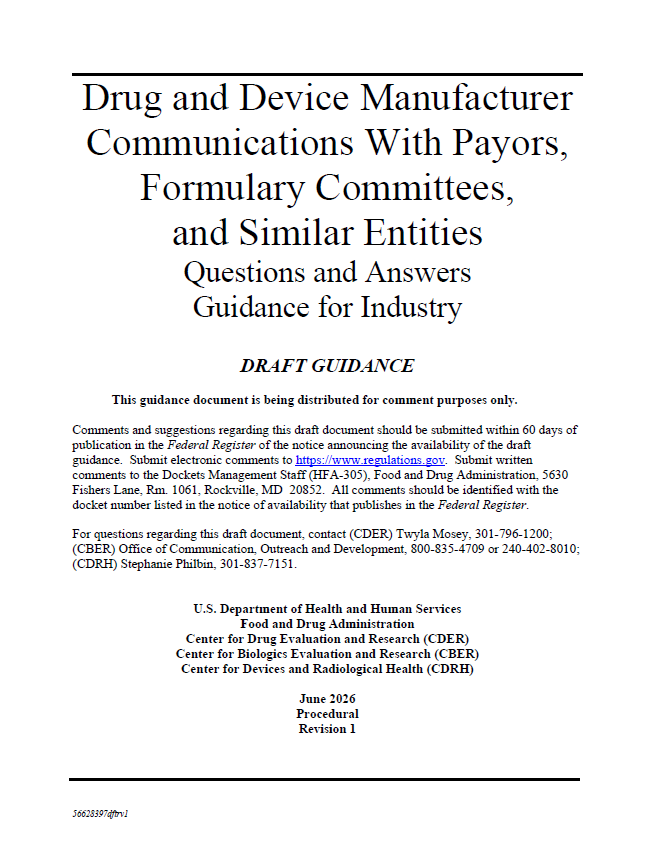
The U.S. Food and Drug Administration (FDA) has published a draft revision of its guidance on communications between medical product manufacturers and payors, formulary committees, and similar entities. The updated document expands and clarifies provisions that now explicitly apply to medical devices, reflecting statutory changes introduced by the Consolidated Appropriations Act of 2023.
The draft guidance, titled Drug and Device Manufacturer Communications With Payors, Formulary Committees, and Similar Entities – Questions and Answers, replaces the FDA’s 2018 guidance once finalised and provides additional clarity on how manufacturers can communicate health care economic information (HCEI) and information about investigational products or uses.
Why this matters for medical device manufacturers
While the guidance does not create new legal obligations, it provides FDA’s current thinking on what constitutes truthful and non-misleading communication with payors. This is particularly relevant for manufacturers preparing reimbursement strategies, health economic dossiers, market access activities, and value-based discussions.
A key change is that the statutory provisions relating to HCEI now explicitly apply to medical devices, not only pharmaceuticals. FDA also aligns the guidance with Section 502(gg) of the Federal Food, Drug, and Cosmetic Act, which addresses certain communications regarding investigational products and investigational uses.
Health economic information: broader opportunities, but clear expectations
The guidance confirms that manufacturers may communicate economic analyses related to approved or cleared devices to appropriate payor audiences, provided the information is based on competent and reliable scientific evidence and remains truthful and non-misleading.
Examples of acceptable economic analyses may include:
Budget impact models;
Cost-effectiveness analyses;
Real-world evidence on resource utilisation;
Length-of-stay analyses;
Patient subgroup evaluations;
Adherence and persistence studies;
Comparative economic assessments against alternative interventions.
However, FDA emphasises that manufacturers should clearly disclose methodology, assumptions, limitations, generalisability considerations, and any material differences between the analysis and the device’s cleared or approved labelling.
Communication about investigational devices
The revised guidance also provides updated recommendations regarding communications with payors about investigational devices and investigational uses of marketed devices.
Manufacturers may share certain factual information, including:
Device descriptions and features;
Clinical study information;
Development timelines;
Pricing expectations;
Utilisation projections;
Factual study results that do not make conclusions regarding safety or effectiveness.
FDA stresses that these communications must not imply that an investigational device has been cleared or approved, nor suggest that safety or effectiveness has been established before regulatory review is complete.
Practical implications for manufacturers
For device manufacturers, the draft guidance reinforces the growing importance of health economics and market access evidence alongside traditional regulatory submissions.
Companies developing reimbursement strategies should review whether their health economic materials include:
Transparent methodologies;
Robust scientific substantiation;
Appropriate disclosure of limitations;
Clear distinction between approved and investigational claims;
Processes for updating information when significant new evidence becomes available.
Although this guidance is currently in draft form, it provides a useful indication of FDA’s expectations regarding communications with payors and may influence how manufacturers structure future value and reimbursement discussions.