FDA Releases New Guidance on Postapproval Pregnancy Safety Studies for Drugs and Biologics
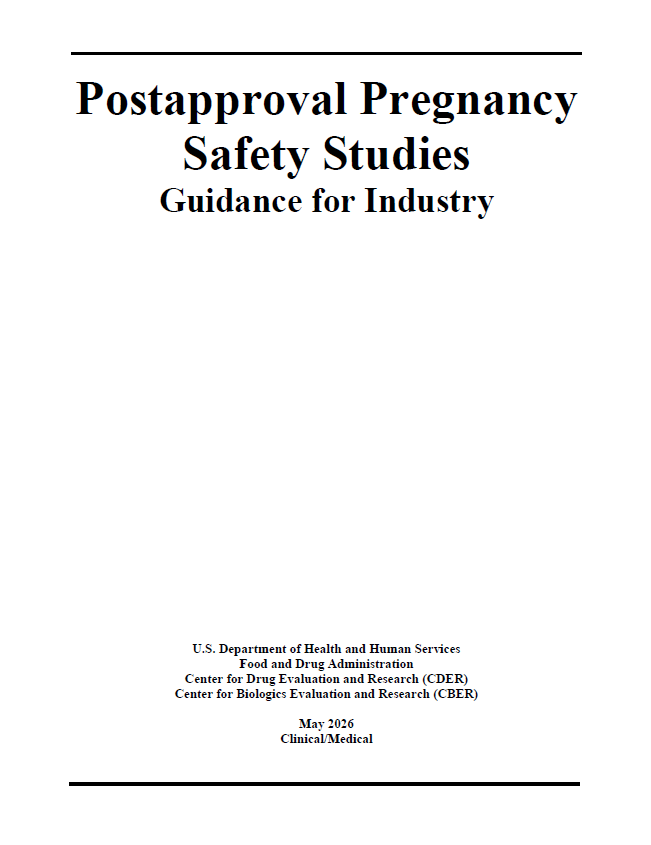
In May 2026, the U.S. Food and Drug Administration (FDA) published a new guidance document titled “Postapproval Pregnancy Safety Studies – Guidance for Industry”. The document provides recommendations for sponsors and investigators on how to design and conduct postmarketing studies evaluating the safety of drug and biological products used during pregnancy.
The guidance reflects the FDA’s current expectations regarding the collection and assessment of pregnancy safety data after product approval, particularly when clinical data in pregnant populations are limited at the time of market authorization.
Why This Guidance Matters
Pregnant women are historically excluded from most clinical trials, resulting in limited human safety data at the time many medicinal products enter the market. According to the FDA, this creates a significant need for robust postmarketing surveillance and real-world evidence generation.
The Agency highlights that approximately 3.6 million births occur annually in the United States and that many pregnant patients require ongoing treatment for chronic or acute medical conditions during pregnancy. The guidance also notes that unintended pregnancies remain common, increasing the likelihood of inadvertent exposure to medicinal products.
For manufacturers, this document reinforces the growing regulatory expectation for structured postapproval safety monitoring in pregnancy and may impact pharmacovigilance strategies, registry planning, and lifecycle management activities.
Key Areas Covered by the FDA Guidance
The document outlines three major approaches for evaluating pregnancy safety in the postmarketing setting:
1. Case Reports and Case Series
The FDA emphasizes the importance of collecting high-quality spontaneous reports and published case reports to identify potential safety signals related to pregnancy exposure.
Manufacturers are encouraged to obtain comprehensive information such as:
Timing of exposure during pregnancy
Dosage and duration of treatment
Maternal medical history
Pregnancy outcomes
Neonatal and fetal outcomes
Genetic and environmental risk factors
Although case reports alone may not establish causality, the FDA notes that they can play a critical role in identifying rare or serious teratogenic risks.
2. Pregnancy Registries
A major focus of the guidance is the use of prospective pregnancy registries as a real-world data collection tool.
The FDA describes pregnancy registries as particularly valuable because they allow:
Prospective enrollment before pregnancy outcome is known
Detailed exposure assessment
Collection of maternal, fetal, and infant outcome data
Longitudinal follow-up
However, the guidance also recognizes important operational challenges frequently faced by sponsors, including:
Low enrollment rates
Patient retention difficulties
Limited statistical power
Challenges in identifying appropriate comparator groups
The FDA strongly encourages manufacturers to assess study feasibility early and to implement robust recruitment and retention strategies.
Increased Emphasis on Real-World Evidence (RWE)
Another important aspect of the guidance is the increasing reliance on real-world evidence and complementary observational studies.
The FDA specifically discusses the use of:
Electronic health records (EHRs)
Medical claims databases
Population-based surveillance systems
National birth defect registries
Case-control studies
This reflects the Agency’s broader movement toward integrating real-world evidence into regulatory decision-making processes.
For manufacturers, this may require stronger capabilities in pharmacoepidemiology, data analytics, and postmarket surveillance infrastructure.
Potential Impact on Manufacturers
Although the guidance is nonbinding, it provides a clear indication of FDA expectations for postapproval pregnancy safety monitoring.
Manufacturers may need to consider:
Earlier planning of pregnancy safety studies during product development
Enhanced pharmacovigilance procedures
Implementation or participation in pregnancy registries
Improved data collection for maternal and infant outcomes
Integration of real-world evidence strategies into postmarket surveillance programs
The guidance may be particularly relevant for companies developing products intended for women of reproductive potential, chronic therapies, vaccines, biologics, or treatments likely to be used during pregnancy.
Final Considerations
The FDA acknowledges that pregnancy registries alone are often insufficient to fully characterize safety risks and therefore encourages the use of complementary study designs and multiple data sources.
Overall, the new guidance represents another step toward strengthening regulatory expectations around pregnancy safety evidence generation throughout the product lifecycle.
Manufacturers should evaluate whether their current pharmacovigilance and postmarket surveillance strategies are aligned with these evolving expectations.
Read the full document below.