EU Reaches Provisional Agreement to Simplify AI Act Implementation
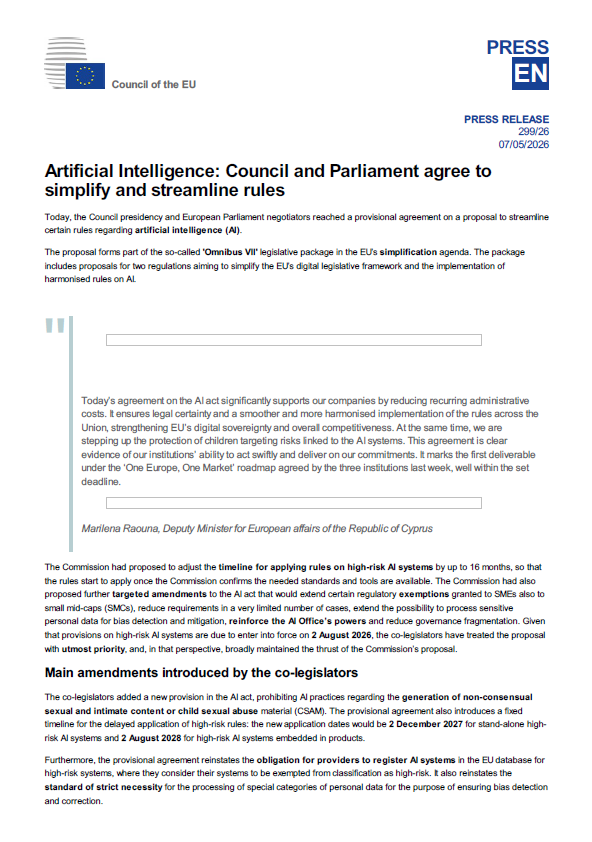
The Council of the European Union and the European Parliament have reached a provisional agreement to simplify and streamline certain provisions of the EU Artificial Intelligence Act (AI Act). The agreement forms part of the European Commission’s “Omnibus VII” simplification package, which aims to reduce administrative burdens and support a more harmonised implementation of digital legislation across the European Union.
Delayed Application of High-Risk AI Rules
One of the main outcomes of the agreement is the postponement of the application deadlines for high-risk AI systems.
According to the provisional agreement:
Rules for stand-alone high-risk AI systems would apply from 2 December 2027
Rules for high-risk AI systems embedded in products would apply from 2 August 2028
The European Commission had initially proposed delaying the application of these requirements by up to 16 months to ensure that the necessary standards and implementation tools are available before the rules become fully applicable.
For manufacturers developing products that include AI functionalities, the extended timelines may provide additional time to assess regulatory obligations and prepare compliance strategies.
Clarification on Sectoral Legislation
The provisional agreement also addresses the interaction between the AI Act and sector-specific legislation in areas including:
Medical devices
Machinery
Toys
Lifts
Watercraft
According to the text, the co-legislators agreed on a mechanism intended to address situations where sectoral legislation already contains AI-specific requirements similar to those established under the AI Act. In such cases, the application of certain AI Act requirements may be limited through implementing acts.
The agreement also introduces specific provisions related to the Machinery Regulation, including an exemption from the direct applicability of certain AI Act provisions and the possibility for the European Commission to adopt delegated acts introducing AI-related health and safety requirements.
Registration Obligations Maintained
The provisional agreement reinstates the obligation for providers to register AI systems in the EU database for high-risk systems, including situations where providers consider their systems exempt from classification as high-risk.
Manufacturers and other economic operators should therefore continue assessing whether registration obligations may apply to their AI systems.
Processing of Sensitive Personal Data
The agreement also reinstates the requirement of “strict necessity” for the processing of special categories of personal data when used for bias detection and correction purposes.
This may be relevant for companies developing AI systems that rely on health-related or other sensitive datasets.
Transparency Obligations for AI-Generated Content
Another change concerns transparency obligations for artificially generated content.
The agreement reduces the implementation period for transparency solutions from six months to three months, establishing a new deadline of 2 December 2026.
AI Regulatory Sandboxes
The deadline for national competent authorities to establish AI regulatory sandboxes would be postponed until 2 August 2027.
These sandboxes are intended to support the development and testing of innovative AI systems within controlled regulatory environments.
New Prohibited AI Practices
The provisional agreement also introduces a new prohibited AI practice related to the generation of:
Non-consensual sexual and intimate content
Child sexual abuse material (CSAM)
Next Steps
The provisional agreement must still be formally endorsed by both the Council and the European Parliament before undergoing legal and linguistic review ahead of formal adoption.
Read the full document below.