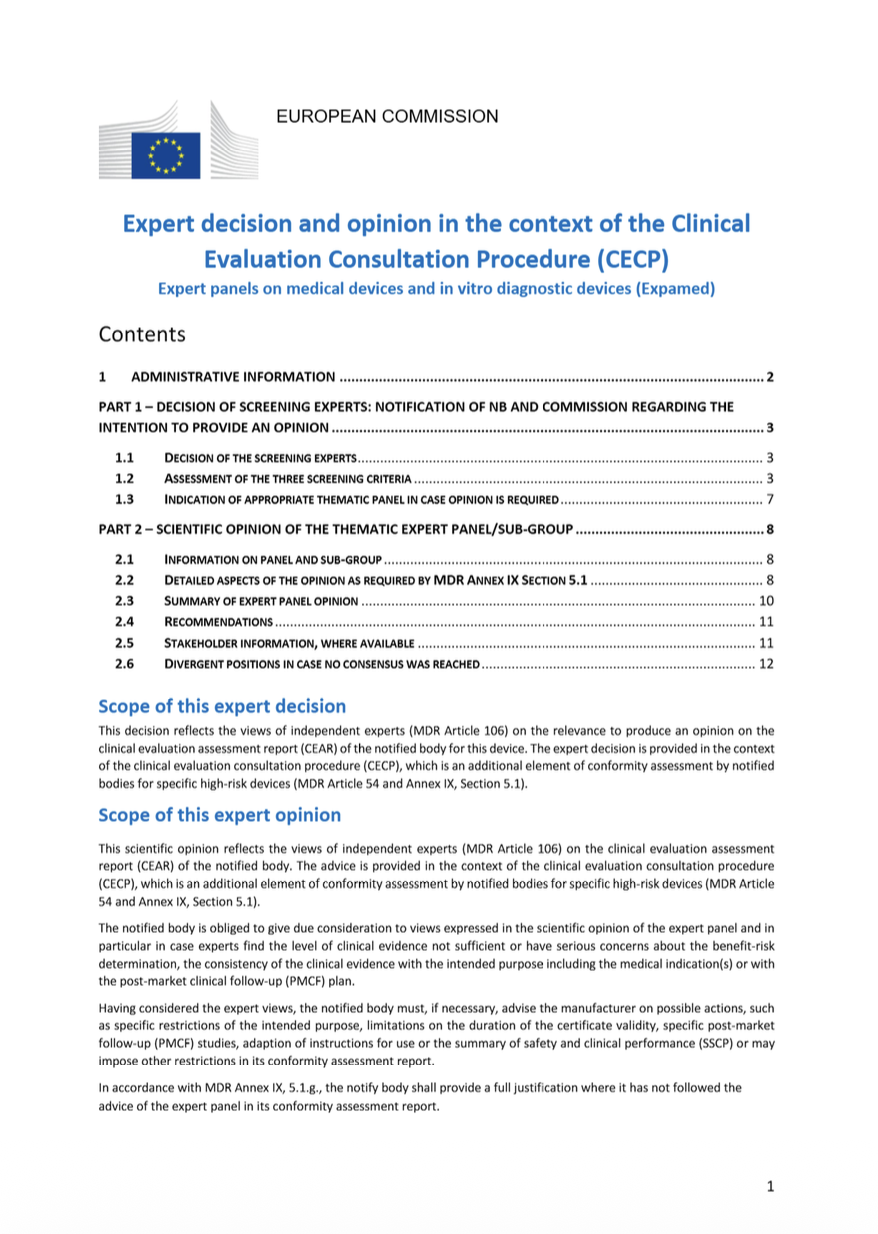
EU Expert Panel Raises Clinical Evidence Concerns for Bioabsorbable Orthopaedic Screws
The European Commission’s medical device Expert Panel has issued a scientific opinion under the Clinical Evaluation Consultation Procedure (CECP) concerning bioabsorbable orthopaedic screws intended for trauma and orthopaedic surgery.
The device is a Class III implantable medical device intended for fixation of bone fractures, osteosyntheses and correction of deformities or malalignments. The CECP dossier was assessed within the orthopaedics field. 1790835007419
Why the Device Was Selected for Expert Review
The screening experts decided that a scientific opinion was required because the device represented a meaningful level of novelty and could have significant clinical impact.
The screws are made from a degradable magnesium alloy and are intended to be absorbed after the fracture site has healed.
The expert panel considered this potentially advantageous because a second surgery to remove the implant may no longer be necessary.
Potential Benefits of Bioabsorbable Screws
Compared with conventional metallic implants, bioabsorbable screws may offer several potential advantages.
These include:
avoiding implant removal surgery;
reducing the long-term presence of permanent metallic material;
potentially lowering healthcare burden;
reducing patient exposure to a second surgical procedure.
The experts acknowledged these possible benefits but also emphasised that the safety and performance of degradable implants depend heavily on the relationship between fracture healing and implant degradation.
Key Risks Identified
The panel highlighted several potential risks associated with bioabsorbable magnesium-alloy orthopaedic screws.
These included:
inflammatory reactions;
reduced load-bearing capacity during degradation;
degradation occurring too quickly;
hydrogen gas formation;
accumulation of degradation products;
premature loss of mechanical strength;
possible implant failure or fracture non-union;
potential toxicity concerns;
difficulty controlling degradation rate.
The panel considered the balance between bone healing and implant degradation to be particularly important.
Clinical Evidence Considered Insufficient
The Expert Panel concluded that the available clinical evidence was not sufficient to fully demonstrate long-term safety and performance.
One major concern was the lack of adequate clinical data showing the degradation process in humans over time.
The panel noted that degradation should be monitored at fixed intervals using imaging such as:
radiographs;
CT scans.
These data would help establish whether the implant maintains sufficient mechanical integrity during the healing period and whether degradation occurs at an appropriate rate.
Concerns About Available Clinical Studies
The CECP opinion notes that some studies involved devices made from magnesium alloys that were not fully equivalent to the device under assessment.
The panel also considered the available clinical dataset limited in terms of:
study size;
duration;
relevance to all intended indications;
long-term degradation behaviour;
clinical follow-up.
The experts therefore considered additional clinical evidence necessary.
Benefit-Risk Determination
The Expert Panel did not consider the available evidence sufficient to fully support the manufacturer’s benefit-risk determination.
The opinion states that additional prospective clinical evidence should be generated to strengthen the assessment.
The experts also recommended using adequate radiological imaging at fixed intervals to evaluate degradation and its relationship with fracture healing.
Broad Intended Indications
Another major concern related to the breadth of the device’s intended use.
The device was intended for multiple anatomical locations and fracture types, including different upper- and lower-extremity indications.
The panel considered that a single feasibility study may not adequately support such a wide range of indications.
Different fracture types may involve substantially different:
mechanical forces;
bone biology;
healing characteristics;
loading patterns;
clinical risks.
Need for More Representative Clinical Evidence
The Expert Panel recommended clinical investigations covering different types of fractures and osteotomies representative of the intended use.
The experts considered it important to evaluate whether the screws provide adequate fixation during the period required for bone healing.
Where inappropriate degradation or loss of strength occurs too early, there may be a risk of instability or failure before the fracture or osteotomy has sufficiently healed.
PMCF Plan Considered Inadequate
The opinion also raises concerns regarding the manufacturer’s Post-Market Clinical Follow-up (PMCF) plan.
The panel considered the available PMCF information too general and lacking sufficient detail.
In particular, the plan should more clearly define:
follow-up duration;
imaging strategy;
timing of radiological assessments;
endpoints;
fracture types;
patient groups;
degradation monitoring;
bone healing outcomes.
Imaging Follow-Up
The Expert Panel specifically recommended imaging at fixed time points.
Radiographs and CT scans may be needed to assess:
implant degradation;
gas formation;
bone union;
implant integrity;
residual material;
relationship between degradation and healing.
The panel considered this especially important because degradation may continue for several years.
Clinical Follow-Up Duration
The experts considered that longer-term follow-up is needed to establish the complete degradation profile.
The opinion notes that clinical follow-up should extend far enough to determine whether the implant is fully degraded and whether any late complications occur.
This is particularly important for a device designed to disappear progressively after fulfilling its mechanical function.
Recommended Additional Studies
The Expert Panel recommended that the manufacturer conduct additional studies, including:
a literature review focused on magnesium-alloy degradable screws;
pre-authorisation clinical studies using adequate imaging follow-up;
prospective post-authorisation clinical studies;
studies comparing healing and degradation across different fracture or osteotomy types.
The panel also recommended that clinical evidence be generated for representative indication groups rather than relying on a single narrow population.
Importance of Mechanical Stability
A central issue identified in the opinion is the relationship between implant strength and healing time.
The screw must maintain sufficient mechanical stability for the fracture or osteotomy to heal before substantial degradation occurs.
If degradation is too rapid, mechanical support may be lost prematurely.
If degradation is too slow or produces excessive by-products, other safety concerns may arise.
Role of the Notified Body
Under the CECP framework, the Notified Body must give due consideration to the Expert Panel’s scientific opinion.
Where the Notified Body decides not to follow the panel’s advice, it must justify that decision in its conformity assessment documentation.
The CECP opinion therefore becomes an important input into the final conformity assessment of the device.
Impact on Manufacturers of High-Risk Orthopaedic Devices
For manufacturers of Class III orthopaedic implants, particularly degradable or bioabsorbable devices, the opinion highlights several important regulatory expectations.
Stakeholders should pay particular attention to:
long-term clinical follow-up;
degradation kinetics;
imaging-based monitoring;
representative clinical populations;
indication-specific evidence;
mechanical performance throughout healing;
comprehensive benefit-risk justification;
detailed PMCF planning;
alignment between intended purpose and clinical evidence;
evidence supporting each major anatomical indication.
The broader lesson is that novel degradable implant technologies require more than demonstration of short-term clinical performance. Regulators may expect robust evidence showing how degradation, mechanical support and bone healing interact over the full lifecycle of the implant.