FDA Issues Updated Guidance on 510(k) Submissions for Hemodialysis Blood Tubing Sets
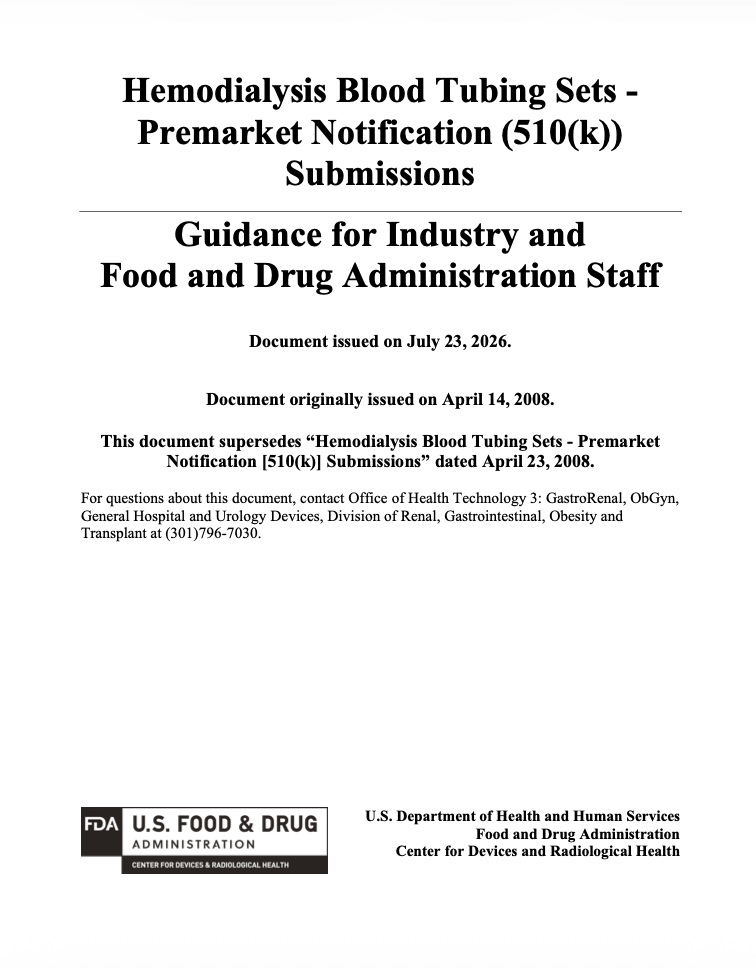
The U.S. Food and Drug Administration has issued updated guidance titled “Hemodialysis Blood Tubing Sets – Premarket Notification (510(k)) Submissions.”
The document was issued on 23 July 2026 and supersedes the previous guidance of the same title dated 23 April 2008.
Purpose of the Guidance
The guidance is intended to help industry prepare premarket notification submissions (510(k)s) for hemodialysis blood tubing sets used as the extracorporeal blood circuit during hemodialysis treatment.
FDA identifies specific recommendations for testing and labeling to include in 510(k) submissions for these devices.
Scope
The guidance applies to hemodialysis blood tubing sets under 21 CFR 876.5820 and product codes FJK and KOC.
The document clarifies that the scope does not include tubing or devices used for vascular access, such as hemodialysis catheters, or tubing used for peritoneal dialysis.
Device Description and Predicate Comparison
FDA recommends that manufacturers provide a clear device description, including a description of the overall device system, labeled diagrams, model specifications, component functionality and compatible hemodialysis delivery systems.
Manufacturers should also compare the proposed device with a legally marketed predicate device, including intended use, design features, performance specifications and relevant safety and effectiveness information.
Performance Testing
The guidance recommends functional testing to demonstrate that the blood tubing set performs as described.
Recommended testing includes pressure leak testing, pump segment endurance testing, injection port endurance testing, priming volume assessment, tensile testing, transducer leakage testing, clamp performance testing, hemocompatibility where applicable and kink resistance testing after repeated clamping.
FDA also recommends evaluating the blood tubing set on each hemodialysis delivery system specified in the labeling and operator’s manual, using blood analog fluid for four hours at 37 °C to demonstrate that tubing failure does not occur.
Materials and Biocompatibility
The guidance states that submissions should describe the materials used for all components of the hemodialysis tubing set, including colorants, plasticizers such as DEHP, and additives.
FDA recommends grouping materials based on whether they have direct or indirect contact with circulating blood. Where an identical legally marketed device cannot be identified, FDA recommends evaluating biocompatibility endpoints such as cytotoxicity, sensitization, irritation or intracutaneous reactivity, acute systemic toxicity, material-mediated pyrogenicity, subacute or subchronic systemic toxicity, hemocompatibility, genotoxicity, chronic systemic toxicity and carcinogenicity.
Sterility, Shelf Life and Packaging
FDA recommends that hemodialysis blood tubing sets be sterile, with a sterility assurance level of 1 x 10⁻⁶.
Because these devices contact circulating blood, FDA also recommends pyrogenicity testing and submission of information on the test method, testing endpoint, extraction technique and reference method used.
For shelf life, FDA recommends that labels include an expiration date and that manufacturers provide performance testing on aged samples and package integrity testing to demonstrate sterility and non-pyrogenicity.
Labeling Recommendations
The guidance provides labeling recommendations covering device description, warnings, outer package labeling and other labeling elements.
FDA recommends that labeling identify the components in the package, tubing lengths, pump segment outer diameter, priming volume, compatible hemodialysis delivery systems, maximum operating pressures, single-use status, non-toxic and non-pyrogenic fluid path, and sterile package status.
FDA also recommends warnings regarding the risk of significant hemolysis in kinked blood tubing, especially in the post-pump arterial segment, and a precaution that the device is intended for single use only.
July 2026 Update
The guidance history explains that the July 2026 revision was issued under Level 2 guidance procedures.
The update harmonizes the guidance with FDA’s ISO 10993-1 biocompatibility guidance and includes other minor updates, primarily to remove outdated submission format information now contained in 510(k) eSTAR.
Impact on Medical Device Manufacturers
For manufacturers of hemodialysis blood tubing sets, the updated guidance reinforces the importance of preparing clear and complete 510(k) submissions aligned with current FDA expectations.
Manufacturers should pay particular attention to:
device description and model specifications;
predicate device comparison;
compatible hemodialysis delivery systems;
pressure, endurance, tensile and kink resistance testing;
materials characterization, including DEHP and additives;
ISO 10993-based biocompatibility evaluation;
sterility and pyrogenicity information;
shelf-life and package integrity evidence;
labeling, warnings and outer package information;
eSTAR-related submission expectations.
For manufacturers preparing 510(k) submissions, the guidance highlights the need to link device design, performance data, material safety, sterility assurance and labeling into a coherent evidence package supporting substantial equivalence.