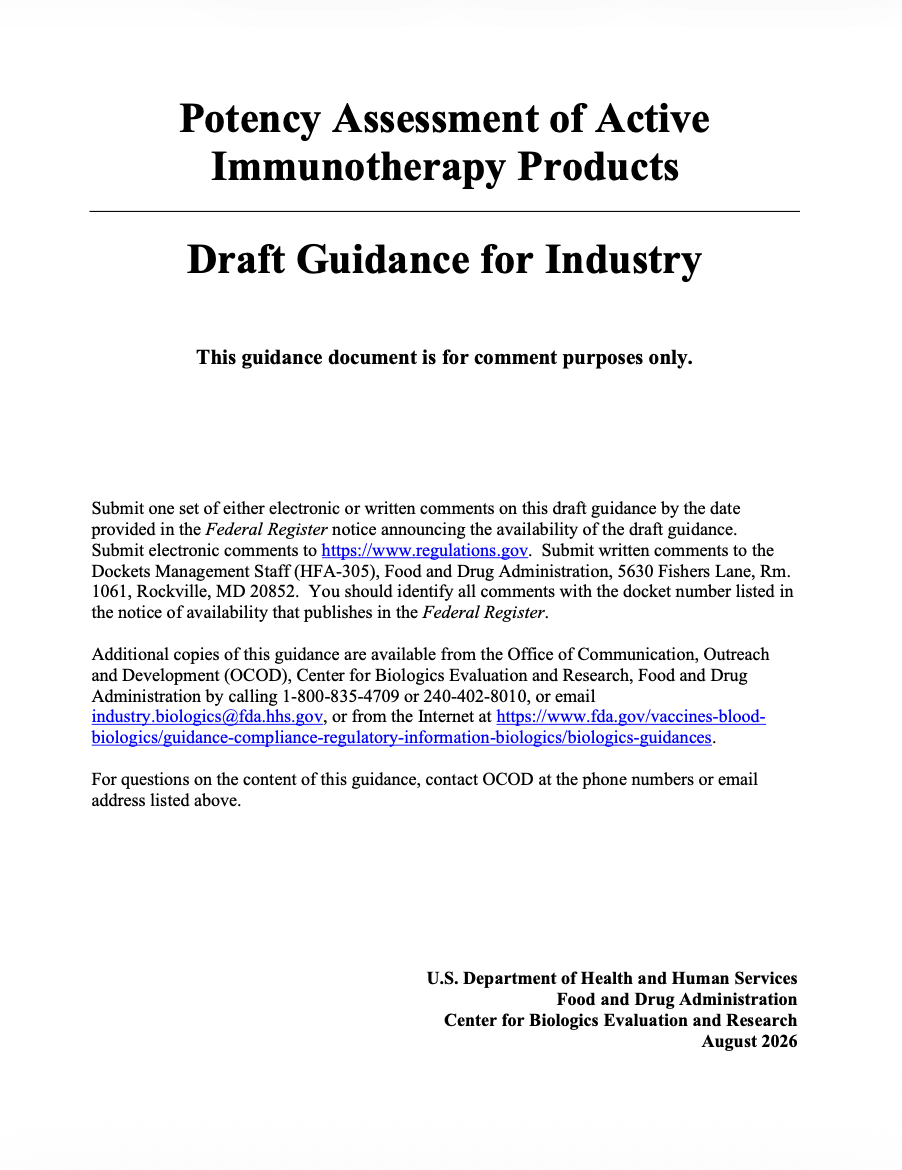
FDA Issues Draft Guidance on Potency Assessment of Active Immunotherapy Products
The U.S. Food and Drug Administration has issued the draft guidance “Potency Assessment of Active Immunotherapy Products.”
The document, issued by the Center for Biologics Evaluation and Research in August 2026, is currently for comment purposes only and is marked “Draft — Not for Implementation.”
Purpose of the Guidance
The draft guidance provides recommendations for developing assays to assess potency as part of a potency assurance strategy for active immunotherapy products, also referred to as ACTIMPs.
FDA explains that active immunotherapies aim to treat a pre-existing disease or condition by inducing, stimulating or modulating immune effector cells through the introduction of disease-associated antigens to the immune system.
Scope
The guidance applies to ACTIMPs regulated as biological products under section 351 of the Public Health Service Act.
FDA states that the guidance does not apply to preventive vaccines for infectious disease indications, bacteriophage products for infectious diseases, live biotherapeutic products, fecal microbiota for transplantation products or allergenic products.
The document also notes that ACTIMPs may include vectors that express antigens, peptide or protein antigens, or cells that present or express antigens, such as cell lysates or antigen-pulsed antigen-presenting cells.
Potency Assessment Challenges
FDA highlights that potency assessment for ACTIMPs can be challenging because biological activity often depends on host immune responses.
The challenge can be greater for personalized therapeutic ACTIMPs, where patient-specific neoantigens may create unique assay design considerations, including limited availability of specific reagents for each product lot.
Regulatory Framework
The draft guidance explains that potency assays are critical for ensuring that a biological product is capable of functioning as intended.
Potency assays are used during lot release testing, comparability studies and stability testing, helping ensure that only product lots meeting defined criteria are administered during clinical investigations or after marketing authorization.
For licensed ACTIMPs, FDA states that biologics license applications must include data demonstrating that the product is potent and that continued potency is assured. Potency assays used for lot release testing of licensed biological products must comply with applicable regulations and be validated.
General Recommendations for Potency Assays
FDA recommends that sponsors use a thorough understanding of the active ingredient and mechanism of action to identify potency-related critical quality attributes.
The relationship between the mechanism of action and potency-related CQAs should be supported by appropriate scientific information, product characterization, nonclinical studies or clinical studies.
The draft guidance also recommends that potency assays should be quantitative and sufficiently precise to distinguish between product that is sufficiently active and product with insufficient activity, allowing sub-potent lots to be identified and rejected.
Potency Measurement Approaches
FDA describes several approaches for potency measurement.
Bioassays are described as the most direct assessment of ACTIMP potency, measuring the product’s effect on the immune system using living cells, tissues or animals. FDA encourages methods that replace or reduce animal use whenever possible.
Physicochemical assays may be used where potency can be adequately assured without a bioassay. These assays may assess immunochemical, biochemical or molecular product attributes related to potency.
FDA also notes that multiple complementary assays may be needed where multiple potency-related CQAs cannot be adequately evaluated using a single assay.
Product-Specific Considerations
The guidance provides recommendations for several ACTIMP types, including:
non-personalized peptide- and protein-based ACTIMPs;
non-personalized vectored ACTIMPs;
personalized peptide- and protein-based ACTIMPs;
personalized vectored ACTIMPs;
cell-based ACTIMPs.
For personalized peptide- and protein-based ACTIMPs, FDA notes that product-specific bioassays for lot release may not be practical for each patient’s product. In such cases, physicochemical methods may be used to assess potency-related CQAs if the manufacturing process is adequately controlled.
For cell-based ACTIMPs, FDA states that potency assays should measure an activity of the cellular product that can be used to evaluate its ability to perform as intended. Cell viability is identified as an important potency-related CQA and should be part of the overall potency assessment.
Impact on Manufacturers and Sponsors
For manufacturers and sponsors developing active immunotherapy products, the draft guidance reinforces the importance of early potency assay planning and a science- and risk-based potency assurance strategy.
Sponsors should pay particular attention to:
mechanism of action understanding;
potency-related critical quality attributes;
quantitative potency assay design;
lot release, stability and comparability testing;
bioassay and physicochemical assay selection;
reagent availability and qualification;
personalized product challenges;
bioinformatics pipeline justification;
manufacturing process qualification;
CBER engagement during product development.
For developers of active immunotherapy products, the key message is that potency assurance should be built progressively across development, with assays and acceptance criteria evolving as product understanding, clinical data and manufacturing experience increase.