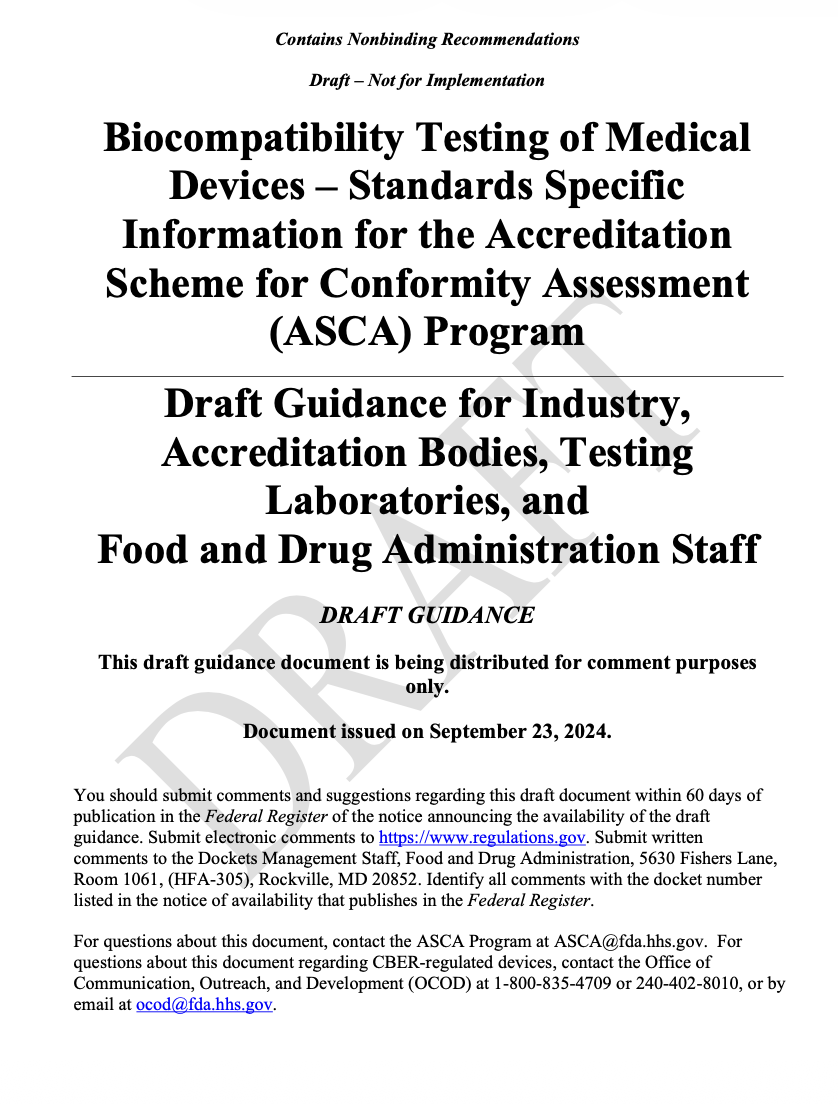
The U.S. Food and Drug Administration has issued a draft guidance titled “Biocompatibility Testing of Medical Devices – Standards Specific Information for the Accreditation Scheme for Conformity Assessment (ASCA) Program.”
The draft guidance, issued on 23 September 2024, is intended for industry, accreditation bodies, testing laboratories and FDA staff.
When finalized, it will supersede the 2020 guidance on biocompatibility testing under the ASCA Pilot Program.
Purpose of the Draft Guidance
The document explains how Biological Evaluation of Medical Devices standards are incorporated into the ASCA Program.
The ASCA Program is intended to support confidence in testing performed by accredited testing laboratories for selected FDA-recognized consensus standards and test methods.
FDA notes that the guidance is nonbinding and, while in draft form, is not intended for implementation.
Scope of the Guidance
The guidance covers:
FDA-recognized consensus standards and test methods included in the ASCA Program for biocompatibility testing;
assessment and accreditation of testing laboratories by ASCA-recognized accreditation bodies;
ASCA Program specifications for biocompatibility testing;
recommended premarket submission content when testing is conducted by an ASCA-accredited testing laboratory.
FDA also states that certain device types are excluded from the ASCA Program for biocompatibility testing, including devices requiring customized sample preparation or testing methodologies, absorbable devices, in situ polymerizing devices, liquids, creams, gels, hydrogel devices and devices containing nanomaterials.
Standards and Test Methods Covered
The draft guidance lists several biological evaluation standards and test methods relevant to the ASCA Program, including standards from the ISO 10993 series, ASTM standards and USP <151>.
Eligible test methods include:
SC5b-9 complement activation;
direct and indirect hemolysis;
MEM elution cytotoxicity;
closed patch sensitization;
dermal irritation;
intracutaneous reactivity irritation;
guinea pig maximization sensitization;
acute systemic toxicity;
material-mediated pyrogenicity;
animal welfare requirements;
sample preparation requirements.
Testing Laboratory Accreditation
The guidance provides expectations for accreditation bodies assessing testing laboratories under the ASCA Program.
FDA indicates that ASCA-recognized accreditation bodies are expected to assess all applicable biological evaluation standards and test methods within a laboratory’s ASCA accreditation scope, rather than only a sample.
The document also addresses technical assessor competency, laboratory procedures, personnel training, technical records, equipment, test controls, subcontracting and conformance with applicable ASCA specifications.
Premarket Submission Content
For premarket submissions that include biocompatibility testing conducted by an ASCA-accredited testing laboratory, FDA recommends including specific documentation.
This includes:
a cover letter;
an ASCA Declaration of Conformity;
ASCA Summary Test Reports;
supplemental documentation when needed.
FDA also identifies circumstances where a complete test report may be recommended, such as deviations from ASCA procedures, non-standard extraction conditions, extract changes, adverse findings, animal deaths or specific test results that may require further review.
Impact on Medical Device Manufacturers
For medical device manufacturers preparing FDA submissions, the draft guidance is relevant because it clarifies expectations for using ASCA-accredited testing laboratories for biocompatibility testing.
Manufacturers should pay particular attention to:
whether planned biocompatibility testing falls within the ASCA Program;
applicable FDA-recognized standards and test methods;
limitations on eligible device types;
use of 21 CFR Part 58 Good Laboratory Practice requirements;
preparation of ASCA Declarations of Conformity;
ASCA Summary Test Report content;
situations requiring complete test reports;
coordination with testing laboratories during test plan development.
For manufacturers, the draft guidance reinforces the importance of planning biocompatibility testing early and ensuring that testing scope, sample preparation, documentation and reporting are aligned with FDA expectations for ASCA submissions.