FDA Highlights Augmented Reality and Virtual Reality in Medical Devices
The U.S. Food and Drug Administration, FDA, has published information on augmented reality and virtual reality in medical devices.
The FDA states that AR and VR have the potential to transform healthcare by delivering new types of treatments and diagnostics and changing how and where care is delivered.
What Are AR and VR?
The FDA defines Augmented Reality, AR, as a real-world augmented experience that overlays or mixes simulated digital imagery with the real world as seen through a camera or display, such as a smartphone, head-mounted display or heads-up display.
Digital imagery may interact with real surroundings, and this may also be referred to as mixed or merged reality.
The FDA defines Virtual Reality, VR, as a virtual-world immersive experience that may require a headset to replace the user’s surrounding view with a simulated, immersive and interactive virtual environment.
Examples of AR/VR Applications
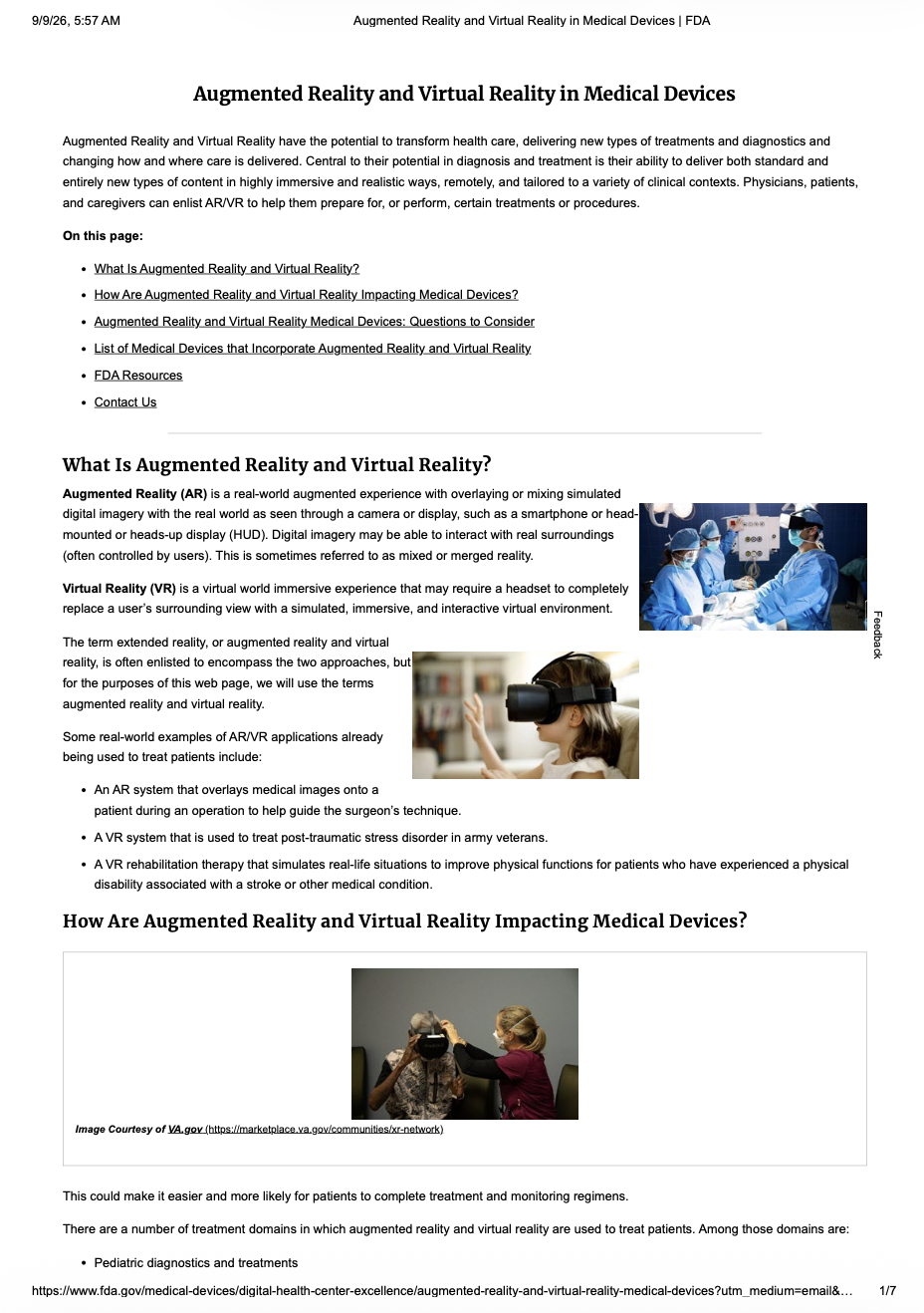
The FDA provides examples of AR/VR applications already being used to treat patients.
These include an AR system that overlays medical images onto a patient during an operation to help guide the surgeon’s technique, a VR system used to treat post-traumatic stress disorder in army veterans, and VR rehabilitation therapy that simulates real-life situations to improve physical function after stroke or other medical conditions.
Clinical Domains
According to the FDA, AR/VR technologies are used across several treatment and diagnostic domains.
These include:
pediatric diagnostics and treatments;
pain management;
mental health;
neurological disorders;
surgery planning;
intraoperative procedures;
ophthalmic diagnostics;
telemedicine;
virtual care;
postoperative and other rehabilitation therapies.
Potential Benefits
The FDA lists several probable benefits of AR/VR medical devices.
These include increasing access to necessary healthcare when in-person access is difficult, improving healthcare professionals’ ability to prepare for certain treatments, fulfilling unmet medical needs, mitigating preoperative anxiety, making procedures less invasive, accelerating diagnoses and allowing self-directed care.
Potential Risks
The FDA also highlights potential risks associated with AR/VR devices.
These include risks related to device use, such as neck pain from headset weight, and risks related to content and images, such as low-contrast images, display errors involving location or depth of anatomy, information overload, dizziness, fatigue or effects on vision.
The FDA also lists probable risks such as cybersickness, head and neck strain, cybersecurity risks, privacy risks, distraction in the operating room, unknown side effects or risks in vulnerable populations, and potential worsening of disparities in diagnostics and treatment.
Questions to Consider
The FDA has developed infographics for patients, caregivers and healthcare professionals considering the use of AR/VR in healthcare or clinical practice.
These materials are intended to support informed decision-making.
AR/VR Medical Devices List
The FDA also maintains an AR/VR Medical Devices List to identify AR/VR medical devices authorized for marketing in the United States.
The list is intended to help digital health innovators understand the current market landscape and regulatory expectations, while also providing transparency for healthcare providers and patients to identify when medical devices use AR/VR technologies.
Contents of the List
The FDA states that devices in the AR/VR list have met applicable premarket requirements, including focused review of overall safety and effectiveness.
The list provides direct links to FDA database entries, which may include releasable information such as summaries of safety and effectiveness. The FDA also notes that the list is not comprehensive and is based primarily on information provided in marketing authorization summary descriptions.
Latest Entries and Total Devices
The AR/VR Medical Devices List is organized in reverse chronological order by date of final decision.
The visible table includes recent 2026 entries such as Helion Viewer Suite, Pytheas Your Guided Trajectory, SCRIPT™ Implant System, Knee+, VRNT and Avatar Medical Vision.
The table shown on the FDA page indicates 120 entries in total.
Impact on Medical Device and Digital Health Stakeholders
For medical device manufacturers, AR/VR developers, digital health companies, healthcare providers and regulatory teams, the FDA page is relevant because it outlines both the opportunities and risks associated with AR/VR medical devices.
Stakeholders should pay particular attention to:
intended use and clinical context;
immersive content and user interaction;
patient and clinician usability;
safety and effectiveness evidence;
display accuracy and image quality;
cybersecurity and privacy risks;
vulnerable populations, including pediatrics;
operating room distraction risks;
health equity and access considerations;
FDA authorization pathways and database entries;
public summaries for AR/VR-enabled devices.
For companies developing AR/VR medical devices, the key message is that these technologies may support new models of care, treatment and diagnosis, but they require careful attention to safety, effectiveness, usability, cybersecurity, privacy and transparency.