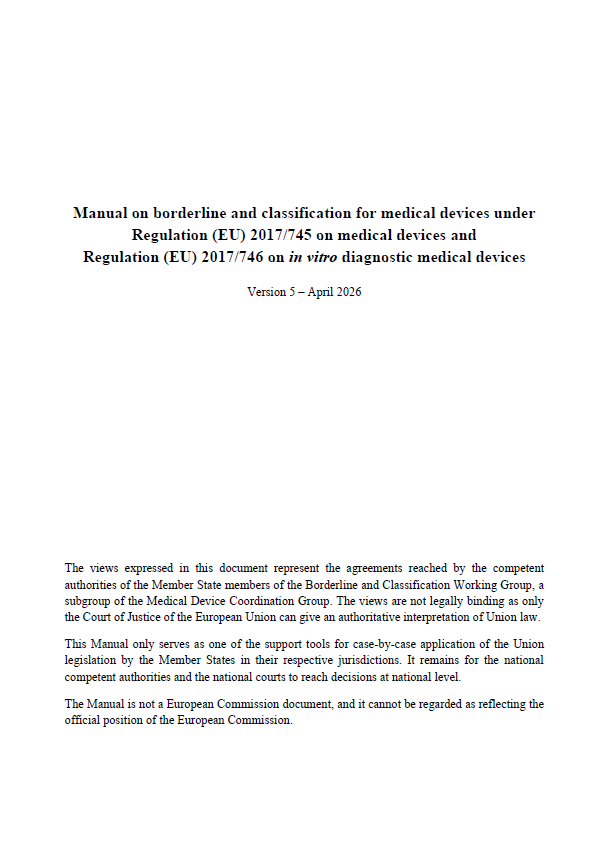
The Version 5 (April 2026) of the Manual on Borderline and Classification for Medical Devices under Regulations (EU) 2017/745 (MDR) and (EU) 2017/746 (IVDR) has been made available, reflecting agreements from Member State authorities within the Borderline and Classification Working Group (BCWG).
Nature and role of the Manual
The Manual compiles agreed positions from competent authorities on borderline and classification cases. It is intended to support the case-by-case application of MDR and IVDR.
However, it is important to note:
The Manual is not legally binding
It does not represent the official position of the European Commission
Final decisions remain with national competent authorities and courts
Only the Court of Justice of the European Union can provide authoritative interpretation of EU law
Scope of the document
The Manual addresses:
Qualification (borderline): whether a product is a medical device, an IVD, or falls outside the scope
Classification: application of MDR and IVDR classification rules where difficulties arise
It also confirms that qualification is primarily governed by:
MDR Article 4 and IVDR Article 3
Definitions and exclusions under Article 1 of both Regulations
Examples relevant for manufacturers
The Manual includes practical cases illustrating how authorities interpret borderline and classification questions.
Products not considered medical devices
Several examples confirm that products are outside the scope of MDR where the principal mode of action is not compatible with the definition of a medical device:
A nasal spray with antibodies for COVID-19, where the principal action is immunological
A dual-action cream with menthol and capsaicin, where the effect is pharmacological
Lactose vaginal tablets, where the principal action is metabolic
Substance-based devices and classification
The Manual provides examples where devices incorporating substances may fall under higher classification rules:
Root canal irrigation solutions (NaOCl or CHX)
May qualify as medical devices only if a mechanical mode of action is demonstrated
Otherwise, due to antimicrobial effects, they should be classified as Class III under Rule 14, unless robust scientific evidence demonstrates no ancillary effect
Additive solutions containing adenine for red blood cell processing
Classified as Class III under Rule 14, as adenine is considered a medicinal substance with ancillary action
Classification examples
The Manual also clarifies classification in specific cases:
Saline solutions for nasal irrigation → Class IIa (Rule 21)
Medical calculator software → qualifies as a medical device, classified at least Class IIa under Rule 11, depending on the significance of the information provided
Products outside MDR due to lack of medical purpose or direct action
Some products are not considered medical devices because they do not meet the definition under Article 2(1) MDR:
Systems intended only to prepare medicinal products
Products intended to protect healthcare professionals only
Tools used for counting or workflow control without a direct medical purpose
Key considerations for manufacturers
Based on the cases included in the Manual:
Qualification must be carefully assessed before classification
The principal mode of action is critical to determine whether a product falls under MDR
Scientific evidence is essential, particularly for products involving substances
Claims alone are not sufficient to establish qualification or classification
Relationship with other guidance
The Manual should be read together with relevant MDCG guidance, including:
MDCG 2022-5 – Borderline between medical devices and medicinal products
MDCG 2019-11 – Qualification and classification of software
MDCG 2021-24 – Classification rules under MDR
This update provides additional examples that may support manufacturers in assessing borderline situations and classification under MDR and IVDR, while confirming that regulatory decisions remain case-specific and at national level.
Read the full document below.