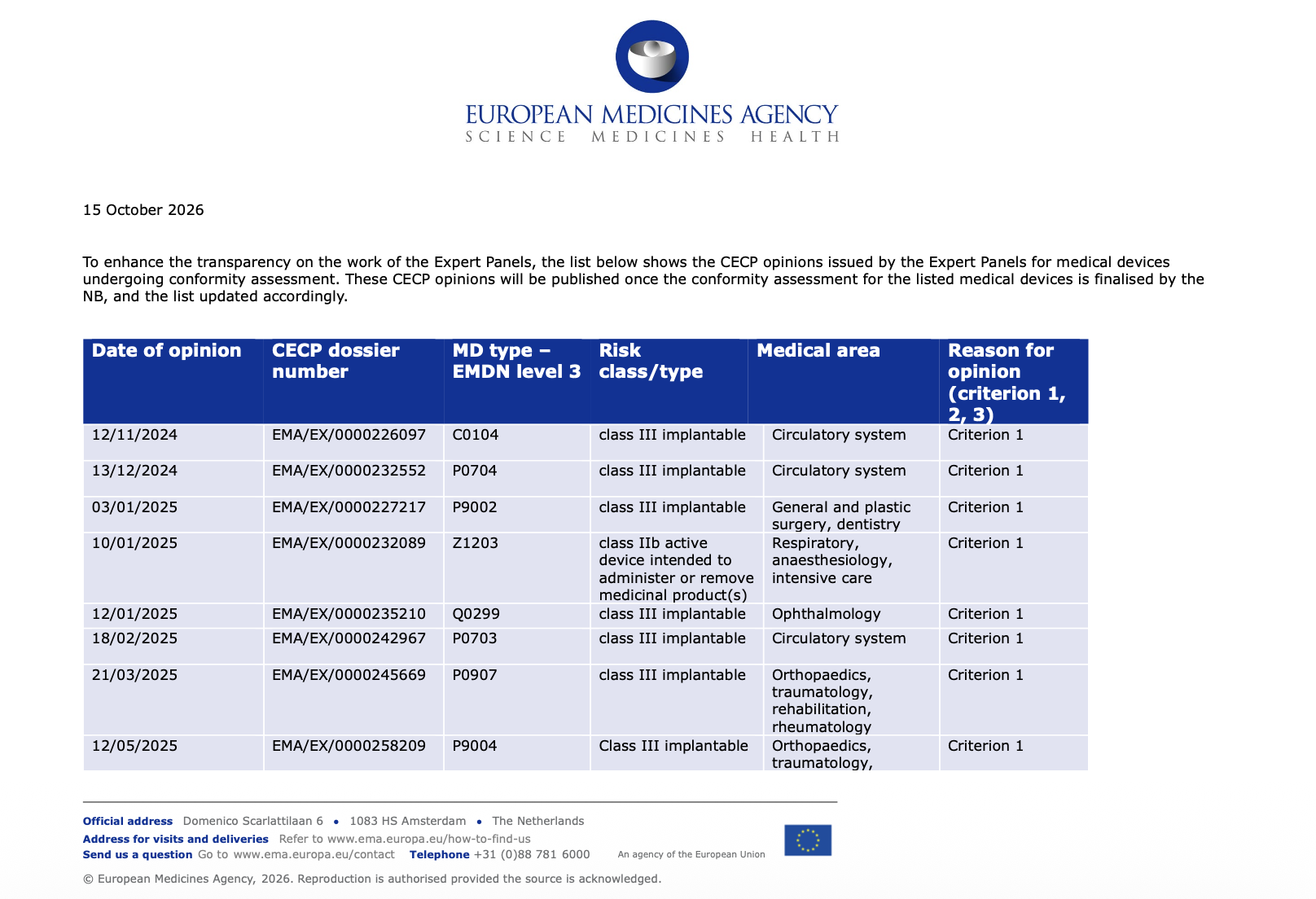
The European Medicines Agency (EMA) has published an updated list of Clinical Evaluation Consultation Procedure (CECP) opinions issued by Expert Panels for medical devices undergoing conformity assessment.
The list, dated 15 October 2026, is intended to improve transparency around the work of the Expert Panels. EMA notes that individual CECP opinions will be published once the corresponding conformity assessment has been finalised by the Notified Body. 1792577996708
New October 2026 CECP Opinion
The latest addition to the list is an opinion issued on 5 October 2026.
The dossier is identified as:
EMA/EX/0000361423
The device is classified as:
EMDN level 3: P0704
Risk class/type: Class III implantable
Medical area: Circulatory system
Reason for opinion: Criterion 1 1792577996708
This adds another high-risk implantable cardiovascular device to the CECP transparency list.
What Is the CECP?
The Clinical Evaluation Consultation Procedure is an expert-panel review mechanism under the European medical device regulatory framework.
It applies to certain high-risk devices undergoing conformity assessment and provides an additional level of scrutiny of the manufacturer’s clinical evaluation.
The EMA document itself identifies CECP as the Clinical Evaluation Consultation Procedure, EMDN as the European Medical Device Nomenclature, and NB as Notified Body. 1792577996708
Strong Focus on Class III Implantable Devices
The updated list shows that the majority of CECP opinions concern Class III implantable devices.
Medical areas represented include:
circulatory system;
orthopaedics;
neurology;
ophthalmology;
obstetrics and gynaecology;
general and plastic surgery;
dentistry. 1792577996708 1792577996708
The list also includes a Class IIb active device intended to administer or remove medicinal products, associated with respiratory, anaesthesiology and intensive care applications. 1792577996708
Circulatory System Devices Remain Prominent
Several dossiers on the list relate to Class III implantable devices in the circulatory system.
These include opinions issued in:
November 2024;
December 2024;
February 2025;
November 2025;
October 2026. 1792577996708 1792577996708
This continued presence reflects the level of scrutiny associated with high-risk implantable cardiovascular technologies.
Orthopaedic Devices Also Feature Heavily
Orthopaedics, traumatology, rehabilitation and rheumatology also appear repeatedly in the CECP list.
Examples include opinions covering EMDN categories:
P0907;
P9004;
P0908. 1792577996708 1792577996708 1792577996708
For manufacturers of Class III orthopaedic implants, these opinions are relevant indicators of the types of devices that may attract Expert Panel involvement during conformity assessment.
Criterion 1 Dominates the List
Most opinions listed by EMA were issued under Criterion 1.
One listed opinion, dated 8 September 2025, was issued under Criterion 2 for a Class III implantable orthopaedic device. 1792577996708
The document does not define the detailed legal meaning of each criterion, so those distinctions should be interpreted using the applicable MDR and CECP procedural framework rather than inferred from the list alone.
Publication Depends on Completion of Conformity Assessment
A key point is that the presence of a dossier on this list does not mean the full Expert Panel opinion is already publicly available.
EMA states that the CECP opinions will be published once the conformity assessment for the listed device has been finalised by the Notified Body. 1792577996708
The list therefore functions as a transparency tool showing which opinions have been issued before their full publication.
Impact on High-Risk Medical Device Manufacturers
For manufacturers of Class III and other high-risk medical devices, the updated list provides useful visibility into the types of products currently subject to CECP review.
It reinforces the importance of robust:
clinical evaluation;
clinical evidence;
benefit-risk analysis;
post-market clinical follow-up;
lifecycle evidence planning;
interaction with Notified Bodies.
Manufacturers developing high-risk implantable devices should continue to monitor EMA Expert Panel activity and published CECP opinions, as these may provide useful insight into evolving expectations around clinical evidence and conformity assessment.