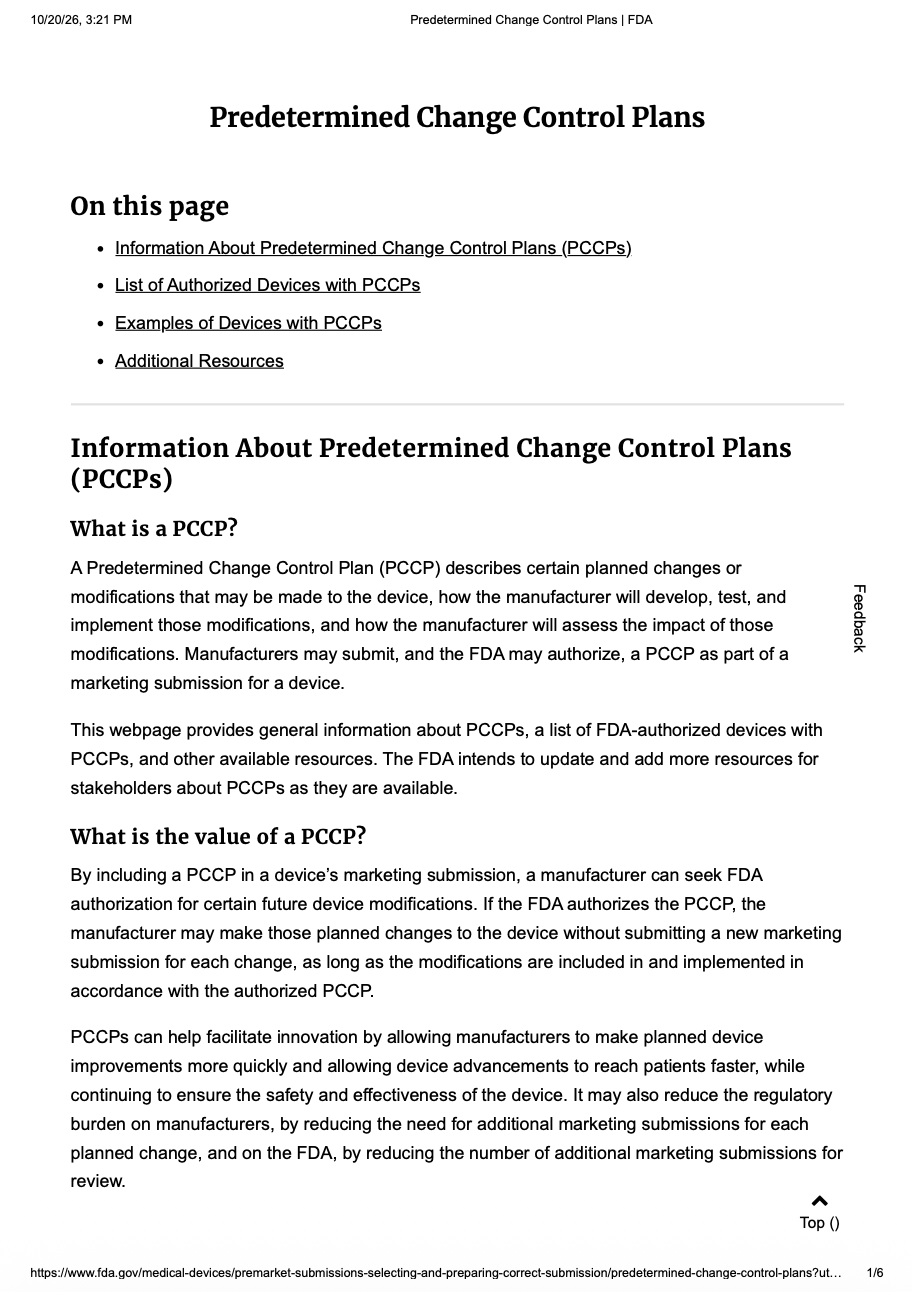
The U.S. Food and Drug Administration (FDA) has expanded its public information on Predetermined Change Control Plans (PCCPs) for medical devices.
A PCCP describes planned future modifications to a device, how those modifications will be developed, tested and implemented, and how the manufacturer will assess their potential impact. FDA may authorize a PCCP as part of a device marketing submission. 1792647412695
Why PCCPs Matter
The main advantage of a PCCP is that it allows manufacturers to seek FDA authorization for specified future modifications before those changes are implemented.
Once the PCCP has been authorized, manufacturers may make the covered modifications without submitting a new marketing submission for every individual change, provided the changes remain within the authorized plan. 1792647412695
FDA notes that this model can facilitate innovation, accelerate device improvements and reduce regulatory burden while maintaining safety and effectiveness. 1792647412695
What Changes Can Be Included?
FDA states that a PCCP may include modifications that:
would otherwise require a new marketing submission;
remain within the device’s intended use;
for 510(k) devices, allow the device to remain substantially equivalent to its predicate. 1792647412695
This allows manufacturers to plan certain lifecycle changes within the original regulatory strategy.
Three Core Components of a PCCP
FDA describes three main components that should generally be included in a PCCP.
1. Description of Modifications
The manufacturer should clearly describe the planned changes, including potential changes to:
device characteristics;
performance;
specifications. 1792647412695
2. Modification Protocol
The Modification Protocol should describe how each planned change will be evaluated and implemented.
This includes:
performance evaluation activities;
predefined acceptance criteria;
update procedures;
user notification processes, where applicable. 1792647412695
3. Impact Assessment
The PCCP should also assess:
the individual and cumulative impact of each change;
interactions between different modifications;
benefits and risks;
how the Modification Protocol will continue to ensure device safety and effectiveness. 1792647412695
PCCP vs Traditional Device Changes
Under the traditional approach, a modification made after authorization may require a new or supplemental marketing submission before implementation.
By contrast, a PCCP allows specified future changes to be reviewed in advance.
Once FDA authorizes the plan, the manufacturer can implement those changes without filing a separate submission each time, provided they are made in accordance with the PCCP. 1792647412695 1792647412695
Which FDA Pathways Can Include PCCPs?
FDA confirms that PCCPs may be included in device submissions reviewed through:
510(k);
De Novo;
Premarket Approval (PMA).
This also includes device-led combination products. 1792647412695
For eSTAR submissions, the PCCP can be identified in the General Device Characteristics section and attached as part of the Device Description. 1792647412695
FDA Publishes Authorized Devices With PCCPs
A particularly important development is FDA’s public list of devices with authorized PCCPs.
The page shows 240 entries, providing greater visibility into how PCCPs are already being used across different medical device categories. 1792647412695 1792647412695
Examples include devices in:
microbiology;
cardiovascular;
radiology;
clinical chemistry.
AI and Software-Based Devices Feature Prominently
Several listed devices are software-based or AI-enabled.
Examples include:
Tempus ECG-MR;
A2Z-Abdo-Triage;
QCT Lung (V1.0);
iLet Dosing Decision Software;
EchoPAC Software Only / EchoPAC Plug-in. 1792647412695
This reinforces the relevance of PCCPs for adaptive, software-driven and AI-enabled technologies where post-market modifications may be frequent.
PCCPs Are Not Limited to AI
Although PCCPs are often discussed in the context of AI-enabled devices, FDA’s list shows that they are being used across a broader range of technologies.
The listed examples also include:
antimicrobial susceptibility testing systems;
cardiac ablation systems;
diagnostic assays;
radiology software;
cardiovascular technologies. 1792647412695 1792647412695
Additional FDA Resources
FDA also references several supporting resources, including:
draft guidance on PCCPs for medical devices;
guidance for AI-enabled device software functions;
PCCP guiding principles for machine learning-enabled devices;
hypothetical case examples;
webinars and related materials. 1792647412695
These resources provide manufacturers with additional context on how PCCPs should be structured and applied.
Impact on Medical Device Manufacturers
For manufacturers, PCCPs represent a significant lifecycle-management tool.
They may be especially valuable where products are expected to evolve through:
software updates;
algorithm improvements;
performance enhancements;
workflow modifications;
new validated configurations.
A well-structured PCCP can help align innovation planning with regulatory expectations from the beginning of the submission process.
Manufacturers should ensure that planned modifications are sufficiently defined, supported by appropriate validation strategies, and accompanied by a clear impact assessment.
Impact on AI-Enabled Medical Devices
For AI-enabled devices in particular, PCCPs may provide a structured pathway for managing controlled evolution after authorization.
Rather than treating every algorithm or software modification as a separate regulatory event, the PCCP framework allows manufacturers to define in advance how certain changes will be assessed and controlled.
This can support more predictable lifecycle management while maintaining regulatory oversight.