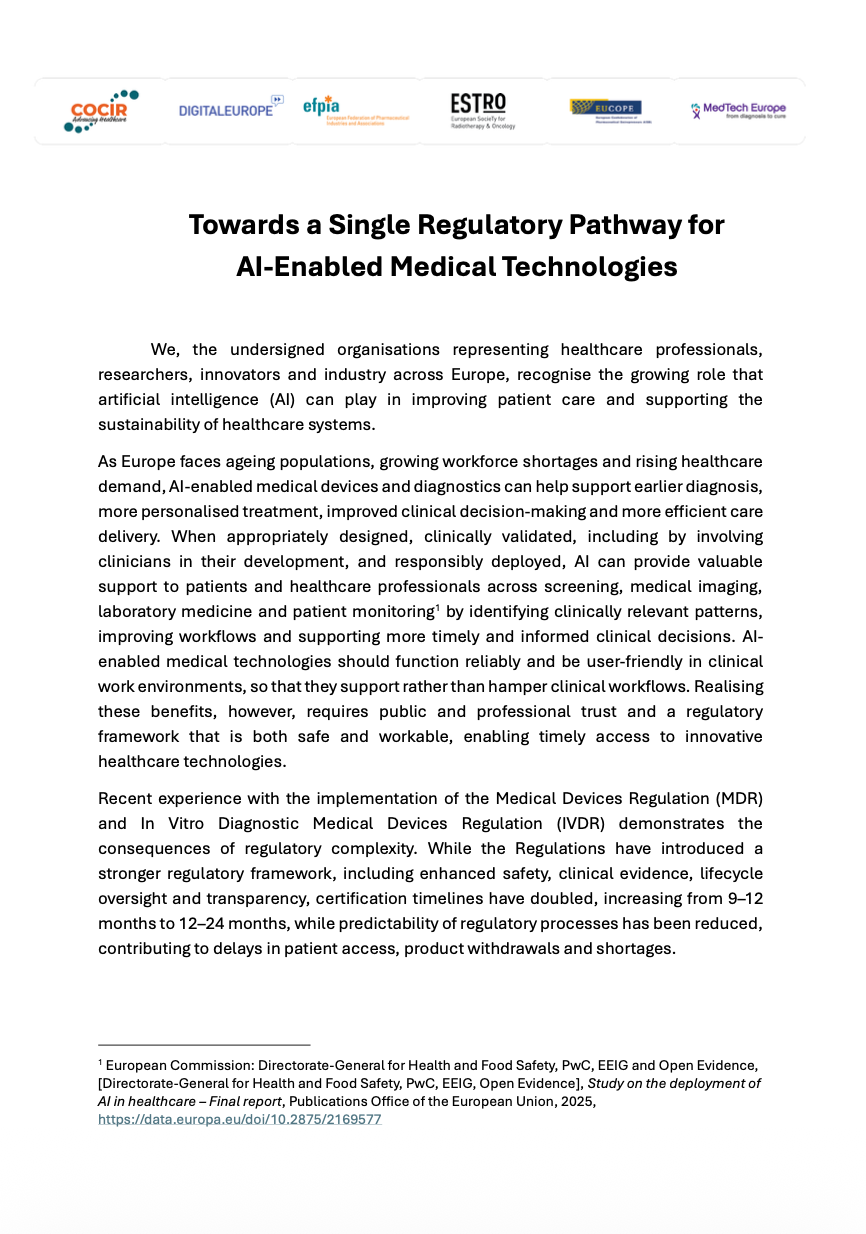
A coalition of European organisations representing healthcare professionals, researchers, innovators and industry has called for a single regulatory pathway for AI-enabled medical devices and diagnostics.
In the joint position paper “Towards a Single Regulatory Pathway for AI-Enabled Medical Technologies”, the signatories argue that AI-related requirements should be integrated into the existing sector-specific framework under the Medical Devices Regulation (MDR) and In Vitro Diagnostic Medical Devices Regulation (IVDR) rather than creating parallel and potentially overlapping regulatory systems. 1792234089639 1792234089639
AI’s Growing Role in Healthcare
The paper recognises the growing role of AI in European healthcare, particularly in areas such as:
screening;
medical imaging;
laboratory medicine;
patient monitoring;
clinical decision-making;
workflow optimisation.
The signatories argue that, when appropriately designed, clinically validated and responsibly deployed, AI-enabled medical technologies can support earlier diagnosis, more personalised treatment and more efficient healthcare delivery. 1792234089639
At the same time, they stress that these technologies need to operate reliably in real clinical environments and must be supported by public and professional trust.
Regulatory Complexity Under MDR and IVDR
A key argument in the paper is that Europe should avoid adding further complexity to an already demanding regulatory environment.
The signatories point to experience with MDR and IVDR implementation, noting that certification timelines have increased from approximately 9–12 months to 12–24 months, while predictability has declined.
According to the paper, this has contributed to delayed patient access, product withdrawals and shortages. 1792234089639
It also states that more than 60% of healthcare professionals report medical device shortages, while a similar proportion of hospital pharmacists indicate that shortages have affected patient care. 1792234089639
Avoiding Two Parallel Regulatory Systems
The central recommendation is to avoid creating two separate product-regulatory frameworks for AI-enabled medical devices and diagnostics.
The paper argues that medical devices already operate within a highly regulated lifecycle framework under MDR and IVDR, covering:
safety;
performance;
clinical evaluation;
performance evaluation;
risk management;
vigilance;
post-market surveillance;
lifecycle oversight. 1792234089639
Because AI-related risks need to be assessed alongside the clinical benefits and overall performance of the product, the signatories consider the MDR and IVDR framework the most appropriate basis for regulating these technologies.
European Commission Proposal
The paper supports the European Commission’s proposal to move the MDR and IVDR from Section A to Section B of Annex I of the AI Act.
According to the document, this would allow relevant AI requirements to be applied through the existing medical device regulatory framework rather than through a separate conformity-assessment pathway. 1792234089639
The signatories argue that this reflects the specific characteristics of medical devices and diagnostics as products already subject to extensive sector-specific regulation.
Integrating AI Act Requirements Into MDR and IVDR
The coalition proposes integrating relevant AI Act requirements directly into MDR and IVDR.
Examples highlighted include:
transparency;
data governance;
human oversight;
AI governance;
equity;
appropriate clinical oversight. 1792234089639
This would allow an AI-enabled medical technology to be assessed as a complete product in its clinical context, rather than splitting the assessment between its AI component and its medical device or diagnostic function.
Unified Vigilance and Market Surveillance
A single pathway would also support unified post-market oversight.
The paper argues that safety signals and incidents involving AI-enabled technologies should be managed through a coherent vigilance and market-surveillance system.
This could enable faster and more appropriate action when patient-safety concerns emerge. 1792234089639
Preserving High-Risk AI Safeguards
The signatories stress that a single pathway should not weaken the safeguards applicable to high-risk AI systems.
Instead, the proposed approach aims to preserve AI Act objectives while avoiding unnecessary duplication.
The paper argues that this could provide:
greater legal certainty;
fewer duplicative processes;
faster patient access;
stronger European competitiveness;
a more attractive environment for AI-enabled medical technology development. 17922340896391792234089639
Call for Changes to MDR and IVDR
To make the model operational, the signatories argue that the revised MDR and IVDR should require the European Commission to introduce the relevant high-risk AI requirements into the General Safety and Performance Requirements (GSPRs).
They also call for these measures to be developed transparently and in consultation with:
patients;
healthcare professionals;
clinicians;
scientific experts;
other relevant stakeholders. 1792234089639
Call to the European Parliament and Council
The position paper concludes with a direct call to the European Parliament and the Council to preserve the Commission’s proposal.
Specifically, the organisations support moving MDR and IVDR from Section A to Section B of Annex I of the AI Act and incorporating relevant high-risk AI requirements into the medical device framework through a time-bound process. 1792234089639
Impact on AI Medical Device Manufacturers
For manufacturers of AI-enabled medical devices and IVDs, the proposal could have significant implications for future regulatory strategy.
A single pathway could potentially reduce duplication between the AI Act and MDR/IVDR while requiring manufacturers to address AI-specific issues within existing lifecycle processes.
Key areas likely to remain central include:
clinical validation;
risk management;
data governance;
transparency;
human oversight;
post-market surveillance;
vigilance;
lifecycle change management.
The paper’s core message is that AI should be assessed within the complete medical technology and clinical context, rather than as an isolated software component.