Anvisa Publishes Manual on Notification of Risk Class I and II Medical Devices
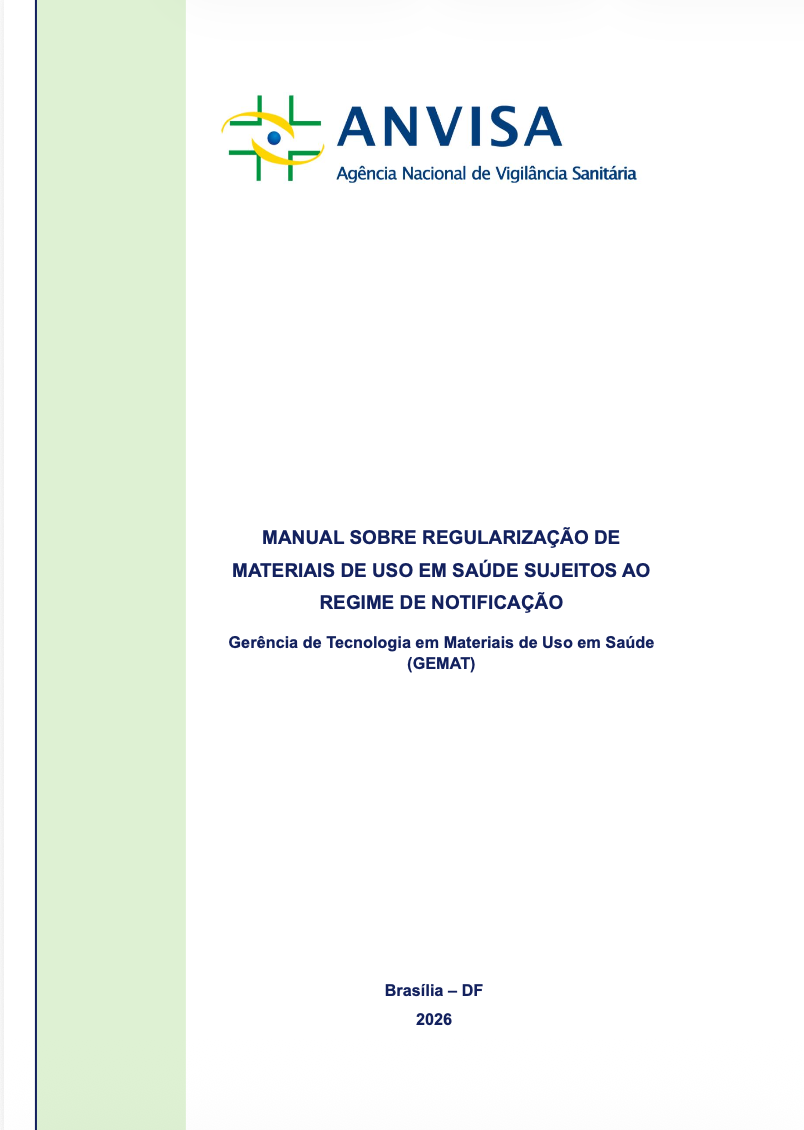
The Brazilian Health Regulatory Agency, Anvisa, has published the “Manual sobre Regularização de Materiais de Uso em Saúde Sujeitos ao Regime de Notificação.”
The manual was prepared by the Gerência de Tecnologia em Materiais de Uso em Saúde — GEMAT and provides guidance on the notification process for lower-risk medical devices in Brazil.
Purpose of the Manual
The general objective of the manual is to guide manufacturers, importers, distributors and other regulated stakeholders on the procedures required to comply with Brazilian legislation for the regularization of risk class I and II medical devicessubject to notification under RDC nº 751/2022.
The document also aims to provide clear and updated technical, regulatory and documentary guidance, facilitate understanding of lower-risk device regularization processes, reduce documentation failures and rework, and support the correct use of Anvisa’s electronic petitioning system.
Context for Medical Device Regularization in Brazil
The manual reinforces that medical device regularization in Brazil is essential to ensure the safety, efficacy and quality of products intended for public health.
It also highlights that no medical device of interest, whether manufactured domestically or imported, may be industrialized, offered for sale or delivered for consumption in the Brazilian market before being regularized with Anvisa.
Notification Regime for Class I and II Devices
According to the manual, notification is the act of communicating to Anvisa the intention to market a medical device that is exempt from registration and classified as risk class I or II under RDC nº 751/2022.
Class I devices are considered low risk, while class II devices are considered medium risk. These devices are subject exclusively to the notification regime and are exempt from registration.
The manual explains that the notification regime does not involve technical analysis for product regularization, although documentation may be assessed at any time through pre- or post-notification audits.
Key Steps Before Submission
The manual outlines several steps that companies should follow before filing a notification petition.
These include confirming whether the product is a medical device, determining whether it is subject to registration or notification, classifying the device under the risk classification rules in RDC nº 751/2022, assessing whether product grouping is possible and identifying the correct petition type and subject code.
The flowchart on page 18 visually summarizes the process, from product framing and company regularization through sanitary identification, petition identification, electronic submission and Anvisa processing up to publication in the Brazilian Official Gazette.
Company Regularization: AFE, Local Licence and GMP
Before requesting a medical device notification, the company responsible for the device must be regularized within the Brazilian health surveillance system.
This includes obtaining an Autorização de Funcionamento da Empresa — AFE and a Licença de Funcionamento — LF or sanitary permit. Without these authorizations, the notification petition cannot be filed.
The manual also states that companies manufacturing, importing or marketing notified medical devices in Brazil must comply with Good Manufacturing and Control Practices, under RDC nº 665/2022. Companies that manufacture only class I and II devices are exempt from submitting a GMP certificate in the notification process, but remain required to comply with GMP requirements.
Classification and Scope
The manual covers only devices classified as risk class I and II, which are subject to notification.
Risk class III and IV devices are subject to registration and are addressed in a separate Anvisa manual. The document also explains that every device must be classified under one of the 22 classification rules in Annex I of RDC nº 751/2022.
The classification diagram on page 22 shows that class I and II devices follow the notification route, while class III and IV devices follow the registration route and require GMP certification and revalidation.
Electronic Petitioning Through Solicita
The manual explains that electronic petitioning through the Solicita system is the procedure that formally initiates a medical device notification request.
Companies must complete the required information electronically and must first be registered in Anvisa’s electronic system. For secondary petitions, such as changes, additions, cancellations or publication rectifications, the company must submit an electronic petition linked to the primary process number.
From RDC nº 947/2024 onward, document submission to Anvisa must occur exclusively electronically through the available petitioning systems, except in cases specified by the regulation.
Documentation and Signature Requirements
The manual emphasizes that information entered in the notification form serves as the reference for all other documents in the process.
Forms made available on Anvisa’s website cannot be modified and must be correctly completed. Missing or incorrect information may lead to petition refusal.
It is also the regulated party’s responsibility to submit all documents required in the applicable checklist and legislation. Insufficient technical information may result in refusal of the petition.
The manual further highlights that petition documentation must be duly signed by the company’s legal and technical representatives.
Processing and Common Reasons for Refusal
Anvisa states that GEMAT routinely processes notification petitions within 30 days after filing.
If the documentation complies with RDC nº 751/2022 and other applicable rules, the petition is forwarded for publication in the Diário Oficial da União — DOU, granting the device notification.
The manual identifies recurring reasons for refusal, including incomplete mandatory documentation, missing mandatory documentation, forms without electronic signatures and incorrect regulatory classification.
Impact on Medical Device Manufacturers
For medical device manufacturers, importers and distributors operating in Brazil, the manual is an important practical reference for preparing notification submissions for class I and II devices.
Companies should pay particular attention to:
correct product framing as a medical device;
risk classification under RDC nº 751/2022;
distinction between notification and registration routes;
company regularization through AFE and LF;
GMP compliance under RDC nº 665/2022;
correct petition type and subject code;
product grouping rules;
complete and consistent notification forms;
mandatory checklist documentation;
digital signatures by legal and technical representatives;
monitoring of petition status and Anvisa communications;
readiness for pre- and post-notification audits.
For companies placing lower-risk medical devices on the Brazilian market, the manual reinforces that the notification pathway is intended to be more agile, but still requires careful regulatory preparation, complete documentation and ongoing compliance.