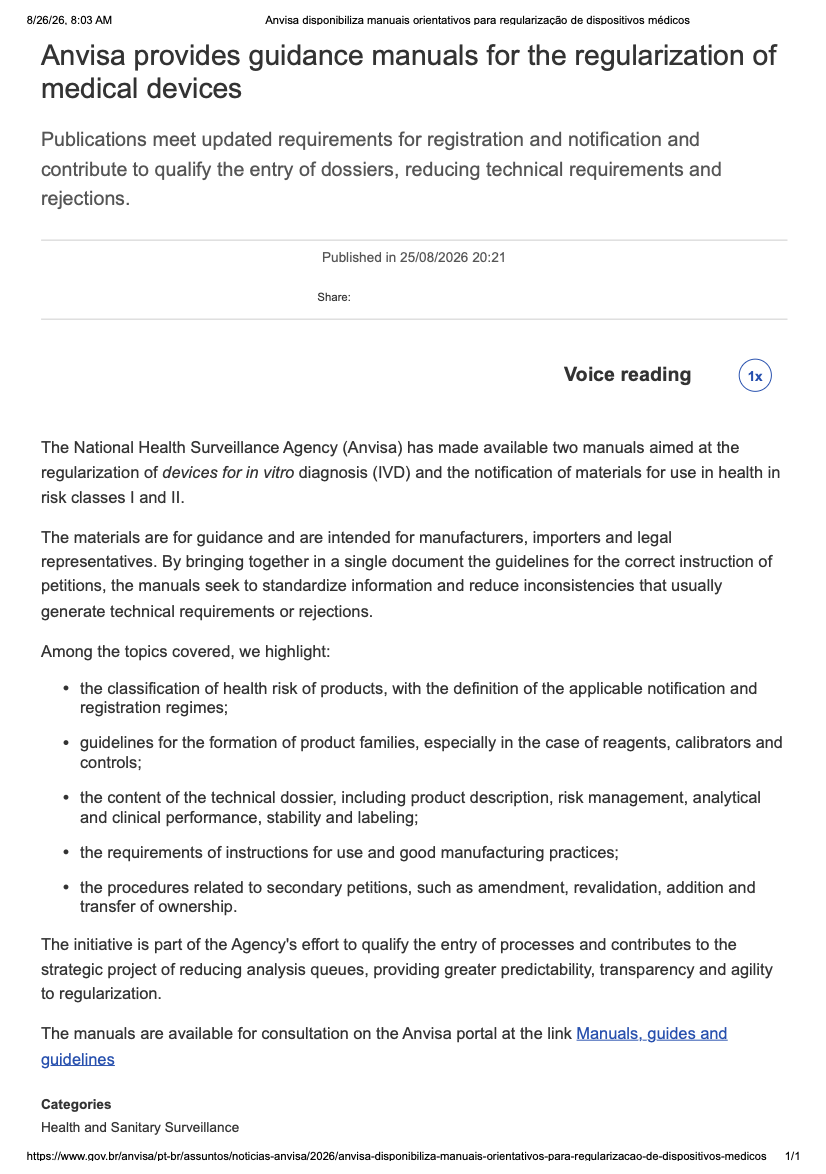
Anvisa Publishes Guidance Manuals for Medical Device Regularization
The Brazilian Health Regulatory Agency, Anvisa, has made available two guidance manuals aimed at supporting the regularization of in vitro diagnostic devices and the notification of materials for use in health classified in risk classes I and II.
The publication was issued on 25 August 2026 and states that the manuals meet updated requirements for registration and notification, while contributing to improved dossier entry and reducing technical requirements and rejections.
Purpose of the Manuals
The manuals are intended for manufacturers, importers and legal representatives.
According to Anvisa, the objective is to bring together, in a single document, guidance for the correct instruction of petitions. This is intended to standardize information and reduce inconsistencies that commonly generate technical requirements or petition rejections.
Key Topics Covered
The publication highlights several topics addressed in the manuals.
These include the health risk classification of products and the definition of applicable notification and registration regimes. The manuals also cover guidance on forming product families, especially for reagents, calibrators and controls.
Technical Dossier and Regulatory Requirements
Anvisa also notes that the manuals address the content of the technical dossier, including product description, risk management, analytical and clinical performance, stability and labelling.
The publication also refers to requirements for instructions for use and good manufacturing practices, as well as procedures related to secondary petitions.
Secondary Petitions
The manuals also include procedures related to secondary petitions, such as:
amendment;
revalidation;
addition;
transfer of ownership.
These procedures are relevant for manufacturers and legal representatives managing product lifecycle changes after initial regularization.
Contribution to Regulatory Predictability
Anvisa states that the initiative is part of the Agency’s effort to qualify the entry of processes and support the strategic project of reducing analysis queues.
The publication also highlights expected benefits such as greater predictability, transparency and agility in the regularization process.
Impact on Medical Device and IVD Manufacturers
For medical device and IVD manufacturers operating in Brazil, the publication is relevant because it consolidates Anvisa’s expectations for dossier preparation and petition instruction.
Manufacturers, importers and legal representatives should pay particular attention to:
correct health risk classification;
applicable notification or registration route;
product family formation rules;
technical dossier structure;
product description and intended use;
risk management information;
analytical and clinical performance evidence;
stability and labelling documentation;
instructions for use;
good manufacturing practice requirements;
lifecycle management through secondary petitions.
For companies seeking Brazilian market access, the key message is that better-prepared dossiers and consistent petition documentation can help reduce regulatory delays, technical requirements and rejections.