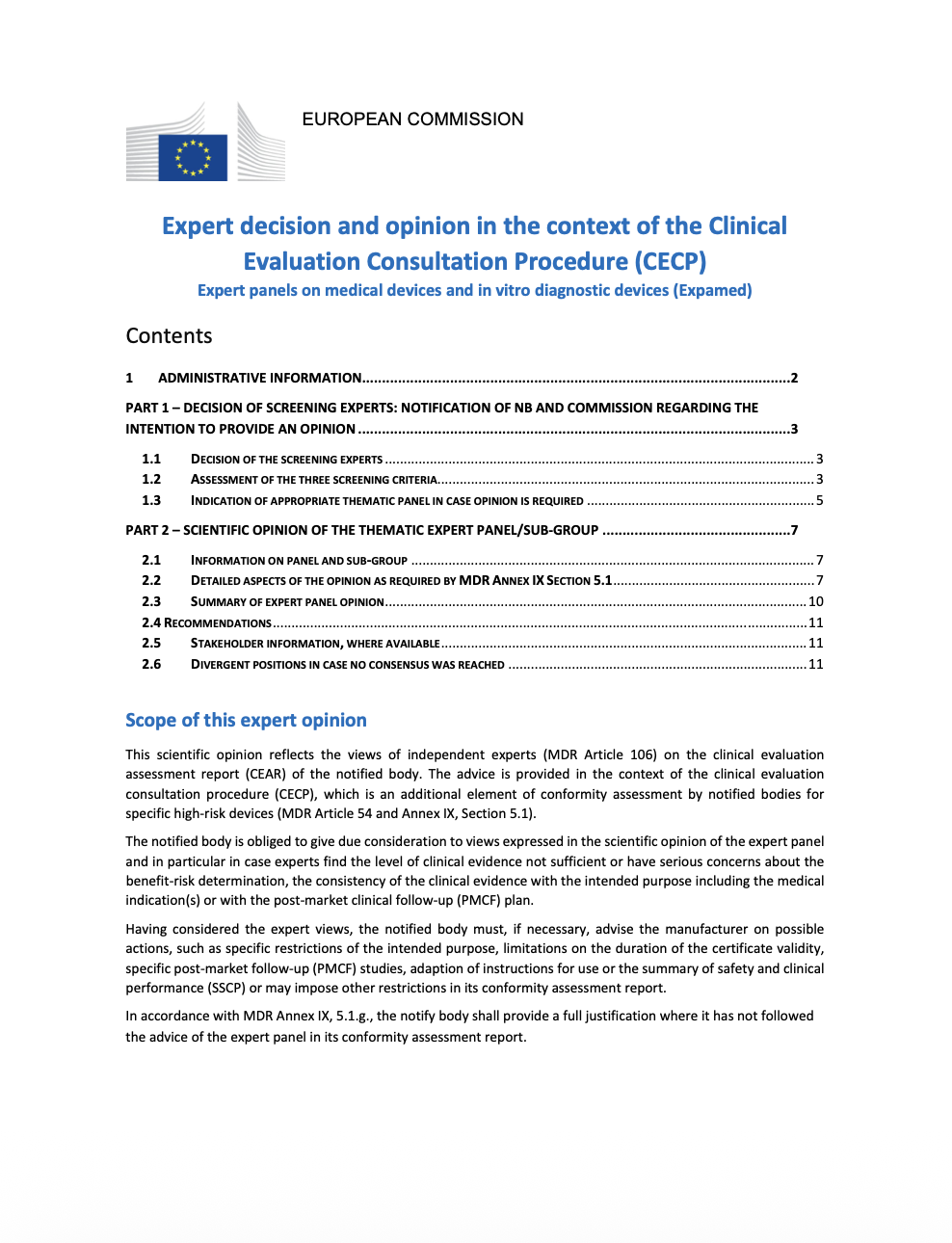
A European expert panel has issued a scientific opinion under the Clinical Evaluation Consultation Procedure (CECP)raising concerns about the adequacy of clinical evidence available for a novel class III implantable ophthalmic deviceintended for continuous intravitreal delivery of a medicinal product.
The opinion was prepared by the Ophthalmology expert panel and concerns a refillable ocular implant designed to provide sustained delivery of ranibizumab for adults with neovascular, or wet, age-related macular degeneration who have previously responded to intravitreal VEGF inhibitor therapy.
CECP Review Triggered by Novelty and Potential Clinical Impact
The CECP screening experts decided that a scientific opinion should be provided because of the combination of:
high device novelty;
potential major clinical impact;
identified safety concerns;
lack of equivalent devices for MDR equivalence purposes.
The device was assessed as having a high level of novelty, and the possible negative clinical or health impact associated with that novelty was considered major.
A Refillable Intravitreal Drug Delivery Device
The device is a refillable reservoir surgically implanted into the eye through the pars plana.
It delivers ranibizumab continuously through passive, concentration-gradient-driven diffusion.
The intended clinical benefit is to reduce the need for repeated intravitreal injections and potentially lower the burden of clinical visits while improving adherence.
Previous Septum Dislodgement Led to Recall and Redesign
A major focus of the expert panel’s review was the history of septum dislodgement associated with an earlier version of the implant.
The issue led to:
further investigation;
changes to the implant design;
changes to the refill needle;
a voluntary recall in the United States in 2022;
suspension of new implantations during that period.
The new version under review incorporated design modifications intended to improve septum retention.
Expert Panel Finds Clinical Evidence Insufficient for the New Version
The expert panel concluded that the notified body had performed a detailed assessment of the manufacturer’s clinical evaluation report and previous clinical evidence.
However, the panel considered the CEAR not fully adequate, particularly regarding serious adverse events associated with the novel device.
A central concern was that the new post-septum-improved commercial implant differed from previous versions used in earlier clinical studies.
The panel therefore considered that the available clinical data were insufficient to appropriately assess the safety and performance of the redesigned device.
Serious Adverse Events Remain a Key Concern
The expert panel highlighted a range of serious adverse events reported with earlier versions of the device.
These included:
endophthalmitis;
rhegmatogenous retinal detachment;
implant dislocation;
septum dislodgement;
vitreous haemorrhage;
conjunctival retraction;
conjunctival erosion;
conjunctival bleb.
The panel noted that some of these complications may require additional surgical or medical intervention.
Higher Adverse Event Rates Compared with Intravitreal Injections
The opinion refers to results from clinical studies comparing the implant with conventional intravitreal injections.
In the ARCHWAY trial at week 40:
adverse events were reported in 94.4% of patients in the device arm versus 35.5% in the intravitreal injection arm;
serious adverse events were reported in 5.6% versus 1.2%.
At week 96:
adverse events were reported in 60.5% versus 49.1%;
serious adverse events were reported in 8.9% versus 2.4%.
The expert panel also noted an endophthalmitis rate of approximately 2% among implanted patients in the available studies.
Limited Experience with the Redesigned Device
Another important concern was the limited clinical experience with the redesigned implant.
The panel noted that, as of 31 July 2024, only 13 patients had been implanted with the post-septum-improved version.
The panel therefore considered that the short- and long-term safety profile of the new version could not yet be fully established.
Benefit-Risk Determination Considered Not Fully Adequate
The expert panel disagreed with the notified body’s conclusion that the manufacturer had provided sufficient clinical evidence to support the safety assessment.
It considered the benefit-risk determination not fully adequate, mainly because of:
insufficient safety evidence;
limited follow-up;
limited experience with the redesigned version;
lack of a sufficiently critical evaluation of the available data.
Intended Purpose Remains Supported
Despite its safety concerns, the expert panel did not reject the intended medical indication.
The panel considered that the clinical evaluation report and related documentation contained sufficient evidence for the intended use, apart from the concerns relating to serious adverse events.
It therefore agreed that the clinical evidence supported use in adults with neovascular AMD who had previously responded to VEGF inhibitor therapy.
PMCF Plan Also Receives Critical Review
The manufacturer proposed three PMCF studies, including:
longer-term safety follow-up;
real-world evaluation;
monitoring of the redesigned implant and updated refill needle.
However, the expert panel raised concerns about combining safety data from different device versions.
It considered that pooling results from older implants with the redesigned version could make it difficult to assess the true safety profile of the current device.
Product Registry Preferred Over Questionnaire-Based Follow-Up
The panel also expressed reservations about a proposed questionnaire-based user survey.
It considered this approach vulnerable to reporting bias and instead recommended establishing a product registry.
This would allow more structured collection of post-market safety and performance data.
Additional Clinical Study Recommended
The expert panel’s main recommendation is the conduct of a study specifically focused on the safety and clinical performance of the redesigned version of the device.
The panel states that the available evidence is insufficient to characterise the latest implant configuration adequately.
Serious Adverse Event Rates Should Be Clearly Communicated
The panel also recommends that the manufacturer communicate the incidence rate of each identified serious adverse event.
This information should be included either in:
the Instructions for Use; or
the Summary of Safety and Clinical Performance.
The recommendation reflects the panel’s view that users need clearer information about the risk profile of the device.
Patient Preferences and Quality of Life Should Be Evaluated
The opinion goes beyond traditional safety and performance endpoints.
The panel also recommends collecting specific data on:
patient preferences;
quality of life;
patient satisfaction;
ophthalmologist satisfaction.
These data could help determine whether the potential reduction in injections and clinical visits translates into meaningful patient benefit.
Importance for Manufacturers of High-Risk Devices
This CECP opinion illustrates the level of scrutiny that novel class III devices may face when:
significant design changes occur late in development;
historical clinical data relate mainly to earlier versions;
serious adverse events have previously been identified;
the current commercial design has limited clinical exposure.
Manufacturers should therefore ensure that clinical evidence is clearly linked to the specific version of the device undergoing conformity assessment.
Importance of Version-Specific Clinical Evidence
One of the strongest messages from the opinion is that evidence from an earlier device version may not automatically be sufficient to support a redesigned product.
Where modifications are intended to address a known safety issue, regulators and expert panels may expect:
direct clinical evidence on the new configuration;
version-specific safety data;
dedicated PMCF activities;
transparent comparison with previous versions.
Implications for PMCF Strategy
The opinion also reinforces the need for PMCF activities to be designed around the unresolved evidence gaps of the current device.
Pooling data from materially different versions may undermine the ability to determine whether a redesign has actually addressed the original risk.
For high-risk implantable devices, structured registries may therefore be preferable to less controlled post-market data collection methods.
Role of the Notified Body After Expert Panel Review
Under the CECP, the notified body must give due consideration to the expert panel’s scientific opinion.
Where the expert panel raises serious concerns regarding clinical evidence or benefit-risk determination, the notified body may need to require actions such as:
restrictions to the intended purpose;
limitations on certificate duration;
additional PMCF studies;
changes to the IFU;
updates to the SSCP;
other conformity assessment restrictions.
If the notified body does not follow the expert panel’s recommendations, it must provide a full justification in its conformity assessment report.
Impact on Regulatory and Clinical Teams
For manufacturers developing high-risk implantable devices, this opinion highlights several practical priorities:
maintain clear traceability between clinical evidence and device version;
evaluate the impact of late-stage design changes;
avoid over-reliance on historical data from previous configurations;
develop version-specific PMCF;
ensure serious adverse event rates are clearly communicated;
consider registries for long-term post-market follow-up;
collect patient-centred outcome data where relevant.
A Strong CECP Signal on Evidence Quality
The opinion does not reject the medical indication or the potential clinical value of the device.
Instead, it demonstrates how CECP scrutiny can focus on whether the evidence is sufficiently specific, current and robust for the exact configuration undergoing conformity assessment.
For novel class III devices, especially those associated with significant prior safety issues, clinical evidence must demonstrate not only intended benefit but also adequate safety of the final commercial design.