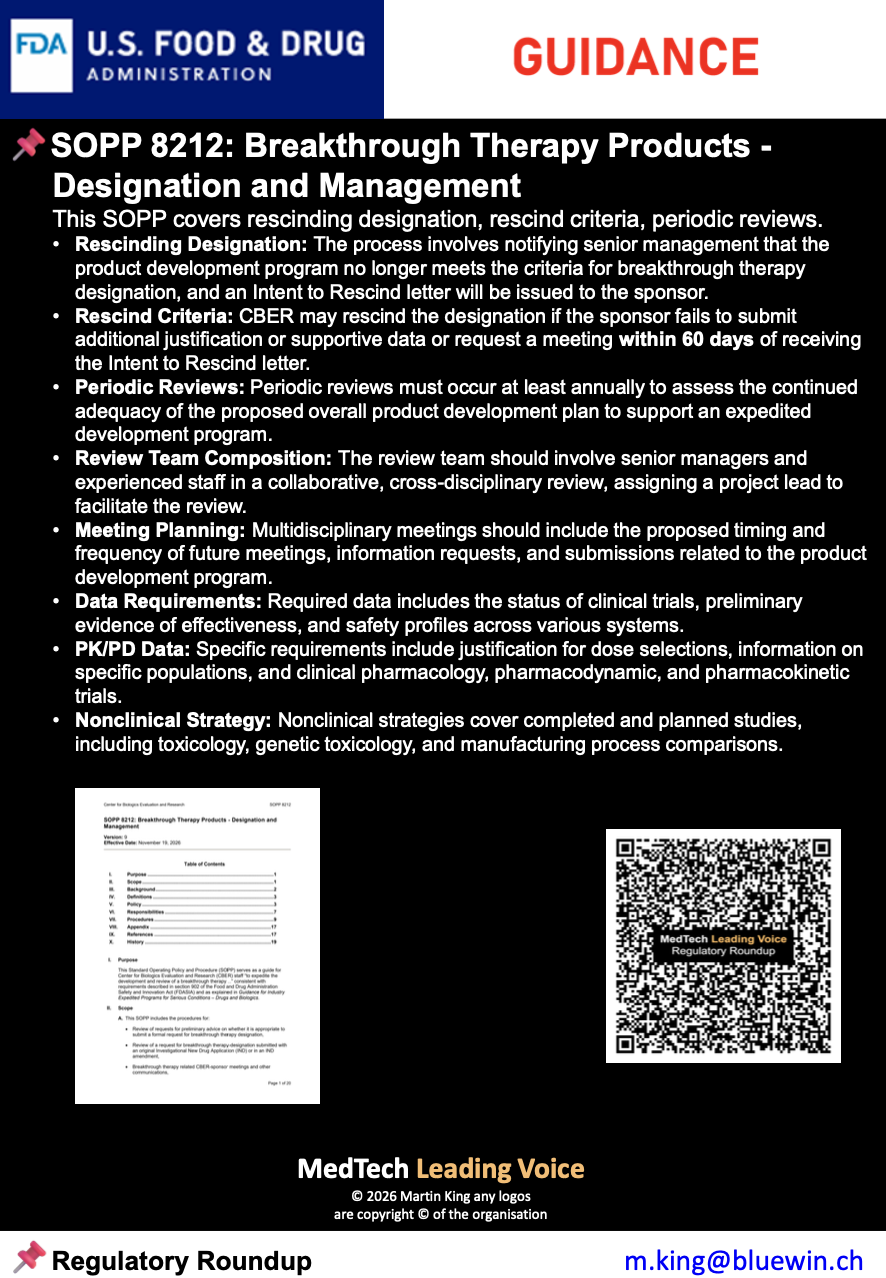
The U.S. Food and Drug Administration’s Center for Biologics Evaluation and Research (CBER) has detailed its internal approach to managing products with Breakthrough Therapy designation through SOPP 8212: Breakthrough Therapy Products – Designation and Management.
The procedure addresses several important areas, including:
ongoing management of designated development programmes;
periodic review of the designation;
multidisciplinary review-team involvement;
development-plan discussions;
data expectations;
circumstances that may lead to rescission of Breakthrough Therapy designation.
Breakthrough Therapy Designation Is Not Necessarily Permanent
One of the most important elements of SOPP 8212 is the possibility that FDA may determine that a development programme no longer meets the criteria for Breakthrough Therapy designation.
Where this occurs, the process involves notifying senior management and issuing an Intent to Rescind letter to the sponsor.
This reinforces that Breakthrough Therapy designation requires continued regulatory justification throughout development.
Sponsors Have 60 Days to Respond to an Intent to Rescind
According to the SOPP summary, CBER may rescind the designation where the sponsor does not:
provide additional justification;
submit supportive data; or
request a meeting
within 60 days of receiving the Intent to Rescind letter.
For sponsors, this makes timely engagement with FDA particularly important when questions arise regarding continued eligibility for the expedited programme.
Periodic Reviews Must Occur at Least Annually
CBER should conduct periodic reviews of Breakthrough Therapy-designated development programmes at least once every year.
The purpose is to determine whether the proposed overall product development plan remains adequate to support an expedited development programme.
This means Breakthrough Therapy status should be actively managed throughout development rather than treated as a one-time regulatory milestone.
Multidisciplinary Review Is Expected
SOPP 8212 also emphasises a collaborative and cross-disciplinary review approach.
The review team should involve:
senior managers;
experienced review staff;
relevant scientific and regulatory disciplines.
A project lead should also be identified to facilitate the review process.
Meetings Should Support the Development Strategy
Multidisciplinary meetings are expected to consider the future regulatory interaction needed to support the programme.
This may include discussion of:
timing of future meetings;
frequency of interactions;
information requests;
planned submissions;
development milestones.
For sponsors, this highlights the value of a structured FDA engagement strategy throughout development.
Clinical Development Status Is a Core Review Element
The periodic assessment should include current information on the clinical development programme.
Relevant data include:
status of clinical trials;
preliminary evidence of effectiveness;
available safety profiles.
These data help CBER assess whether the product continues to justify expedited development under the Breakthrough Therapy pathway.
Pharmacokinetic and Pharmacodynamic Data Are Also Important
The SOPP also identifies specific expectations relating to PK/PD and clinical pharmacology.
These may include:
justification of dose selection;
information relating to specific patient populations;
clinical pharmacology studies;
pharmacodynamic studies;
pharmacokinetic studies.
This shows that continued designation assessment is not limited to headline efficacy data.
Nonclinical Development Remains Part of the Overall Strategy
CBER’s review also considers the nonclinical development programme.
The SOPP summary identifies areas including:
completed studies;
planned studies;
toxicology;
genetic toxicology;
comparisons associated with manufacturing processes.
This reflects the broader regulatory expectation that an expedited clinical programme must still be supported by an appropriate overall development strategy.
Implications for Sponsors
For sponsors developing a Breakthrough Therapy-designated product, SOPP 8212 reinforces several practical priorities:
maintain updated evidence supporting continued designation;
monitor clinical and safety data;
maintain a coherent development plan;
prepare robust dose-selection rationale;
keep nonclinical development aligned with clinical progress;
plan FDA interactions strategically;
respond promptly to FDA concerns;
maintain cross-functional regulatory coordination.
Expedited Status Still Requires Active Regulatory Management
Breakthrough Therapy designation can provide important opportunities for more intensive FDA interaction and expedited development.
However, SOPP 8212 reinforces that designation does not remove the need for:
strong scientific evidence;
regulatory discipline;
timely submissions;
appropriate development planning;
continued demonstration that designation criteria remain satisfied.
Periodic Review Can Affect Regulatory Strategy
The requirement for at least annual review means companies should consider Breakthrough Therapy designation as part of their ongoing regulatory strategy.
Changes in:
emerging efficacy data;
safety findings;
development timelines;
dose strategy;
manufacturing plans;
overall benefit-risk considerations
may affect FDA’s assessment of whether the programme continues to merit expedited status.
Importance of Cross-Functional Readiness
Because the review may involve clinical, safety, pharmacology, nonclinical and manufacturing information, companies should ensure that regulatory teams have access to current information across functions.
This may require coordination between:
Regulatory Affairs;
Clinical Development;
Pharmacovigilance;
Clinical Pharmacology;
Nonclinical Development;
CMC and manufacturing teams.
Regulatory Takeaway
The key message from SOPP 8212 is that Breakthrough Therapy designation must continue to be supported throughout development.
FDA may revisit the designation, and where the programme no longer appears to meet the applicable criteria, CBER may initiate a rescission process.
For sponsors, maintaining high-quality evidence and proactive regulatory engagement is therefore essential.